VO2 Max Testing and Its Role in Longevity Risk Assessment
A single fitness test predicts mortality risk as strongly as smoking or diabetes.

VO2 max measures how much oxygen the body can take in, move, and use during maximal effort. That single number depends on four systems working together at once: the lungs handling gas exchange, the heart pushing out blood, the vessels carrying oxygen to tissue, and the muscles (down to the mitochondria inside them) pulling that oxygen out and turning it into energy. None of those systems gets to coast. A weak link in any one of them, whether that's poor capillary density, a heart that can't raise its output under strain, or muscle tissue with too few mitochondria, drags the whole number down.
Strasser and Burtscher laid out the actual math behind this in 2018: oxygen delivery comes down to cardiac output, hemoglobin concentration, and arterial oxygen saturation, and VO2 max itself equals maximal cardiac output multiplied by the arterio-venous oxygen difference. That second term, the arterio-venous difference, is about how well muscle tissue extracts the oxygen once it arrives. If the heart pumps blood past muscle that can't pull oxygen out of it, the score still comes out mediocre. The number only goes up when the pump and the periphery both improve.
That's why VO2 max works as a whole-body indicator, not just a cardio score. Dr. Abirached notes that many longevity-focused clinics skip VO2 testing. Abirached, despite the fact that no other single measurement captures this much integrated system function in one sitting. A blood panel tells you about the chemistry in a vein at rest. VO2 max tells you what your lungs, heart, vessels, and muscles can do together under load, which is a far closer approximation of how the body performs in daily life.
The metabolic connection runs deeper than cardiovascular fitness. VO2 max values run meaningfully lower in people with diabetes, and HbA1c, the standard marker of long-term blood sugar control, accounts for a measurable share of the variation in VO2 max scores across individuals. A number born out of exercise physiology turns out to be tangled up with metabolic disease risk. That overlap sets up the question that matters most: does this number actually predict how long someone lives, or is it just a marker of current fitness? The mortality research answers that directly.
What the mortality research shows
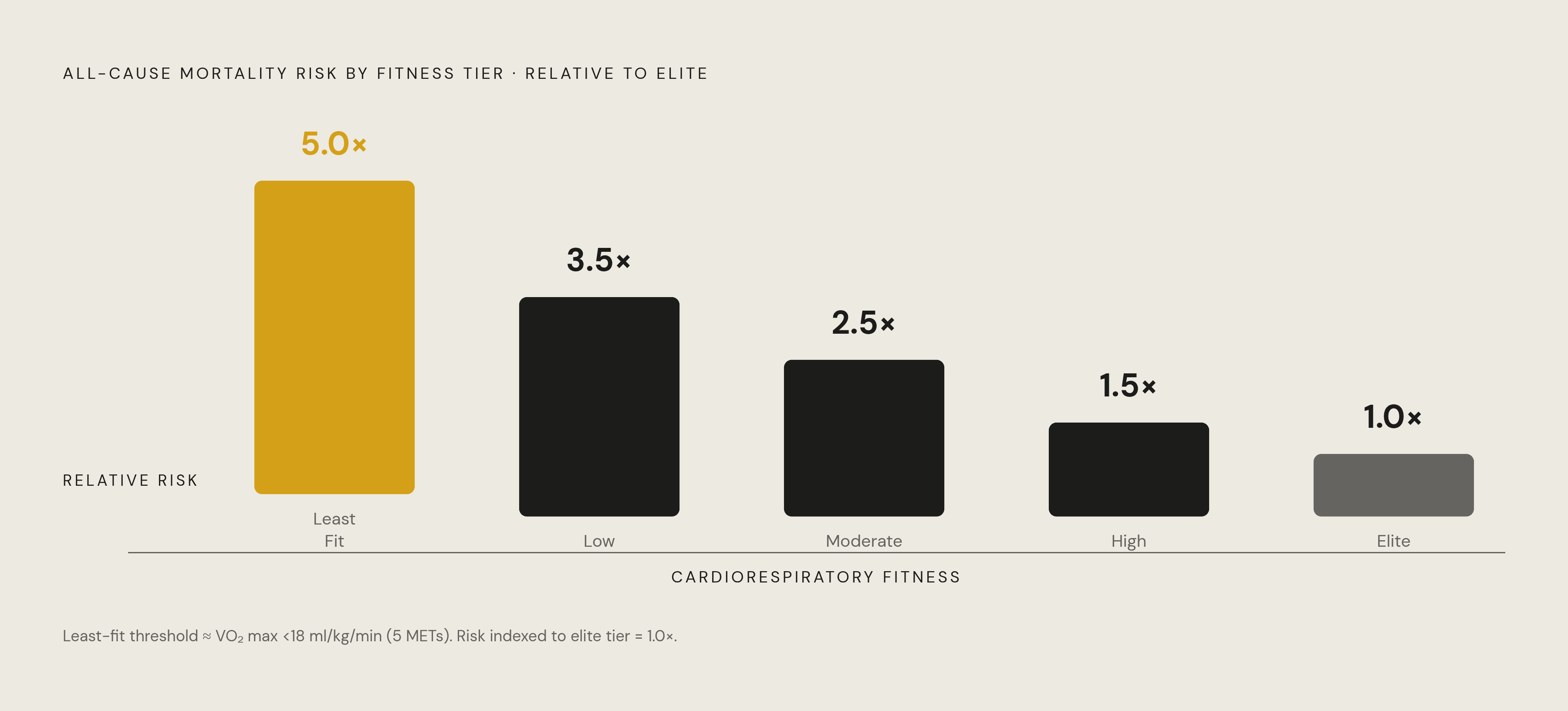
The relationship between VO2 max and mortality is one of the most replicated findings in epidemiology. The shape of that relationship is a dose-response curve with no upper ceiling and a floor that carries risk on par with smoking or diabetes. Pinto and Fernandes, reviewing the literature in 2025, report a consistent finding across studies: each 1-MET increment in VO2 max, roughly 3.5 ml/kg/min, tracks with a meaningful drop in both overall mortality and cardiovascular mortality.
A Cleveland Clinic study of a large patient cohort found cardiorespiratory fitness inversely associated with all-cause mortality, with no observed upper limit on the benefit. People in the elite fitness category had the lowest death risk of any group measured. People in the least-fit group carried roughly five times the mortality risk of that elite group. Low fitness carried a mortality risk comparable to, or exceeding, risk factors doctors already treat aggressively, including smoking, diabetes, and high blood pressure. This puts cardiorespiratory fitness in the same risk tier as conditions medicine already screens for routinely, but VO2 max testing isn't part of most standard checkups.
A meta-analysis published in Mayo Clinic Proceedings, drawing on data from millions of participants, found that people in the top third of fitness had substantially lower all-cause mortality risk than those in the bottom third. A 2025 meta-analysis in the British Journal of Sports Medicine pushed the finding further: fit people showed no significant increase in mortality risk regardless of BMI, while normal-weight individuals who were unfit faced nearly double the mortality risk of fit individuals. Fitness, not body weight, was the variable doing the work.
The cancer finding extends this argument beyond the heart. Imboden and colleagues followed a cohort for more than 24 years and found that each MET increment in cardiorespiratory fitness tracked with reductions in all-cause mortality, cardiovascular mortality, and cancer mortality. Cancer showing up as its own distinct, protected endpoint means the protective effect of fitness isn't confined to the cardiovascular system. Something systemic is happening across tissue types and disease pathways.
There's a floor on the other end of this curve that carries direct clinical weight. A VO2 max below roughly 18 ml/kg/min is associated with the highest mortality rates recorded in this research. A value near 17.5 ml/kg/min, equivalent to 5 METs, is the threshold where independent living gets harder to sustain and survival rates drop. Pinto and Fernandes, synthesizing this body of work in 2025, describe VO2 max as a strong, independent predictor of all-cause mortality that holds regardless of sex, BMI, or the other risk factors clinicians typically rely on. Few single measurements in medicine carry that much weight on their own.
How VO2 max ages
VO2 max isn't a fixed trait set once in early adulthood. It declines naturally starting in the early 40s, and where a person sits on that declining curve at a given age carries as much clinical information as the raw number itself. Two people can post the same VO2 max at age 50. If one of them scored substantially higher five years earlier and the other has been flat the whole time, they are not facing the same risk, even though the single reading looks identical.
Strasser and Burtscher documented the physiology behind that decline in 2018. The aging respiratory system loses elastic recoil and gas-exchange efficiency. The aging cardiovascular system loses maximal cardiac output and stroke volume. Aging skeletal muscle loses mitochondrial density, and it shifts toward fiber types that burn oxygen less efficiently. Each of those changes lowers the ceiling on how much oxygen the body can use, independent of effort or motivation.
None of that decline is fixed in its rate. Dr. Sellars notes that active individuals maintain meaningful cardiorespiratory performance well into their 50s and 60s, and highly trained athletes can post impressive VO2 max scores into their 70s. Biological age and metabolic age tend to track together, and consistent training, sleep, and recovery slow the decline substantially compared to a sedentary trajectory at the same chronological age.
Timing matters too. Strasser and Burtscher note that a higher VO2 max earlier in life confers the greatest survival benefit, which argues for building an aerobic base before the decline curve steepens. One might argue the real value of testing VO2 max isn't the number itself but the trend it reveals. A person whose VO2 max is falling faster than expected for their age group is showing systemic risk earlier than any blood panel would catch it. So serial measurement, testing every year or two rather than once, is the actual tool here. A single data point tells you where you stand today. A series of them tells you where you're headed.
The ceiling question in elite athlete lifespan data
A reasonable question follows from all this: if more fitness is better, is there a point where extreme training starts working against longevity instead of for it? The evidence doesn't support that concern. Elite endurance athletes consistently outlive the general population, and the data on this point is now substantial enough to answer the question directly.
Knowles and colleagues, writing for the American College of Cardiology in 2025, reviewed the evidence on elite athletes and longevity and concluded that elite athletes generally live longer than the general population, with lower mortality rates and reduced risk of both cardiovascular disease and cancer. One study tracked 200 runners who had broken the four-minute mile, a group whose training demanded very high volumes of maximal effort. After adjusting for age, birth year, and nationality, those runners lived on average 4.7 years longer than the general population. All of the runners in that study were male.
A meta-analysis of former elite athletes found the same pattern across a larger cohort: longer lifespans overall, along with reduced cardiovascular disease mortality and reduced cancer mortality compared to the general population. High training volumes, defined as 10,000 MET-minutes per week or more, were not associated with increased mortality risk. Intensity appears to matter more than sheer volume when it comes to reducing cardiovascular mortality specifically.
Not every sport confers this benefit equally. Endurance-based activities like running seem to produce greater longevity advantages than power sports do. That pattern lines up with the mechanism already described: VO2 max is the thing endurance training improves most directly, and endurance training is what produces the longevity benefit measured in these studies. The Cleveland Clinic finding of no upper ceiling on fitness benefit lines up with this elite athlete data. So together, they close the case on the old U-shaped hypothesis, the idea that too much exercise might start harming longevity past a certain point. So you can pursue cardiorespiratory fitness aggressively, without needing to worry about an upper limit.
VO2 max alongside blood-based cardiovascular and metabolic markers
If you already track cardiovascular and metabolic health through blood work, you're likely familiar with markers like ApoB, hs-CRP, fasting glucose, and HbA1c. VO2 max doesn't compete with those markers. It answers a different question than any of them can.
The American Heart Association has recommended that VO2 max get added to the standard list of vital signs. Strasser and Burtscher cite the AHA's own finding behind that recommendation: VO2 max levels predicted the likelihood of dying from certain diseases more accurately than blood pressure or the count of traditional risk factors a person carried. That's a striking claim for a single functional measurement to earn against an entire category of established clinical tools.
Blood markers capture a biochemical snapshot at rest. ApoB reflects the atherogenic particle burden circulating in the blood. Hs-CRP reflects systemic inflammation. Fasting glucose and HbA1c reflect how well the body manages blood sugar over time. Each one is tied to specific disease risks on its own. VO2 max adds something none of them can: a picture of how the body's systems perform under actual physical demand, not what the chemistry looks like sitting still. A person with borderline ApoB who tests in the elite tier for cardiorespiratory fitness carries a different risk profile than a sedentary person with the exact same ApoB number. The lab value is identical. The risk differs.
VO2 max and blood markers are complementary, and a low VO2 max alongside otherwise normal blood work is a warning sign that merits further investigation. But if your VO2 max is high, that doesn't cancel out an elevated ApoB reading, so both still need attention. An evidence-based annual monitoring approach to cardiometabolic health already includes ApoB, fasting glucose, HbA1c, fasting insulin, and hs-CRP. VO2 max belongs in that same panel, not as a replacement for any of those blood markers but as the functional counterpart that shows what the body can actually do with the chemistry those tests describe.
How VO2 max is tested
Getting an accurate VO2 max reading doesn't require choosing between extremes. The options range from a full hospital-grade test down to field protocols that need no lab equipment at all, and the right choice depends mostly on what someone plans to do with the result.
The gold standard is a cardiopulmonary exercise test, or CPET, run in a hospital exercise physiology lab or a specialized medical facility. A CPET measures VO2 peak, VCO2 production, the respiratory exchange ratio, ventilatory thresholds (labeled VT1 and VT2), O2 pulse, heart rate and blood pressure response, and ECG findings throughout the test. That depth of data serves both athletic performance assessment and clinical diagnosis, so CPET remains the reference standard other methods get judged against.
Below that clinical tier, you find fitness-grade VO2 max tests, usually run out of exercise physiology studios or university labs. These measure VO2 peak directly and produce usable training zones, which is enough for most healthy adults looking for a number to guide training and flag basic risk. Further down the ladder are indirect field protocols: the Cooper test, the Rockport walk test, and various shuttle run tests. Pinto and Fernandes call these validated, feasible alternatives for large-scale assessment when you can't run direct gas analysis, and they still give you meaningful estimates of cardiorespiratory fitness.
The added cost of a clinical CPET over a fitness-grade test buys continuous ECG monitoring, blood pressure tracking throughout the test, and a physician's interpretation of the full cardiopulmonary dataset. That medical oversight accounts for most of the price difference between tiers, and it earns its keep for people with known cardiovascular disease, active symptoms, or another clinical reason to need a doctor's eyes on the data in real time. If you're a healthy adult without those indications, a fitness-grade test that includes a results review and gives you real training zones, not just a raw VO2 max figure, offers better value than the clinical tier. A number without zones attached can't be turned into an actual training plan.
Access to this kind of testing has widened in recent years. Portable metabolic analyzers, the same category of device used in settings like the Duke University ICU and for NCAA athletic team testing, now show up in wellness clinics, gyms, physiotherapy practices, and health centers. Dr. Sellars points to this shift as having moved accurate VO2 max testing well outside the university and hospital labs that once had a near-monopoly on it.
Wearable VO2 max estimates: useful for tracking, not for risk assessment
Wearable devices that estimate VO2 max run heart rate data, pace, and movement patterns through an algorithm, not direct gas analysis. That makes them useful for spotting trends over weeks or months of training. It also means the number they produce is an estimate built on a model, not a measurement of actual oxygen uptake. The two are related, but they're not interchangeable.
For someone tracking whether a training block is working, a wearable's VO2 max trend can be a reasonable signal, especially if the device, activity type, and conditions stay consistent across readings. That's a different use case from the one this article has been building toward: using VO2 max as a clinical-grade input into mortality and longevity risk assessment. The mortality data covered earlier, the dose-response curve with no ceiling, the floor near 18 ml/kg/min, the MET-by-MET reductions in cardiovascular and cancer mortality, all comes from studies using directly measured or carefully validated VO2 max values. A wearable's algorithmic estimate hasn't been validated against that body of evidence to the same degree.
The honest way to use a wearable estimate is as a rough trend line between actual tests, not as a stand-in for one. Pair it with a periodic fitness-grade or clinical test; the wearable data becomes a useful bridge between the more rigorous measurements. Treated as a substitute for a real CPET or a fitness-grade lab test, that same number risks giving false confidence about where someone actually stands on a curve where the stakes, measured in years of life, are too high for an estimate to carry alone.