Core Biomarker Panel for a First-Time Health Baseline
Essential tests for tracking your health over time, not just catching disease.
A standard annual physical checks about 15 markers: basic metabolic panel, complete blood count, a standard lipid panel. That's a fine screening tool for catching disease that's already underway, but it was never built to give someone a real starting map of their own metabolism, hormones, and cardiovascular risk. This piece lays out what a genuinely useful first-time baseline should cover, and why each category earns its spot before anything fancier gets added to the list.
This isn't an argument for testing everything under the sun. The USPSTF and similar bodies have actually moved toward more targeted, risk-based screening in recent years, partly because broad, indiscriminate panels can lead to overdiagnosis and chasing noise. A good baseline isn't about running more tests. It's about running the right ones, and understanding why each one made the cut.
Why a baseline is not just a snapshot, it is a personal reference range
Lab reference ranges get built from population data, usually the middle 95% of people who tested "healthy." That range describes a group. It says almost nothing about you specifically.
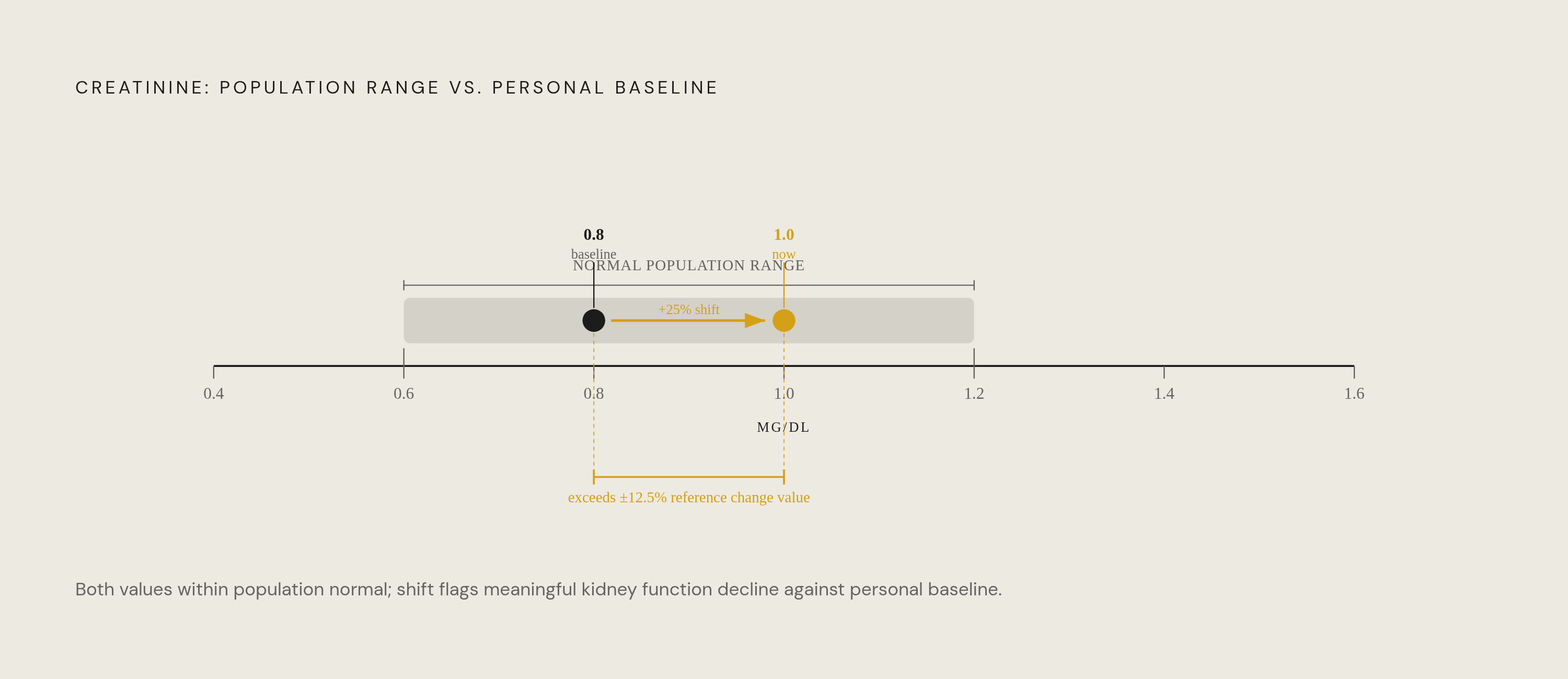
Here's the gap that creates. Within-person biological variation, the amount a single person's own numbers naturally shift test to test, is often far tighter than the population range suggests. Take serum creatinine: its natural variation within one person runs around 5%, which means a real change in kidney function, what's called the reference change value for eGFR, is roughly plus or minus 12.5%. So picture someone whose creatinine goes from 0.8 mg/dL to 1.0 mg/dL. Both numbers are comfortably inside the normal population range of 0.6 to 1.2 mg/dL. A doctor glancing at either result in isolation would call it normal. But that shift is a statistically meaningful decline in kidney function, and a one-off test would miss it completely.
That's the entire case for a baseline. It's not a test to pass. It's the anchor every future result gets compared against, which is exactly why a sparse 15-marker physical can't do the job. You need enough data points, tracked consistently, for trends to mean something. Every category covered below earns its place partly because it's trackable over time, not because it's interesting to look at once.
The cardiovascular markers a lipid panel alone cannot give you
A standard lipid panel measures total cholesterol, LDL-C, HDL-C, and triglycerides. Useful, but incomplete in ways that matter.
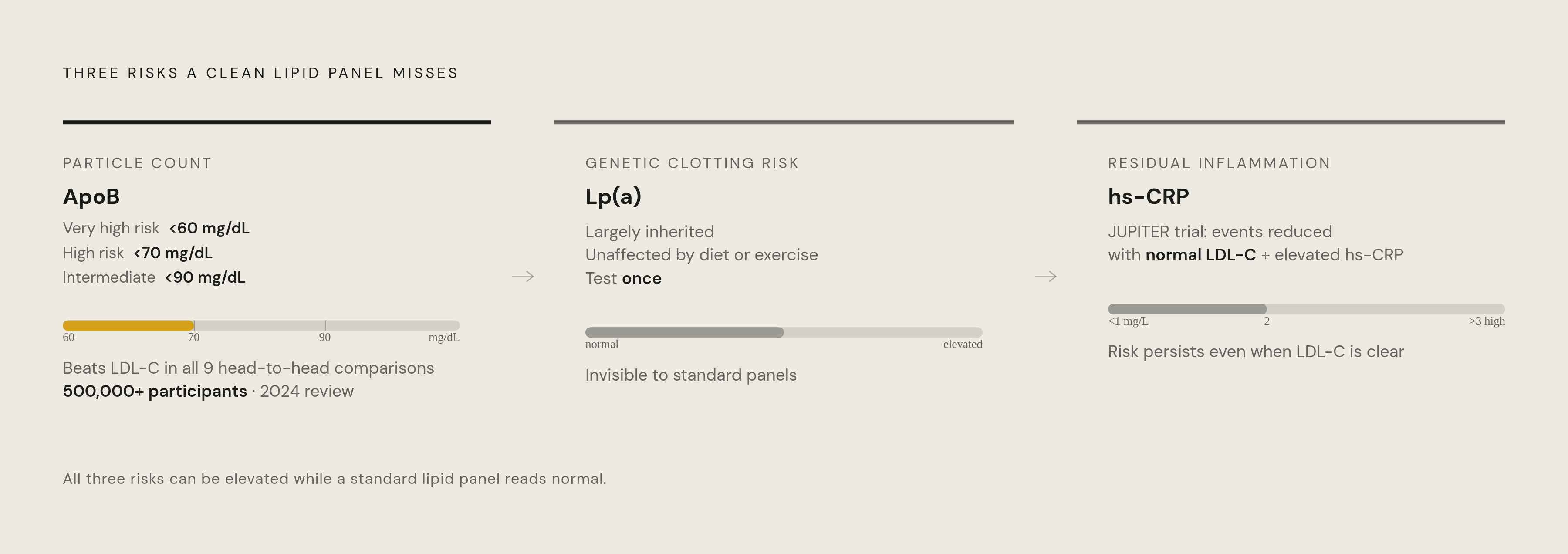
Start with ApoB. Every atherogenic particle circulating in blood, LDL, VLDL, IDL, Lp(a), and their remnants, carries exactly one ApoB molecule on its surface. So counting ApoB means counting the actual number of particles capable of lodging in an artery wall and starting plaque. LDL-C, by contrast, measures the cholesterol cargo those particles carry, not how many particles there are. Two people can post identical LDL-C numbers while one of them is walking around with far more particles doing the damage. A systematic review completed in September 2024, pulling together 15 studies and more than half a million participants, found ApoB beat LDL-C as a predictor of atherosclerotic cardiovascular disease in all 9 head-to-head comparisons it ran. The National Lipid Association has even set concrete targets: under 90 mg/dL for intermediate risk, under 70 for high risk, under 60 for very high risk. Why isn't ApoB standard on every physical yet? Not because the evidence is thin. It's institutional inertia and how insurance reimbursement is structured, which is precisely why paying out of pocket for a baseline panel makes this marker so much more accessible.
Then there's Lp(a), a cholesterol particle that's largely inherited and carries extra clotting and plaque-forming potential on top of whatever LDL is already doing. It raises cardiovascular risk independent of LDL-C, which matters enormously for anyone with a parent or sibling who had a heart attack young, or anyone who's had a cardiovascular event despite lipid numbers that looked fine. Since Lp(a) is set largely by genetics, diet and exercise don't move it much. Test it once in a lifetime and that's typically enough.
Last piece: hs-CRP, a protein the liver produces in response to systemic inflammation. A 2025 Scientific Statement from the American College of Cardiology names hs-CRP a validated marker of what's called residual inflammatory risk, the risk that's still sitting there even after LDL-C looks well-controlled. The JUPITER trial is the clearest illustration: people with normal LDL-C but elevated hs-CRP saw a real drop in cardiovascular events when treated with rosuvastatin. A clean lipid panel can still produce elevated inflammatory risk, since the two measure different things and one can be normal while the other is not. Paired with ApoB and Lp(a), hs-CRP helps sort out whether risk is coming from particle count, genetics, or inflammation, and that distinction shapes what actually makes sense to do about it.
Blood sugar and insulin: the three-test metabolic picture most panels run as one
Most physicals run fasting glucose, HbA1c, or sometimes only one of the two. Fasting glucose is a single snapshot: under 100 mg/dL is normal, 100 to 125 is prediabetes, 126 or above is the threshold for diabetes. It's sensitive to whatever's going on that particular morning.
HbA1c smooths that out by reflecting average blood sugar over roughly the prior three months. Under 5.7% is normal, 5.7 to 6.4% is prediabetes, 6.5% or higher is diabetes. Run alongside fasting glucose, it shows where things stand right now and where they've been trending.
But what if both of those numbers look perfectly normal and elevated inflammation or insulin resistance is still driving the risk? That's where fasting insulin closes a real gap. By the time fasting glucose creeps past 100 or HbA1c crosses 5.7%, the pancreas may have already been overproducing insulin just to keep glucose looking normal. It's compensating, quietly, and the standard panel has no way to catch that. Picture someone with fasting glucose in the 75 to 90 range and HbA1c at 5.0 to 5.4%, both textbook "normal." But fasting insulin is already elevated, and a calculated HOMA-IR score confirms insulin resistance is underway. That's the window where lifestyle changes, diet, exercise, sleep, do the most good, precisely because nothing has crossed into disease territory yet. Adding fasting insulin to a first baseline can surface that pattern before conventional markers would flag it.
Thyroid: what TSH alone can and cannot tell you
TSH is the right place to start with thyroid testing, and mainstream guidelines agree on the logic here. If TSH comes back normal, there's usually no need to run anything further. If it's abnormal, free T4 gets tested next. Free T3 gets reserved for cases where symptoms strongly suggest thyroid trouble but free T4 came back confusingly normal.
Subclinical hypothyroidism, elevated TSH paired with a normal thyroxine level, appears fairly often on lab panels and frequently causes no symptoms at all. It may or may not need treatment. That's not a reason to skip TSH as a starting point. It's a reason to read the number in context rather than as a pass or fail grade.
Where does TSH alone start to fall short? Fatigue, weight gain, hair thinning, brain fog, feeling cold all the time: these symptoms are notoriously vague, and they get chalked up to stress or aging long before anyone thinks to check the thyroid. Some clinical researchers argue that relying on TSH alone misses people whose TSH sits within range but whose free T3 or free T4 is running suboptimal for them personally. That debate is active and genuinely unresolved, not a fringe position. A first baseline that includes free T3 and free T4 alongside TSH gives useful context for whether the whole hypothalamic-pituitary-thyroid feedback loop is compensating even while TSH looks fine on paper. Anti-TPO antibodies, by contrast, aren't routinely called for at baseline without a specific clinical reason to suspect autoimmune thyroid disease, which is worth knowing so a thorough panel doesn't look incomplete for leaving it out.
Iron, nutrients, and the markers behind fatigue and brain fog
Ferritin, the storage form of iron in the body, tends to be the earliest sign of iron deficiency, often dropping well before hemoglobin falls low enough to register as anemia on a CBC. That gap matters. Someone can be iron deficient with a completely normal hemoglobin count, still dealing with real fatigue, low stamina, and trouble concentrating, and a standard CBC won't catch any of it.
One complication: ferritin also rises with inflammation, since it behaves as what's called an acute-phase reactant. That can produce a falsely normal or elevated reading that hides a true deficiency. Pairing ferritin with hs-CRP (already covered above) helps sort out what the number is actually reflecting. A full iron panel, ferritin alongside serum iron, TIBC, and transferrin saturation, distinguishes deficiency from overload, and both conditions carry real consequences.
Vitamin D deficiency occurs constantly, especially in people who spend most of their day indoors, get limited sun, or have more melanin in their skin (which reduces vitamin D synthesis from sunlight). Low levels track with fatigue, weaker immune response, and mood changes. The 2024 Endocrine Society guidelines actually advise against routine vitamin D testing in healthy people under 75. That's not a universal rule against ever testing it though. For a first baseline, particularly in anyone symptomatic or with limited sun exposure, it still carries real clinical value.
B12 and folate matter for red blood cell production, nerve function, and DNA synthesis, and deficiency in either produces fatigue, slower thinking, and sometimes nerve tingling or numbness, all symptoms easy to dismiss until a lab value explains them. Homocysteine is an amino acid that climbs when B12 or folate run low, and separately, it functions as its own independent marker of cardiovascular risk, which makes it worth including alongside them. Two reasons to test it, one draw.
Magnesium rounds this section out. It's a cofactor in a large number of enzymatic reactions in the body, and deficiency occurs often in people under heavy stress, training hard, or eating a lower-quality diet. Muscle cramps, restless sleep, irritability: the symptom list overlaps so heavily with other deficiencies that magnesium is easy to overlook without actually testing for it. Taken together, this whole category covers the most common biochemical explanations behind the symptoms that actually send people looking for answers in the first place, tiredness, fog, feeling generally off, rather than something dramatic enough to already have a name.
Hormones: which ones belong in a first baseline and why sex and age shape the answer
Hormones touch energy, mood, libido, muscle mass, sleep, and body composition, which is exactly the list of things that pushes most people toward wanting a full baseline to begin with.
A few markers apply regardless of sex. Morning cortisol, drawn when it's supposed to naturally peak, gives a functional read on how the body's stress response system is holding up under chronic load. DHEA-S, an adrenal androgen that declines with age, offers a window into adrenal reserve and overall hormonal aging. Total testosterone matters for both men and women: low levels in men link to fatigue, reduced libido, and muscle loss, while in women, even lower absolute levels of testosterone still affect energy and libido meaningfully.
From there, the panel splits by sex. For women, estradiol, progesterone, FSH, LH, and AMH together paint a picture of reproductive hormonal status, where someone stands in the perimenopause transition, and ovarian reserve, all useful context for making sense of mood or energy shifts tied to the cycle. For men, free testosterone and sex hormone-binding globulin (SHBG) need to sit alongside total testosterone, because total testosterone by itself can be misleading. If SHBG runs high, it binds up more testosterone and leaves less of it readily available to tissues, so total testosterone can look fine while the usable amount isn't. PSA also belongs in a baseline for men, particularly past 45, or past 40 for anyone at meaningfully higher risk (a BRCA2 mutation, or multiple first-degree relatives with prostate cancer).
Timing isn't a minor detail here either. Cortisol and testosterone both follow a daily rhythm and run highest in the morning, so a baseline drawn early and fasted gives a far more accurate read than one drawn at 3pm after lunch. And this is really the crux of why hormones deserve a spot in a first baseline at all: they vary enormously from person to person, so a single result sitting mid-range on a lab report doesn't say much on its own. What it becomes useful for is comparison, against your own future numbers, months or years down the line.