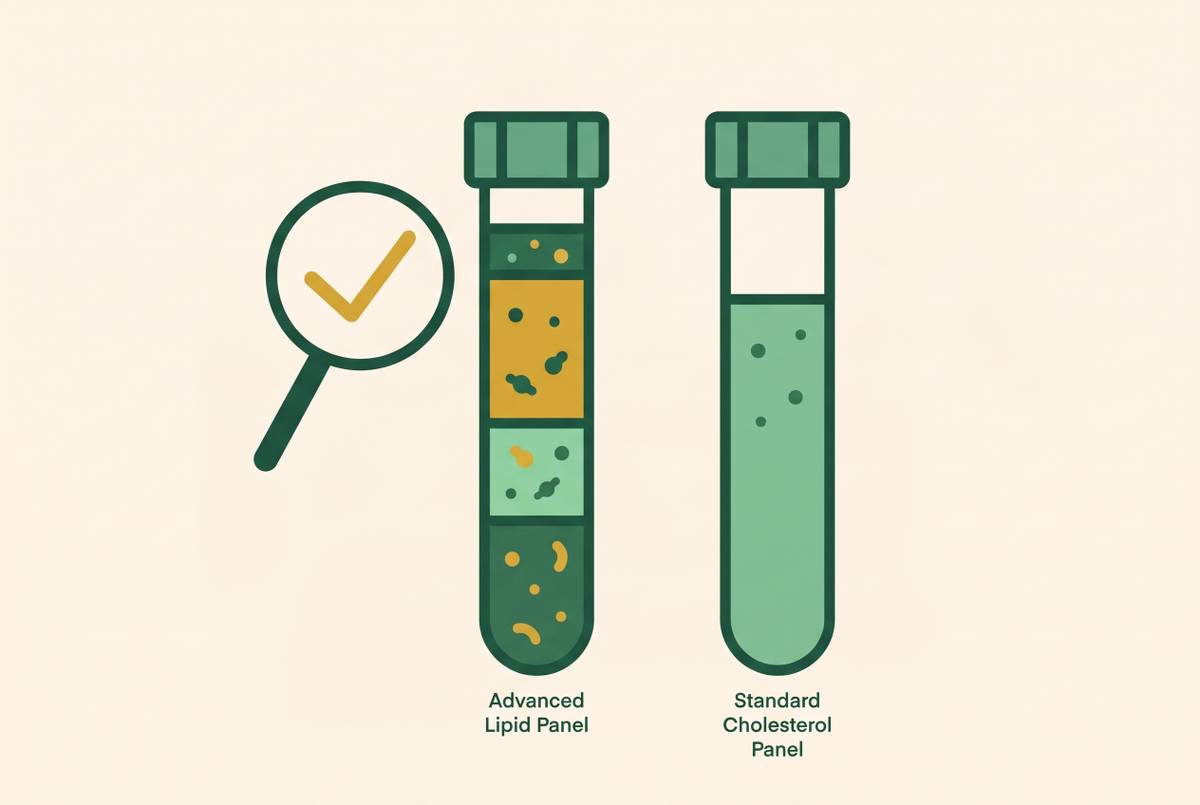
Pharmacogenomic Testing Before Starting Common Medications
Genes control how fast your body processes common drugs, not standard dosing.
A standard dose is a guess dressed up as a number. A standard dose is calibrated to a hypothetical average patient, but your actual response depends on genes fixed since birth, specifically on variants in a family of liver enzymes called cytochrome P450. Think of these enzymes as the body's chemical processing line for drugs: they break medications down so the body can use them or clear them out. How fast that line runs is written into a person's genetic code, and it doesn't shift with diet, exercise, age, or willpower.
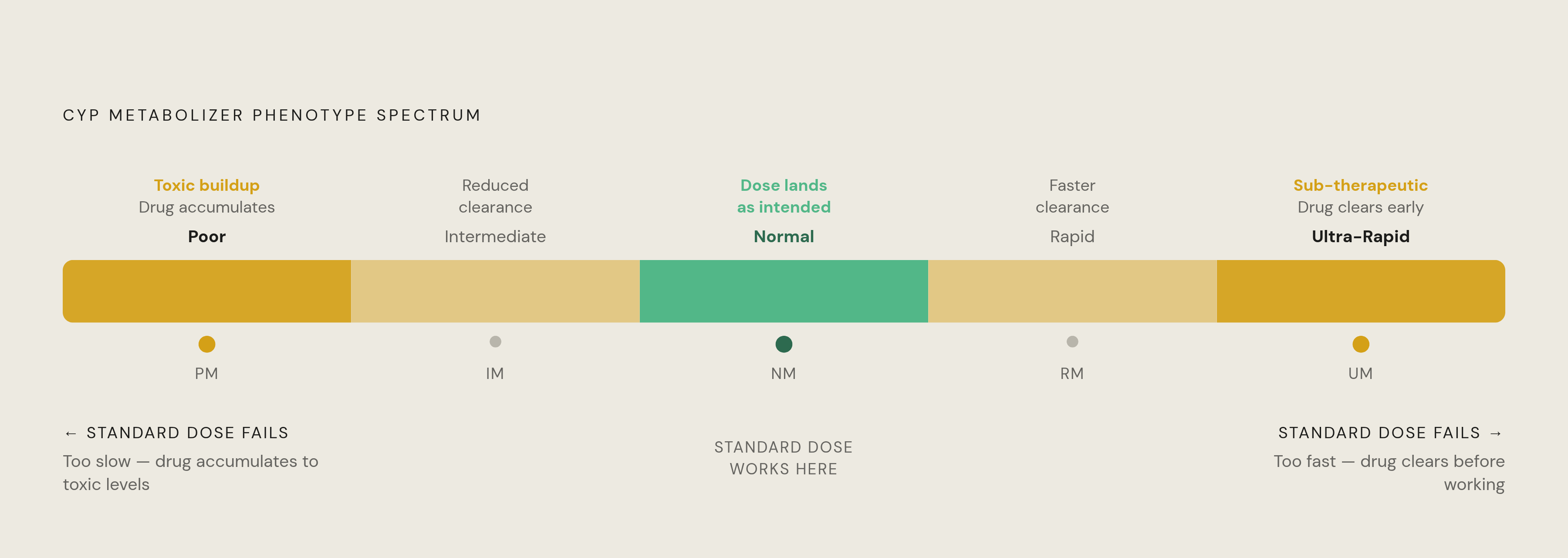
Three genes do most of the heavy lifting here: CYP2D6, CYP2C19, and CYP2C9. Together they handle an estimated 35 to 45% of commonly prescribed drugs, a list that includes antidepressants, antipsychotics, opioids, antiplatelet medications, and blood thinners. CYP2D6 sits at the center of antidepressant, antipsychotic, and opioid metabolism. A person classified as a poor metabolizer on this gene processes those drugs slowly, so the drug can build up toward toxic levels at a dose that would barely register for someone else. An ultra-rapid metabolizer runs the opposite risk: the drug clears so fast it never reaches a therapeutic level, and the medication appears not to work at all, when really it just never got the chance.
CYP2C19 tells a similar story with different drugs. It governs activation of clopidogrel, a blood thinner prescribed after cardiac events and stent placement. If you have a loss-of-function allele on this gene, the drug reaches a significantly reduced level of its active, clot-preventing form, so you can take clopidogrel exactly as directed and still not get meaningful antiplatelet protection. CYP2C19 also shapes how the body handles widely used antidepressants, including citalopram, escitalopram, and sertraline. CYP2C9, the third gene in this trio, alters dose requirements for warfarin and for common NSAIDs like ibuprofen, and its variants connect directly to bleeding risk.
The picture widens beyond these three genes. SLCO1B1 variants are tied to statin-induced muscle damage, so a dose one person tolerates without issue can cause real myopathy in someone else who carries a different variant of that gene. HLA-B*58:01, a marker outside the CYP family entirely, predicts severe skin reactions to allopurinol, a gout medication, in patients from certain ancestral backgrounds. This reaction can be severe, so the American College of Rheumatology recommends testing for it before you start allopurinol in those populations.
None of the labels attached to these results, poor metabolizer, intermediate, normal, rapid, ultra-rapid, are subjective calls. They're read directly off the genotype, describing a pharmacokinetic fact a clinician can act on before a pill is ever swallowed. Every pill bottle's instructions were written for an average person who, statistically, describes almost nobody exactly.
Why prescribing happens too late to learn metabolizer type
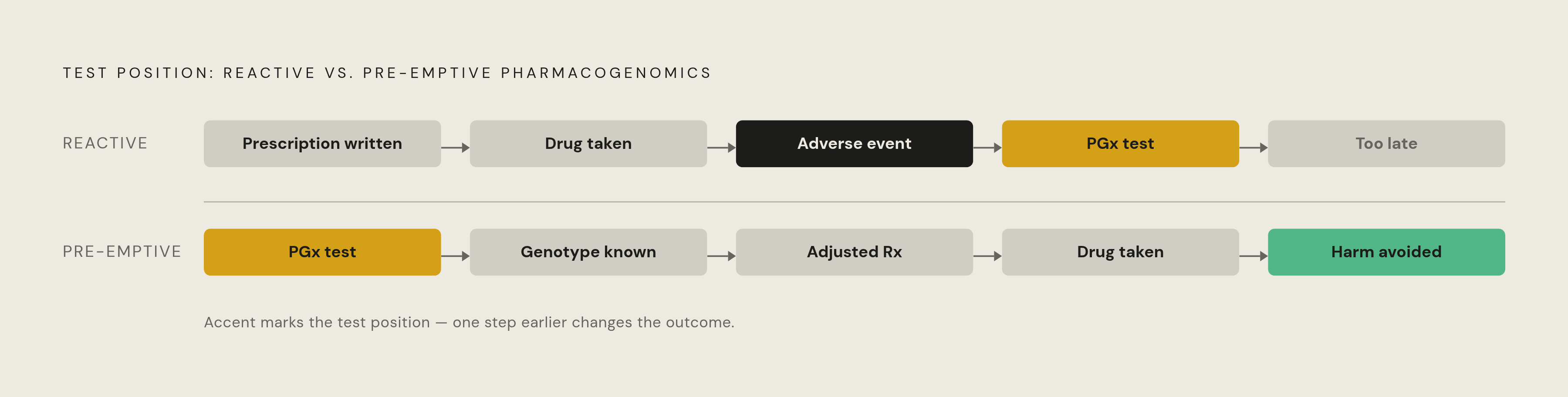
Prescribing, as practiced in most clinics, runs on trial and error. A patient starts a medication, waits several weeks to see whether it helps or hurts, and the clinician adjusts based on what happens. That process works, slowly, but it exposes patients to harm or simple non-response that a known metabolizer phenotype could have flagged before the first dose was taken.
Two different postures toward genetic testing exist: reactive testing responds after a problem has surfaced, while pre-emptive testing answers what will happen before the patient ever takes the drug. Reactive PGx testing happens after a problem has already surfaced, when a patient has a bad reaction or a drug clearly isn't working and someone finally orders the genetic panel to find out why. It answers a useful question, but by the time anyone asks it, the adverse event or the treatment failure has already happened. Pre-emptive testing flips the order: the genetic information arrives before a specific prescription is even written, so the question being answered is what will happen before the patient tries the drug, not why something already went wrong.
A 2025 mini-review in Clinical Pharmacology & Therapeutics, by Stevenson, Smith, Tuteja, and Patel on behalf of the Pharmacogenomics Global Research Network Publications Committee, draws exactly this line between reactive and pre-emptive testing. Its authors come from several major academic medical centers, and they frame pre-emptive testing as the logical starting point for bringing pharmacogenomics into everyday clinical practice.
None of this is a function of careless clinicians. It happens because the system was built around prescribing workflows and insurance incentives that predate affordable genetic testing, so genomic data never had a structural place to enter the decision early. A gene doesn't change. A PGx result obtained today stays valid for every prescription decision that follows for the rest of a patient's life, so the informational value of one test compounds across decades of medication choices still to come.
Evidence from large-scale implementation of pre-emptive testing
The strongest case for pre-emptive testing doesn't rest on mechanism alone. It rests on what happened when researchers actually tried it on real patients at scale. The PREPARE trial is the largest pre-emptive pharmacogenomic implementation study conducted to date, and it set out to test a direct question: does acting on genetic data before prescribing actually cut down adverse drug reactions in real clinical populations?
The trial ran for 36 months, and it enrolled thousands of participants across seven European countries. Patients carrying an actionable genetic variant were prescribed according to Dutch Pharmacogenetics Working Group recommendations whenever they received one of 39 medicines covered by a DPWG guideline, a list that included codeine, clopidogrel, escitalopram, flucloxacillin, and simvastatin. The design mirrored how pre-emptive testing would actually work in a functioning health system: test first, flag the risk, adjust the prescription before it's written.
Not every large trial told the same story, and the honest version of this argument has to sit with that. The INGENIOUS trial, a large pragmatic study conducted in the United States, evaluated PGx testing across 26 drug-gene pairs over one year and came back negative: adverse drug events didn't drop by a significant margin. That result deserves a direct look rather than a quiet footnote, because it's the strongest data point skeptics can point to.
What INGENIOUS actually revealed, according to the researchers who ran it, wasn't a failure of the underlying biology. It was a failure of infrastructure. The trial's own investigators found that faster return of results and better clinical decision support built into the workflow are what's needed to get real benefit from this kind of testing, so a clinician sees and acts on the genetic flag at the moment of prescribing. Put the two trials side by side: the science works when the systems around it deliver results to the right person at the right moment. Pre-emptive testing without timely, actionable reporting back to the prescriber loses the advantage that makes it worth doing.
Drug classes and patient situations with the highest pre-emptive testing payoff
Pre-emptive testing isn't equally valuable everywhere, and its payoff concentrates in situations where metabolizer phenotype decisively shapes how a drug behaves and where getting it wrong carries real clinical weight, which makes it worth mapping out where the signal is strongest.
Psychiatric medication is near the top of that map. CYP2D6 and CYP2C19 together shape the metabolism of a large majority of psychiatric drug labels, and actionable phenotype-drug pairs show up constantly in this category. A leading pharmacogenetics guideline body has concluded that pre-emptive CYP2D6 genotyping may be beneficial before starting aripiprazole, brexpiprazole, haloperidol, pimozide, and risperidone, while another major guideline consortium addresses citalopram, escitalopram, and sertraline through CYP2C19. If you're starting a psychiatric medication, especially after a prior drug didn't work as expected, this information can change your starting dose before you take the first pill.
Cardiovascular medicine offers the single most studied example in the entire field: CYP2C19-guided clopidogrel therapy. If a loss-of-function allele on that gene leaves the drug's active, clot-preventing form unavailable, this drug-gene pair becomes one of the most cost-effective pharmacogenomic applications on record. SLCO1B1-guided statin prescribing belongs in the same conversation, addressing the muscle-damage risk statins carry for some patients and not others.
Pain management is where the logic becomes easiest to see in plain terms. CYP2D6 phenotype determines the rate at which codeine converts into morphine, and that rate decides whether a standard dose relieves pain. An ultra-rapid metabolizer can get a dangerously high effective dose from what looks, on paper, like a standard prescription. A poor metabolizer takes the exact same pill but gets no pain relief at all, because the conversion step barely happens.
If you manage several medications at once, you face a compounded version of this risk. Scotland's 2026-2029 polypharmacy guidance identifies anyone taking 10 or more medicines, including a high-risk medication, as a priority group for medication review, and its appendix on pharmacogenomics notes that PGx testing may help address the specific challenges polypharmacy creates, while also acknowledging that robust evidence for its efficacy in this population still has gaps to fill.
One more detail worth a patient's attention is supplements. Many common supplements induce or inhibit the same CYP enzymes that process prescription drugs, so if you take one alongside a medication, it can quietly shift how much of that medication your body actually sees. If a clinician knows a baseline CYP profile, they have something concrete to check a supplement against, instead of guessing at an interaction after something changes.
The real objection: inconsistent evidence and the phenotype-labeling problem affecting a substantial share of patients
None of this case holds up if it pretends the evidence is uniformly strong, because it isn't. For most drug-gene pairs, the evidence base is thinner than enthusiastic advocates sometimes suggest, and the organizations that pay for this testing have drawn that line explicitly. Carelon's pharmacogenetic testing guideline, effective November 15, 2025 and updated January 1, 2026, along with Humana's pharmacogenomics testing policy, both recognize medical necessity for specific, named drug-gene pairs rather than for broad panel testing applied to general populations. That reflects where the evidence genuinely stands today, not a payer being conservative for its own sake.
Labs don't always agree on what a given patient's genes mean. One retrospective chart review found that phenotype assignments for CYP2D6 and CYP2C19 conflicted between commercial tests and CPIC guidelines at rates near 29% for CYP2D6 and 32% for CYP2C19. A report labeling someone a poor metabolizer or an ultra-rapid metabolizer can come back differently depending on which laboratory ran the analysis and which classification rules it applied. That's a real limitation, not a minor technicality, and anyone relying on a PGx result for a real clinical decision deserves to know it exists.
The economic case for testing tracks the same uneven pattern. A systematic review of the psychiatric pharmacogenomics literature found the strongest supportive economic evidence clustered around CYP2C19 and CYP2D6 drug-gene associations and combinatorial PGx panels, while evidence for many other drug-gene combinations stayed limited.
So where does that leave the argument? These objections are genuine, marking out the edges of where testing is most defensible. Nobody disputes the underlying biological mechanism: enzymes process drugs at genetically determined rates, full stop on that part. Insist on panels that follow CPIC or DPWG standards and on results a clinician actually reviews, rather than trusting a label just because it came back from a lab.
Getting a pre-emptive PGx test outside the standard system
You reach PGx testing the conventional way through a physician's order and an insurer's medical necessity review, but that path is built for a different purpose than pre-emptive testing serves. Most payers define medical necessity around current drug exposure or a documented adverse event that has already happened, so if you ask to be tested before any problem exists, you're asking a system to approve something it wasn't built to recognize.
Patients who want to get ahead of that gap have options that don't depend on insurance sign-off. You can order broad multi-gene panels covering the key CYP genes directly, or arrange them through a clinician who works outside the insurance billing structure, where the lab sets the price. For anyone who already has whole-genome or whole-exome sequencing data sitting on file, certain PGx interpretation services can pull metabolizer phenotypes straight from that existing data, with no new sample required.
Coverage, alignment with prescribing guidelines, and a clinician who reads the result all matter when choosing a panel. Coverage should include CYP2D6, CYP2C19, CYP2C9, and SLCO1B1 at a minimum, since those four genes carry most of the drug classes covered in the sections above. Phenotype assignments should align with CPIC or DPWG guidelines rather than a lab's own proprietary scoring system, given what the labeling discrepancies above already demonstrate about inconsistency across labs. And the result itself needs a clinician to actually read it against the patient's current and anticipated medications, because a report sitting unread in a folder delivers none of the benefit a report acted on would.
The economic logic here is straightforward. A PGx result doesn't expire. The underlying genetic makeup won't change, so the one-time cost of the test becomes an investment that pays out against every prescription decision that follows for the rest of a patient's life. Measured against a single bad reaction avoided, or a single medication that works on the first try instead of the third, the upfront cost of testing before the prescription is written looks a lot smaller than the alternative of finding out the hard way.
Sources
- 22. Appendix J: Pharmacogenomics and Polypharmacy - Polypharmacy Guidance: appropriate prescribing, making medicines safe, effective and sustainable 2026 - 2029 - gov.scot
- Pharmacogenomics Testing Original Effective Date: 04/01/2025
- Navigating Pharmacogenomic Testing in Practice: Who to Test and When to Test - Stevenson - 2025 - Clinical Pharmacology & Therapeutics - Wiley Online Library
- Pharmacogenetic Testing 2025-11-15 updated 2026-01-01
- The role of pharmacogenomics in personalized medicine
- Cost-Effectiveness of Pharmacogenomics-Guided Treatment in Cardiovascular Disease: An Umbrella Review - PMC
- Economic effectiveness of pharmacogenomics-guided prescribing for psychiatric disorders: a systematic review and meta-analysis - PMC