Comprehensive Gut Microbiome Testing for Preventive Health
Reproducibility problems undermine the clinical value of current consumer microbiome tests.

Comprehensive gut microbiome testing could help prevent disease, but its value depends on telling real changes in the gut apart from errors in how they are measured. Understanding what a test measures, which signals matter, and whether the results can change a useful decision is what separates actionable insight from expensive noise.
What the gut microbiome actually is and why its composition matters
The gut microbiome is an active metabolic community. Trillions of microorganisms, including bacteria, fungi, viruses and archaea, live mainly in the colon and represent more than 1,000 species. They ferment fiber, send signals to immune cells and make neuroactive compounds through the gut-brain axis. They also synthesize vitamins, including K2/menaquinones and B12, although B12 produced in the colon is largely unavailable to the body.
Among their most important outputs are short-chain fatty acids, or SCFAs. Butyrate, in particular, nourishes the cells lining the colon, helps maintain the intestinal barrier and regulates inflammatory tone. Dysbiosis, meaning disruption of the microbial community structure, can impair these functions and is associated with chronic inflammation, metabolic dysfunction and compromised immune defense.
Yet there is no single microbial profile that everyone shares. Genetics, birth method, early-life exposures, diet, medications and aging all shape the community. This individuality makes the microbiome a promising source of personal health information, while making it difficult to define a universal benchmark. Because its functions are real and consequential, wanting to measure them is entirely rational.
Which conditions have the strongest research links to microbiome disruption
The strength of the disease evidence varies considerably. In inflammatory bowel disease and IBS, microbial shifts can precede clinical flares, suggesting a possible signal before symptoms worsen. Obesity, type 2 diabetes and cardiovascular disease also have well-established links to altered microbial communities and low diversity. Documented mechanisms include inflammation, endotoxemia and changes in metabolism, although that does not make every associated bacterial pattern a cause of disease.
Mental health research shows another consistent pattern. People with major depressive disorder or bipolar disorder often have microbial communities that, as a whole, differ from those of the healthy groups they are compared with. Depletion of SCFA producers, including Faecalibacterium and Coprococcus, is repeatedly reported, while Roseburia depletion is more reproducible in major depressive disorder. These findings support a biological connection, but causality remains unestablished.
A Nature study identified the bacterial metabolite imidazole propionate, or ImP, as a contributor to atherosclerosis and a potential subclinical biomarker that disrupts insulin signaling and amplifies inflammation. Nature Aging studies published in 2025 identified a mechanistic role for the phenylalanine-derived metabolites PAA and PAGln in vascular endothelial senescence. Cross et al., in Gut Microbes in 2024, documented that the microbiome responds to altered female sex hormone status and can exacerbate metabolic dysfunction.
Studies of populations find patterns that people share, but a commercial test must reliably measure what is in one person's gut and link the result to a step that improves their health. Those are different standards of evidence. The current generation of consumer products has not cleared the latter bar.
What microbiome tests actually measure and how the technology works
Most broad microbiome tests use one of two sequencing methods. The cheaper, faster approach, 16S rRNA gene sequencing, targets a bacterial gene with regions used for identification. It generally reports bacteria at the genus level, rather than reliably distinguishing species, and misses functional information. Shotgun metagenomics sequences all microbial DNA in a sample, so it can identify microbes at the species level and show what they may be able to do. It costs more and requires more analysis, with results depending partly on the reference database used.
Clinician-ordered qPCR-based stool panels serve a narrower purpose. They look for specific known organisms, while broader clinical panels may also test for markers of inflammation or digestive function. Their strength is better analytical validation for targeted questions. A test designed to find a particular pathogen is therefore not interchangeable with a consumer microbiome survey.
Alpha diversity describes the variety within a sample, often using Shannon or Simpson indices, while beta diversity describes how communities differ from one another or from a reference population. Taxonomic abundance reports the relative proportions of bacterial groups and supplies much of the data behind consumer dashboards. Some products also infer metabolite production from the organisms detected, but inferred SCFAs or trimethylamine N-oxide are not direct metabolite measurements.
Porcari et al.'s 2025 Lancet consensus panel concluded that the Firmicutes/Bacteroidetes ratio and other phylum-level composition measures should be excluded from clinical reports because they lack evidence of clinical relevance. The distinction matters because a detailed dashboard can contain both biologically meaningful measurements and numbers with little interpretive value.
How reproducible current consumer tests actually are
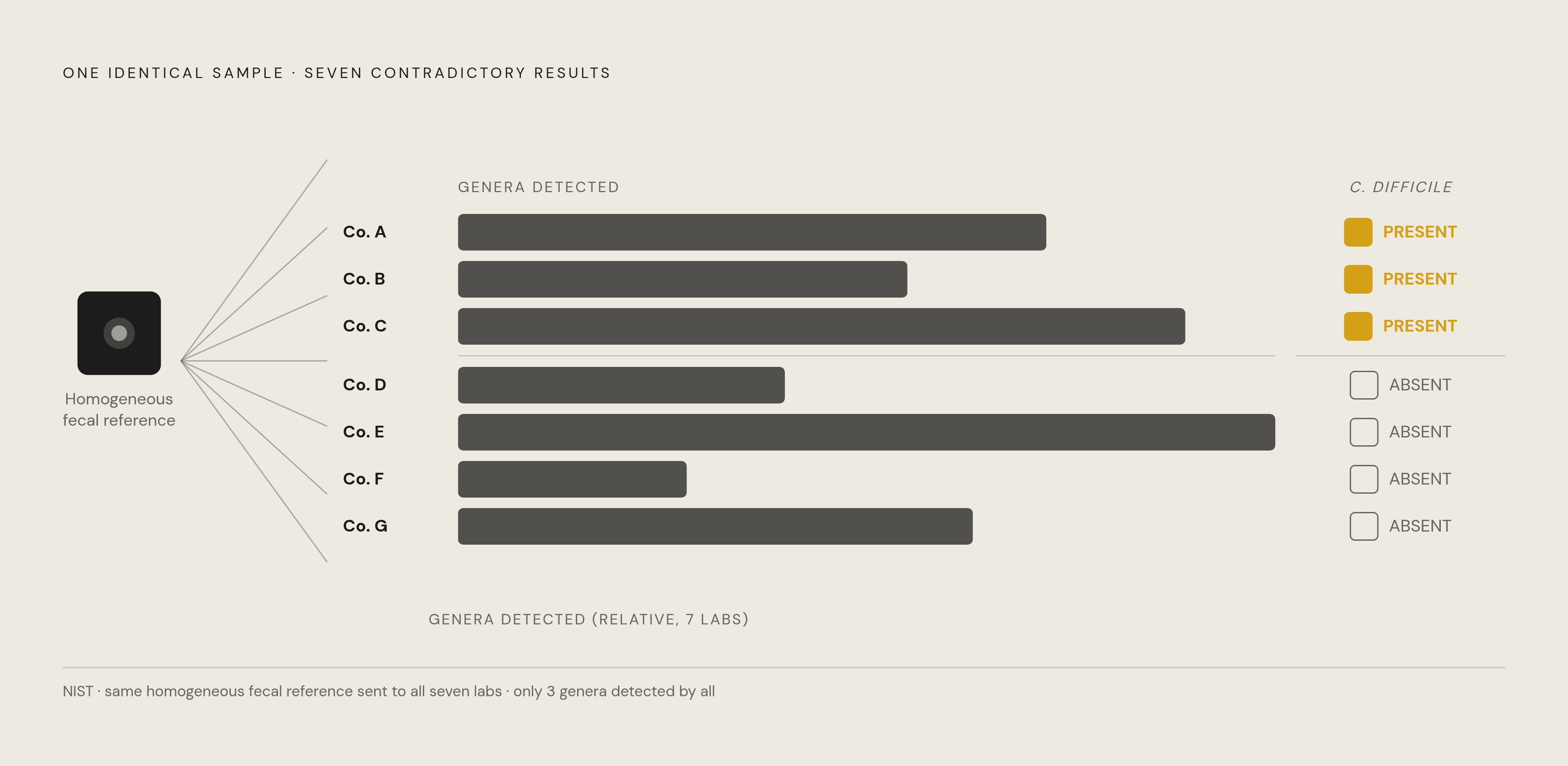
The NIST study by Servetas, Hoffmann, Ravel et al., published in Communications Biology in 2026, tested a basic requirement of useful measurement. Researchers at NIST and the University of Maryland School of Medicine / CAMRI sent homogeneous human fecal reference material to seven direct-to-consumer companies. Because the samples were identical, differences in the results reflected the companies' methods.
The study found that results from different companies varied about as much as the biology of samples from entirely different human donors. Across all analyses, only three genera were consistently detected in every sample. Removing an outlier replicate increased the shared set to just 17 genera, a small fraction of all the taxa identified. Three companies found Clostridioides difficile in the standardized sample, while four said it was absent.
These findings challenge more than the precision of a wellness score. A result may depend as much on the laboratory processing the sample as on its contents, undermining confidence in individual interpretation. Better technology may fix these problems in time, but a test bought now uses today's methods, and tomorrow's standards are still to come. Comparisons across laboratories, repeat samples and time cannot simply be assumed reliable. The federal regulator in the United States has yet to clear or approve any clinical microbiome diagnostic tests, so consumer kits sit between regulated diagnostics and wellness products.
Which biomarkers and signals from microbiome testing carry genuine weight today
Depletion of SCFA-producing bacteria, including Faecalibacterium prausnitzii, Roseburia and Coprococcus, is among the most replicated findings across metabolic, psychiatric and inflammatory conditions. Reliably documented depletion provides a plausible target for dietary change, such as increasing resistant starch to feed butyrate-producing bacteria. The qualification matters because a robust research association does not validate every commercial measurement of it.
Overall diversity also carries weight as a directional signal. Shannon and Simpson indices are consistently lower in populations with obesity, type 2 diabetes, inflammatory bowel disease and depression. Beta diversity is especially consistent in psychiatric microbiome research, showing that community composition differs between affected and healthy groups. Neither measurement, by itself, establishes what an individual's symptoms mean. ImP, PAA and PAGln are newer, mechanistically grounded cardiovascular signals, but they are not yet standard consumer-panel measurements.
Other report features deserve less confidence. A proprietary “health score” compresses uncertain inputs into an apparently decisive number, and the NIST study showed that the same sample could be classified as healthy or unhealthy depending on the company. Species-level claims from a 16S kit are extrapolations, while a report led by the Firmicutes/Bacteroidetes ratio is out of step with the 2025 consensus. The useful goal is to identify modifiable patterns in the context of clinical history and validated biomarkers.
Dietary and lifestyle interventions with evidence behind them for shifting microbiome composition
The strongest evidence for changing microbiome composition centers on diet. Mediterranean, Green-Mediterranean and plant-based patterns, together with intermittent fasting, have evidence for remodeling gut communities and improving inflammatory and cardiometabolic profiles. Fiber-rich foods, including legumes, fruits and vegetables, provide material that microbes ferment into SCFAs. People who eat fiber-rich diets tend to have higher microbial diversity and develop chronic disease less often. Resistant starch is a more specific input for butyrate-producing bacteria, making it relevant when their depletion has been reliably documented.
Human studies, mainly involving fermented dairy, indicate digestive-health benefits. Findings presented at the 2025 GMFH Summit showed that fermented cabbage can affect intestinal barrier function. Those effects varied with fermentation time, probiotic inoculation and homemade versus commercial processing, so “fermented” is not a guarantee of the same biological effect.
Probiotics and prebiotics have evidence for effects on cholesterol, blood pressure and endothelial function, but findings shared at the 2025 GMFH Summit showed that fiber taken as a supplement does not always have the same benefits as fiber-rich foods. High-dose inulin also carries hepatic risk in animal models, with one presented study finding hepatocellular carcinoma in 10% of mice fed inulin-enriched diets. That animal finding argues against treating every prebiotic as harmless or interchangeable.
Food additives and treatment response are also being studied. The ADDapt trial found that a low-emulsifier diet reduced symptoms in active Crohn's disease, while unpublished Nutriomics findings suggested that microbiome gene richness could help predict weight-loss response to GLP-1 analogues. For now, a credible result showing depleted butyrate producers can reasonably motivate Mediterranean-style fiber intake, but a proprietary score tied to a supplement subscription is a different proposition. If the useful response is largely dietary, the test still has to justify its cost.
How to evaluate cost and quality before buying a gut microbiome test
The 2025 pricing range for at-home 16S rRNA kits was approximately $100–$250. These products usually report on composition and diversity, with the limits on resolution and reproducibility described above. Clinician-ordered comprehensive stool panels are typically the most expensive tier, with prices varying by scope, region and provider. Their higher cost may buy validated targeted markers, but not necessarily a broader picture of microbial composition.
Some services charge extra for a report that explains the results in detail, while others charge separately for a consultation with a dietitian or clinician. If actionable professional guidance is the reason for testing, that consultation belongs in the budget. Subscription retesting has biological logic because the microbiome changes, but using the same company does not by itself create a validated longitudinal comparison. Most insurers do not currently cover consumer microbiome tests, and reimbursement pathways are not yet available for routine preventive use.
Look for published peer-reviewed validation of the company's own method, disclosure of its sequencing approach, reference database and analytical pipeline, and clear acknowledgment of limitations. ISO-certified laboratory processing is a basic sign of analytical quality, but it does not prove that a report can help guide prevention. Claims that stool composition can be used to diagnose conditions go beyond what the evidence now shows. What would change the value calculation is stronger standardization and proof that using the result improves decisions or outcomes.
When gut microbiome testing is and is not worth doing right now
Testing has its strongest rationale when it addresses a defined question that could change care or behavior. Recurrent digestive symptoms, IBS, IBD, post-antibiotic dysbiosis and frequent antibiotic exposure provide plausible contexts for considering composition alongside dietary intervention. People with metabolic disorders, chronic inflammatory conditions or a strong family history of colorectal cancer may also consider it after addressing standard clinical markers. Perimenopausal or menopausal women with unexplained weight or energy changes have a biological rationale for interest, but not yet a validated microbiome-based explanation.
For healthy people without symptoms, risk factors or validated markers suggesting gut dysfunction, testing is more likely to be premature. Reliably separating healthy variation from meaningful dysbiosis and diagnosing disease remain beyond the capabilities of current consumer products, with colonoscopy, endoscopy and standard stool pathogen testing retaining their clinical roles. A proprietary gut health score alone is not a sound reason to start treatment or repeated testing.
Before purchasing, identify the question and check whether a standard stool test, inflammatory marker or metabolic panel already answers it more reliably. Then assess whether the company discloses its methods, acknowledges uncertainty and keeps its claims within the evidence. The strongest preventive use is as one layer beside validated measures, including ApoB, CRP, glucose, metabolic panels and hormonal assessments. GUTBIOME-PT and other ongoing trials will help show how useful these tests are in care, and the 2025 Lancet consensus shows that work is underway to set stronger standards. The science is moving quickly, and keeping up with those standards is itself a useful habit for preventive health.
Sources
- Improving Colorectal Cancer Early Screening in Portugal: Identification of Gut Microbiome Biomarkers in Stool (GUTBIOME-PT)
- Gut bacteria as a biomarker for inflammation and cancer: Insights from clinical and microbial analysis - ScienceDirect
- Editorial: Roles of gut microbiota in cancers of the gastrointestinal tract