Bone Density DEXA for Adults Under Sixty-Five
Early screening can catch bone loss in younger adults with specific risk factors.
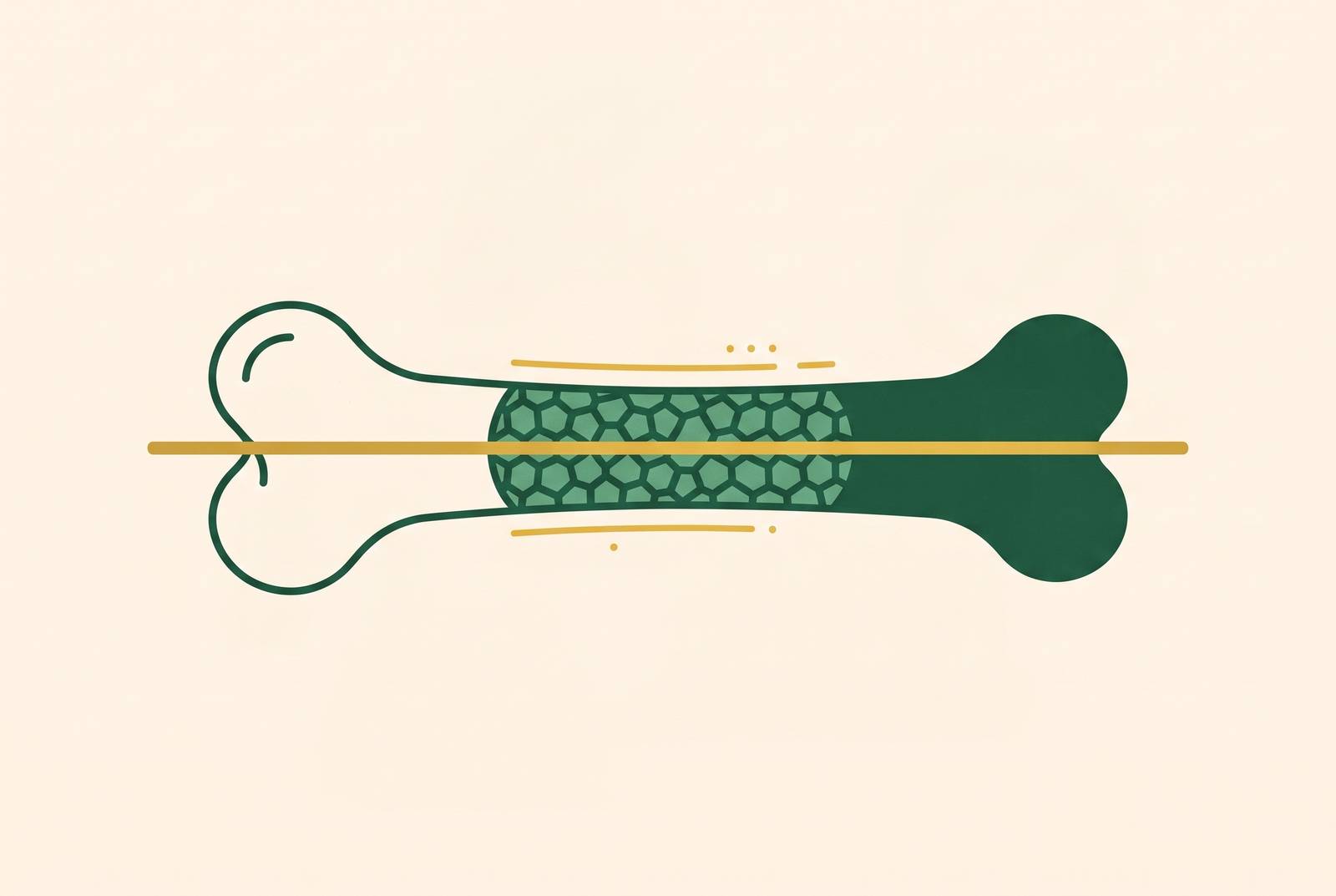
Bone density DEXA testing before 65 helps find bone loss when there is a reason to suspect it. Routine screening thresholds make sense for low-risk people, but they are not a reason to ignore early menopause, bone-affecting medication, low body weight or a fragility fracture.
Why the standard age threshold leaves many adults without a bone density baseline when they need it
The USPSTF guidelines, updated January 14, 2025, recommend DEXA for women aged 65 and older and for postmenopausal women younger than 65 who are at increased risk. For the younger group, the recommended path starts with a clinical risk assessment and moves to bone mineral density screening when that assessment identifies increased risk. Adults in their 40s and 50s therefore do not generally enter routine screening on age alone. Without a risk-based reason to test, they may reach later life without a baseline against which to measure change.
That boundary serves a legitimate purpose, which is avoiding overdiagnosis in people whose risk is low. But an age cutoff for screening cannot tell whether one person needs a scan. The 2025 revision retained the route to earlier screening for postmenopausal women with risk factors and specified DXA as the preferred screening method. The useful distinction is between someone outside routine screening because their risk is low and someone outside it whose higher risk has not yet been recognized. This article concerns that second group.
How bone is built and lost, and why the decades before 65 are not biologically neutral
Bone is not a fixed structure that stays intact until old age. Two kinds of cells constantly reshape it, namely osteoblasts, which add bone, and osteoclasts, which remove it. When people are young, more bone is built than lost, and they reach peak bone mass between about ages 25 and 30. After the early 30s, removal outpaces formation, so the structure gradually thins. More of the loss takes place at the endosteal surface inside bone and in trabecular bone, the network within it.
Hormones help regulate that balance. Estradiol promotes osteoblast activity, suppresses the formation of osteoclasts and helps bring about the death of those bone-removing cells. When estradiol falls, net bone loss accelerates in both women and men. In women, the sharp fall in estrogen at menopause makes the following five to seven years a period of especially rapid loss. An earlier hormonal change therefore brings this vulnerable period forward rather than leaving bone untouched until screening age.
ColumbiaDoctors reports that roughly half of women over age 50 have low bone mass. Columbia University endocrinologist Marcella Donovan Walker notes that roughly one in three women over 50 will experience an osteoporosis-related fracture in their lifetime. These figures explain why scanning around age 50 for those with risk factors can create a window to slow loss before it becomes more severe.
The risk factors that make DEXA clinically warranted before the standard age
Early or surgical menopause brings the estrogen-related loss described above into an earlier part of life. That leaves more years of potential deterioration before routine screening would begin. Main Line Health says menopause without estrogen support is a reason to screen before 65.
Taking a glucocorticoid over the long term is another clear reason to have bone health checked. These steroids slow osteoblast activity and help osteoclasts survive longer, so they cause bone loss at any age. Other medications associated with accelerated bone loss include certain cancer and epilepsy drugs, blood thinners, SSRIs, proton pump inhibitors and some diabetes medications. Columbia University's Walker and Main Line Health identify these medication classes as concerns. Their presence is a reason to discuss bone density monitoring with the prescribing clinician while continuing treatment.
Low body weight matters through two routes. It reduces the mechanical load placed on bone, while lower body fat also reduces its contribution to estrogen production. A previous fragility fracture is a different kind of warning, because a bone that breaks after a minor impact may already be compromised. Waiting for the standard screening age after such an event overlooks an existing clinical signal. Family history also matters because genetics plays a large part in peak bone mass, and having a parent with osteoporosis or a hip fracture is a known risk.
Tobacco and heavy alcohol use can cause still more bone to be lost than built. Smoking inhibits osteoblast activity, increases the breakdown of exogenous estrogen, reduces body weight and is associated with earlier menopause. Excess alcohol interferes with calcium absorption and bone formation.
Chronic diseases can add risk through the disease itself, its treatment or both. These diseases include rheumatoid arthritis, diabetes, chronic liver disease and HIV infection. These risk factors matter for men too, though their routine screening starts later, at 70. The International Society for Clinical Densitometry, or ISCD, and Columbia's clinical guidance recognize earlier evaluation for men with relevant risks. Being younger than the routine threshold does not cancel the effects of a drug, disease or previous fracture.
What happens when the guideline gap goes unfilled — two concrete populations
A 2025 retrospective cohort study from the University of South Florida examined 170 hepatocellular carcinoma patients under 65. Three-quarters had CT-based indicators of low bone mineral density, and among those with low density, roughly one in five fell within the osteoporosis range. These were not DEXA screening results. The researchers used Hounsfield units from existing L1 CT scans as a validated proxy for DEXA T-scores.
Cancer history alone is not included in the criteria for earlier routine screening described here. As a result, these patients can fall outside the usual screening pathway despite substantial bone compromise. The study's authors argue that bone mineral density is a clinically meaningful prognostic factor in this population, linked to survival outcomes. That association makes overlooked bone health a meaningful concern.
A 2026 study from Wayne State University examined adults living with HIV aged 50 and older at an infectious disease clinic. Only a minority had received DEXA screening. Among those screened, roughly half were diagnosed with osteopenia and about one in five with osteoporosis, proportions whose applicability to everyone attending the clinic is uncertain. Even with that limit, the findings expose a gap between having a reason to assess bone health and actually receiving an assessment.
HIV infection itself is linked to lower bone mineral density, and people with HIV have fractures about ten years earlier. Certain antiretroviral therapies, particularly those containing tenofovir disoproxil fumarate, add medication-related risk. Neither group stands for all adults under 65, and neither study gives a reason to screen everyone early. Both studies do, however, show why people with known risks need their bone health checked before they are old enough for routine screening. The same reasoning applies to people with the other risk factors described above.
How to read DEXA results when you are under 65 — the Z-score distinction
A DEXA report may give both a T-score and a Z-score, which answer different questions. The T-score compares your bone density with that of a healthy young adult. On that scale, -1.0 or above is normal, between -1.0 and -2.5 is osteopenia, and below -2.5 is osteoporosis. The Z-score instead compares your density with that of others of the same age, sex and body size. For younger adults, that comparison is particularly useful when asking whether bone loss is greater than expected for their age.
The ISCD defines a Z-score at or below -2.0 as “below the expected range for age”. This points toward investigating secondary causes, including a disease, drug or hormonal condition. For a 45-year-old, a T-score of -1.5 may not be alarming on its own, while a Z-score of -2.2 points toward further workup. The distinction is why a younger reader needs more than a label attached to a single number.
The Fracture Risk Assessment Tool, or FRAX, complements the density result by estimating the ten-year probability of a major osteoporotic fracture. That estimate helps a clinician decide whether to watch for changes, suggest lifestyle changes or offer treatment. Serum calcium and phosphorus are typically normal in people with osteoporosis, so normal results do not rule out bone loss.
What to do if your DEXA finds low bone density before 65
The response to an osteopenia finding, including whether medication is warranted, depends on how low the density is, the Z-score and the risks behind the result. For many adults below routine screening age, the next steps are lifestyle changes and a plan to monitor density. The goal is to understand both the condition of the bone and what may be driving its loss.
Of the lifestyle changes described here, exercise has the most evidence behind it. Main Line Health recommends weight-bearing activities, including walking, squats and lunges, as well as resistance training to support bone strength. Columbia's Walker notes that exercise and diet can slow age-related loss, though their direct effects on density are modest. Exercise has greater value when there is more bone mass left to protect.
Main Line Health recommends talking with a physician about how much to take and says dairy, lean meats, fish and leafy greens provide nutrients that bones need. Supplementation alone has only modest effects on density, with stronger evidence for combined approaches. Quitting smoking and limiting alcohol address other reversible risks. For people taking bone-affecting medication, an abnormal scan also gives the prescribing clinician a specific reason to discuss monitoring frequency or whether alternatives exist.
Medication becomes relevant when the severity of loss and fracture risk warrant it. Columbia's endocrinology team describes bisphosphonates, denosumab and bone-formation-stimulating agents as regulator-approved options that reduce fracture risk. Hormone therapy can also slow bone loss in younger women who have menopausal symptoms. Whatever the initial plan, a clinician can set a repeat-scanning interval based on the findings, because the rate of change may be more informative than the baseline alone.
How to get a DEXA scan before 65, and what it costs without insurance coverage
The first practical step is to find out whether your risks qualify you for covered testing. The Affordable Care Act requires coverage without out-of-pocket cost for eligible preventive screening under the USPSTF recommendation, but most adults under 65 do not qualify by age alone. Main Line Health notes that many insurers cover earlier screening when one or more risk factors are documented. Checking with your plan before scheduling is therefore worth a call. If you do not qualify, self-pay testing provides another path.
You can pay for bone density DEXA at clinics that focus on wellness and body composition, and the price can differ a lot from place to place. A scan at a university exercise science lab can cost far less than one at a hospital-affiliated outpatient department, where technical or facility fees may increase the bill. Self-pay scanning can be available at $75, but that is not a universal price. Calling ahead to ask about the self-pay rate and cash or prompt-pay discounts can help you find out what you would pay. If a package includes services you do not need, ask whether the scan can be booked alone.
Request a report that includes both the T-score and the Z-score, rather than assuming the report will foreground the comparison most useful for a younger adult. If the Z-score is at or below -2.0, ask the clinician reviewing it which secondary causes warrant investigation. The scan is most useful when its result connects back to the risks that prompted it and forward to a monitoring plan. Earlier testing is about recognizing when an adult under 65 already has a reason not to wait.