Advanced Lipid Panel vs. Standard Cholesterol Panel
Standard cholesterol panels miss particle-level risks that advanced testing can reveal.
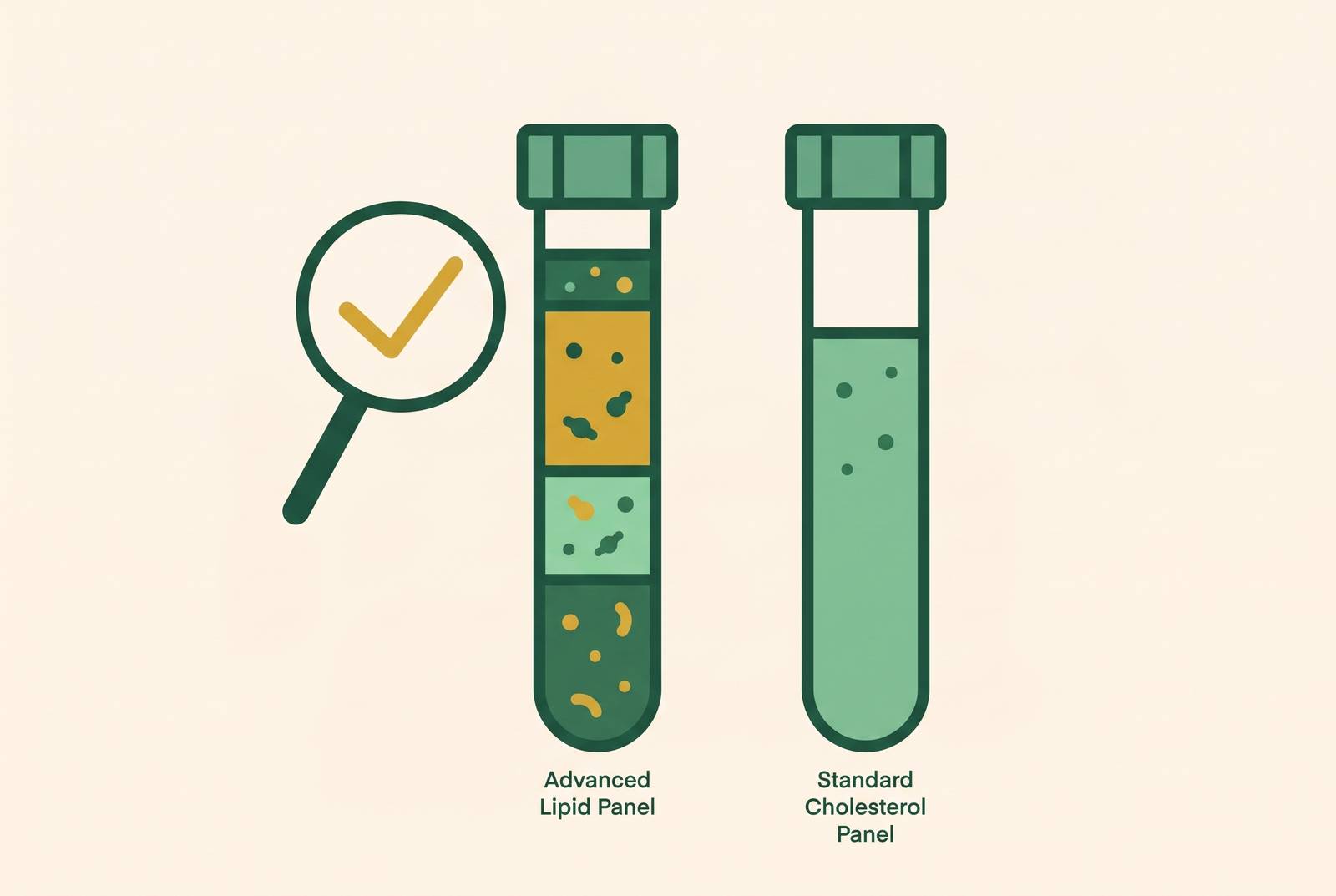
Someone gets their annual bloodwork back. Total cholesterol: fine. LDL: fine. The doctor says everything looks normal, and the appointment is over in under ten minutes. But that same person has a father who had a heart attack at 54, and the green checkmark on the lab report doesn't square with the family history sitting in the back of their mind. That gap between "normal" and "actually low risk" is where this piece starts, and understanding why the gap exists comes before deciding what to do about it.
The standard lipid panel was built decades ago as a population screening tool. Its job was to flag overt dyslipidemia across large groups of people cheaply and quickly, using four concentration-based numbers: total cholesterol, LDL-C, HDL-C, and triglycerides. For that purpose, the panel works. It catches the patients whose cholesterol is dramatically out of range, and it does so at a cost and turnaround time that makes sense for screening millions of people every year.
But a tool built to sort populations into broad risk tiers is not the same tool that tells one specific person, with one specific genetic and metabolic history, how much atherosclerotic risk they're actually carrying. The panel measures how much cholesterol is being transported in the blood. It does not measure how many particles are doing the transporting, how large those particles are, or how prone they are to lodging in an artery wall. That distinction sounds small on paper. At the individual level, it is not.
A meaningful percentage of people have a first heart attack even though their basic cholesterol panel looked acceptable the last time anyone checked. The signal that would have caught them, in many cases, lives in markers that a standard annual physical never orders. That's the residual risk this article works through: not a flaw in the standard panel's design, but a mismatch between what the panel was built to do and what an individual actually needs to know about their own arteries.
What the Standard Panel Reports
Start with what the four numbers actually say, because each one carries real information up to a point, and each one also runs out of road at a specific place.
Total cholesterol is the sum of all the cholesterol being carried by every lipoprotein in the blood. It's a reasonable starting point and a poor stopping point. On its own, it doesn't distinguish between cholesterol riding in particles that cause plaque and cholesterol riding in particles that don't, so treating it as a verdict rather than a prompt is where most of the confusion begins.
LDL-C, the number most people associate with "bad cholesterol," is calculated in most standard panels using the Friedewald equation, a formula that estimates LDL-C from the other three values rather than measuring it directly. That calculation introduces error, especially when triglycerides are elevated. The number labeled LDL-C on a lab report is sometimes an approximation drifting further from reality when accuracy matters most. Two people can post identical LDL-C results and still carry meaningfully different cardiovascular risk, because LDL-C measures the weight of cholesterol cargo, not the number of particles carrying it, and those particle characteristics never appear in the number.
HDL-C measures the concentration of the cholesterol fraction involved in reverse transport, the process that carries cholesterol back to the liver for disposal. It says nothing about how many HDL particles are circulating or how well those particles function, and particle number and function can affect cardiovascular protection independently of concentration, particularly for people with metabolic syndrome.
Triglycerides reflect a mix of diet, liver output, and metabolic status, and they function as an independent cardiovascular risk factor in their own right. They also serve as a marker of insulin resistance. When triglycerides run high alongside low HDL, that combination, known as atherogenic dyslipidemia, is strongly associated with a predominance of small, dense LDL particles, even in cases where the LDL-C number itself looks unremarkable.
None of the four numbers exist in a vacuum, and ratios built from them add interpretive texture the raw values don't offer on their own. A total-to-HDL ratio, a triglyceride-to-HDL ratio, and an LDL reading measured against optimal targets rather than simply "in range" can reveal risk gradients that a flat reference range smooths over. Lab reference ranges are statistical averages drawn from a population, not targets calibrated for someone's cardiovascular longevity. If a result sits inside the range, it can still carry real ten-year risk. The triglyceride-HDL pattern is the clearest hint the standard panel offers that something is happening at the particle level, a hint it can gesture toward but never confirm. That's exactly where particle-level testing picks up the thread.
The Advanced Panel: Particle Number, ApoB, Lp(a), and Particle Size
An advanced lipid panel doesn't throw out the standard four markers. It builds on top of them, adding a layer that measures atherogenic particle burden directly instead of inferring it from how much cholesterol weight those particles happen to be carrying.
LDL particle number, often abbreviated LDL-P, counts the actual number of LDL particles circulating per liter of plasma. A standard test tallies up the total cargo weight. An advanced test counts the vehicles. Ten small cars moving the same total cargo as one large truck still create more traffic, and more traffic means more opportunities for a particle to penetrate an artery wall, regardless of what the total cholesterol weight looks like. In patients where LDL-C and LDL-P point in different directions, LDL-P has shown stronger predictive value than LDL-C.
ApoB, short for apolipoprotein B, takes a different approach to the same problem. Every atherogenic lipoprotein particle, whether it's LDL, VLDL, IDL, Lp(a), or a chylomicron, carries exactly one ApoB molecule on its surface. That one-to-one relationship means a single ApoB measurement is a direct headcount of every particle capable of contributing to plaque, all captured in one blood draw (Lp(a)'s contribution is folded into that total count rather than broken out separately). ApoB isn't a more refined version of LDL-C. It counts particles instead of weighing cargo, a different kind of measurement.
Lp(a), or lipoprotein(a), deserves its own mention because it behaves unlike anything else on this list. It's an LDL-like particle whose levels are largely set by genetics, and it does not appear anywhere on a standard lipid panel. Roughly 20% of the population carries elevated Lp(a) according to available epidemiological data, yet only a small fraction of Americans have ever had it measured. Because Lp(a) levels barely move with diet, exercise, or weight loss, a single lifetime measurement holds lasting value: once it's checked, there's rarely a need to check again. Genetic evidence suggests Lp(a) particles are several times more atherogenic per particle than LDL itself. The 2026 ACC/AHA dyslipidemia guideline, published in Circulation on March 13, 2026 and co-signed by 11 major medical organizations, now recommends that every adult have Lp(a) measured as part of cardiovascular risk assessment, a notable shift from a marker most people have never heard of to one with a universal screening recommendation behind it.
Particle size adds a further dimension. Small, dense LDL particles penetrate artery walls more easily than larger ones, oxidize more readily once inside the wall, and linger in circulation longer before being cleared. NMR LipoProfile testing uses nuclear magnetic resonance spectroscopy, so it can report particle number and particle size from the same blood draw. HDL particle number and size round out the advanced panel. Some evidence suggests HDL particle count and size track cardiovascular protection more reliably than HDL-C concentration alone, especially in people with metabolic syndrome, and a standard panel does not report either measure.
Whether particle size adds anything once you already know ApoB is still a genuinely open question, and the next section works through what the evidence currently says.
Why ApoB is the strongest single marker for atherogenic particle burden
Among all the markers an advanced panel offers, ApoB has accumulated the most consistent evidentiary support as a standalone measure of atherogenic risk. But why has it pulled ahead of particle number, particle size, and the other candidates discussed above?
The clearest answer appears in discordance, the situation where LDL-C and LDL particle number point in different directions for the same patient. When the two measures agree, it hardly matters which one a clinician orders. When they disagree, the choice of marker decides whether elevated risk gets caught or quietly missed. The 20-year ATTICA cohort study, following patients from 2002 to 2022, found that elevated ApoB independently predicted 20-year ASCVD risk regardless of non-HDL-C and Lp(a) levels, specifically in people who also had elevated LDL-C. Folding ApoB into traditional risk assessment accounted for a portion of what had previously been unexplained, residual risk.
That raises a fair follow-up question: once ApoB is measured, does particle size add anything further? A 2025 European Heart Journal analysis of more than 207,000 UK Biobank participants suggests the answer, for most patients, is no. The study found that for ordinary ApoB-containing particles, total particle count explained cardiovascular risk better than whether those particles happened to be large, small, LDL, or VLDL. Average LDL diameter showed an initial association with coronary artery disease, but that association disappeared once total ApoB particle count was accounted for. So detailed NMR particle-size subfractionation may not add meaningful risk stratification beyond what ApoB already captures for most patients, which matters when you weigh the added cost of more granular testing against what it actually changes clinically.
One might argue that ApoB's advantage is overstated, since at a population level ApoB correlates highly with non-HDL-C, LDL-P, and LDL-C, so the average predictive gain across a large group looks modest. That objection holds at the population level, but it misses where ApoB actually earns its keep. Its value is visible at the individual level, in precisely the discordant cases where that correlation breaks down, and those discordant cases are exactly the patients standard testing is most likely to miss. A systematic review of discordance analyses found ApoB to be a more accurate marker of ASCVD risk than both LDL-C and non-HDL-C, even though ApoB remains minimally used in clinical practice across the United States.
Non-HDL cholesterol, calculated directly from the standard panel as total cholesterol minus HDL, can work as a reasonable middle ground when ApoB isn't ordered, capturing every atherogenic particle in a single number. Guidelines increasingly treat it as a primary treatment target alongside LDL and ApoB. It's a useful bridge when ApoB isn't available, but it adds less precision than ApoB itself, because it's still built from cholesterol concentration rather than a direct particle count.
The mismatch between population-level screening tools and individual risk patterns is why direct-access biomarker platforms like Mito Health emphasize particle-level testing. A standard panel can return a result labeled normal while missing the particle-count signals, LDL-P, ApoB, Lp(a), that actually predict someone's cardiovascular trajectory. Clinician-guided access to advanced panels is what lets someone move past a population average and toward a number that actually describes their own arteries.
Inflammation as a second, parallel lane of cardiovascular risk
Particle burden is only half the picture. Residual cardiovascular risk runs along two separate lanes, atherogenic particle burden and vascular inflammation, and measuring only one leaves a real blind spot even after a full advanced lipid panel comes back clean.
High-sensitivity CRP, or hs-CRP, is the primary clinical marker of vascular inflammation. Two people can share the exact same LDL number and still carry very different cardiovascular risk depending on whether their hs-CRP is elevated or low. Cholesterol doesn't damage arteries by itself. It interacts with inflammation, insulin resistance, and blood pressure, and ignoring any one of those interacting factors leaves the risk model incomplete.
The 2025 ACC Scientific Statement on Inflammation formalized the link between inflammation and cardiovascular disease, and it set out specific clinical thresholds. In primary prevention, a persistently elevated hs-CRP warrants consideration of starting or intensifying a statin, regardless of what the LDL cholesterol number shows. If a patient is already on a statin, the same statement calls for considering a higher-intensity dose when hs-CRP stays above 2 mg/L, again regardless of LDL cholesterol. In other words, hs-CRP can change clinical management on its own, even when every lipid marker looks well controlled.
Fasting insulin and HbA1c add further metabolic context, and you want them alongside the lipid picture. Insulin resistance functions as an independent cardiovascular risk factor, and it also drives the atherogenic dyslipidemia pattern described earlier, elevated triglycerides, low HDL, small dense LDL, that a standard panel can hint at but never confirm. Because ApoB, LDL-P, and Lp(a) measure particle count and atherogenic burden directly rather than cholesterol concentration, they belong in an advanced panel as genuinely distinct data rather than redundant versions of LDL-C. Membership-based testing platforms built on transparent, at-cost pricing have no financial incentive to order tests that don't change anything. A recommendation to add an advanced panel, or an inflammatory marker alongside it, can be made because the science supports it rather than because the line item is profitable.
Ordering hs-CRP alongside a lipid panel costs little and can meaningfully change what a clinician recommends next. It's a separate dial from the particle markers covered above, one that needs checking on its own.
Who benefits from going beyond the standard panel
Not everyone needs an advanced lipid panel, and the honest answer to who does depends less on age or general health anxiety than on specific patterns in the numbers someone already has.
People whose standard results look discordant are the clearest candidates. LDL-C comes back looking acceptable, but triglycerides run high and HDL runs low, a pattern that suggests small, dense LDL may be dominating the picture without a standard panel ever confirming it directly. For that person, an advanced panel resolves a question the standard numbers can only gesture toward.
Anyone who lands in an intermediate risk category on a standard cardiovascular risk calculator is another strong candidate. When the standard result doesn't clearly point toward starting treatment or holding off, additional particle-level data can resolve the ambiguity rather than leaving a patient and clinician guessing. The same logic applies to anyone with metabolic syndrome or insulin resistance, because both conditions share an atherogenic dyslipidemia pattern that makes LDL-C unreliable as a standalone measure, even when it reads as normal.
Family history matters here too, particularly for Lp(a), given how strongly that marker is set by genetics rather than lifestyle. For someone with a family history of early heart disease, metabolic syndrome, or discordant standard results, an advanced panel functions less as a premium add-on and more as a clarifying measurement that answers a question lifestyle changes alone can't settle. Direct-access testing models make that kind of testing economically practical, since the per-test cost is transparent and the clinical guidance behind it comes from people whose incentive is accuracy rather than volume.
None of this means every annual physical needs to include ApoB, Lp(a), and an NMR particle-size readout. It means the decision to go beyond the standard panel should follow the pattern in the numbers already in hand, applied differently depending on what those numbers show for each person.
Sources
- Advanced Lipid Panel: What Standard Cholesterol Tests Miss
- Apolipoprotein B outperforms low density lipoprotein particle number as a marker of cardiovascular risk in the UK Biobank - PubMed
- Stay ahead of your health | Mito Health
- Utility of Advanced Lipoprotein Testing in Clinical Practice - Endotext - NCBI Bookshelf
- Cholesterol Guidelines 2026: What Changed and Why It Matters
- Inflammation and Cardiovascular Disease: 2025 ACC Scientific Statement: A Report of the American College of Cardiology
- Concordance‐discordance between apolipoprotein B and lipid biomarkers in predicting 20‐year atherosclerotic cardiovascular disease risk: The ATTICA study (2002–2022)