How Often to Repeat Common Blood Tests in Healthy Adults
Your annual blood test doesn't need to happen every year for most healthy adults.

The annual blood panel feels like a fixed point on the calendar, the thing that happens alongside the physical. No major guideline body actually tells healthy, average-risk adults to get a full panel every year. Testing frequency is a clinical question that depends on which marker is being measured, how old the patient is, and what risk factors are already in play.
Testing frequency is a clinical question, not a calendar habit
Cholesterol runs on one clock, blood sugar on another, and plenty of markers have no routine clock at all for someone healthy and low-risk. No single, unified "get your blood drawn" instruction hides behind the annual physical. The NHS offers adults aged 40 to 74 a structured health check once every five years, and gives healthy people under 40 no routine panels at all unless something's wrong. The NHS approach reflects the same evidence base that American guideline writers draw from, not the NHS cutting corners.
Two separate harms sit on either side of this question, pulling in opposite directions. Overtesting a stable, healthy adult manufactures anxiety out of statistical noise: on a 20-test panel, a completely healthy person has roughly a 64% chance that at least one result lands outside the reference range for no reason other than how reference ranges work. Undertesting carries the opposite risk. It misses slow-moving conditions like dyslipidemia and prediabetes, both of which cause no symptoms until the damage is already done.
Neither erring toward constant testing nor erring toward total avoidance solves this. What works is a tiered framework, built marker by marker, that matches testing frequency to what each marker actually measures and how fast it moves. That's the structure this guide lays out, starting with the outer boundaries set by age and risk before narrowing in on individual tests.
Age and risk profile set the outer boundaries before markers are considered
Before getting into any single marker, it helps to know roughly where a given patient sits. Age and risk tier set the outer frame, and the specific tests slot in underneath.
Healthy adults under 40 generally need routine labs only every one to three years. The evidence-backed list for this age group is short, and most people in their 20s can go years between panels without missing anything clinically meaningful. Adults between 40 and 64 do well with testing every one to two years, especially once weight, blood pressure, cholesterol, glucose, kidney function, or medication effects need tracking. Past 65, annual testing becomes reasonable because risk accumulates and more markers turn clinically relevant: complete blood count, metabolic panel, lipids, A1c, thyroid, vitamin D, and B12 all start earning a yearly look.
Certain risk factors pull the timeline tighter regardless of age. A family history of early heart disease or diabetes, a BMI over 30, a prior borderline result, or a medication that requires monitoring all shorten the interval. Chronic conditions compress it further still. The American Heart Association suggests people managing an existing medical condition get blood checked roughly every three months.
So if someone is 28, feels fine, and has no notable family or medical history, the annual physical still matters, but the annual blood draw becomes negotiable. That framing holds for most of what follows: the visit is the constant, the needle is the variable.
Cholesterol: a four-to-six year clock for low-risk adults
Cholesterol is the clearest example of a marker that doesn't need yearly checking in a low-risk adult. The American Heart Association recommends cholesterol screening every four to six years starting at age 20 for people without elevated risk, not annually.
That long interval isn't a guess. High cholesterol produces no symptoms until it triggers a heart attack or stroke, so there's no early warning sign a more frequent test would catch. At the same time, cholesterol doesn't swing meaningfully from week to week. What matters is whether a slow trend is building over years, not whether this month's number differs from last month's.
A baseline check in someone's 20s still carries value, even with such a long gap before the next one. A very high result early in adulthood can point to an inherited cholesterol disorder, familial hypercholesterolaemia, that quietly drives risk upward for decades if it isn't caught. Catching it young is when treatment pays off the most.
Several things shorten the clock from "every four to six years" to "annually." Total cholesterol above 5.5 mmol/L, or LDL above 3.5 mmol/L under Australian and UK thresholds, moves someone into annual monitoring, as does diabetes, hypertension, a BMI over 30, or a family history of premature cardiovascular disease.
Starting a statin compresses the interval even further, showing the logic of "active monitoring" at its clearest. After starting or adjusting a statin dose, a lipid panel gets repeated 4 to 12 weeks later, then every 3 to 12 months as clinically needed. Once levels are stable on treatment, checking every 6 to 12 months is typically enough. Starting testosterone replacement therapy, gaining significant weight, or shifting to a diet heavy in saturated fat are also reasons to recheck sooner than the default schedule would suggest.
Blood sugar and A1c: the three-year baseline, the prediabetes inflection, and the biological floor on retesting
Blood sugar testing has a defined starting age, a three-year default interval for normal results, and a biological limit on how soon A1c retesting can tell you anything new.
The floor is the most concrete fact in this picture. A1c measures glucose attached to red blood cells, and those cells live for only a matter of months. Retesting sooner than about three months after a prior result is rarely informative, because most of the relevant cell turnover hasn't happened yet, even though the most recent four to six weeks of glucose levels carry more weight in the result than older weeks do.
In the U.S., blood sugar screening now starts at age 35, lowered from the previous threshold of 40 specifically to catch more cases of prediabetes earlier. For adults with normal results, retesting every three years is the default, though the USPSTF notes the ideal interval still isn't settled with precision. That starting age moves earlier for anyone with a BMI over 25, a family history of type 2 diabetes, a history of gestational diabetes, or membership in an ethnic group with higher diabetes prevalence.
Crossing into prediabetes territory, or showing impaired fasting glucose, changes the math. Once A1c reaches the threshold for prediabetes or impaired fasting glucose is present, the interval compresses to yearly. This is the window where lifestyle changes have the best shot at preventing or delaying progression to full type 2 diabetes. For people already diagnosed with diabetes, A1c gets checked at least twice a year if things are stable, and quarterly if therapy just changed or targets aren't being met.
Even a slight elevation can be an early sign that the body isn't managing glucose as well as it should, well before bigger problems appear, which is part of why the longevity-focused corner of medicine favors A1c as a blood sugar marker. It averages glucose control over roughly three months rather than capturing a single moment in time. Fasting insulin offers an even earlier signal than glucose itself, since it rises years before glucose readings turn abnormal. A fasting insulin above 10 mIU/L, or a HOMA-IR score above 2.0, is reason enough to start annual monitoring.
Thyroid (TSH): the five-year rule for normal adults, the age-context nuance, and the tight window after medication changes
TSH may be one of the most over-tested markers in routine primary care. For an adult with a normal result and no risk factors, the evidence supports waiting as long as five years before retesting, but starting or adjusting thyroid medication collapses that window down to weeks.
Specifically, repeating TSH within five years isn't cost-effective for adults without known thyroid disease or risk factors whose level falls between 0.6 and 3 mIU/L. Once someone starts thyroid medication, that changes immediately. Retesting every 6 to 8 weeks until levels stabilize becomes standard, because even small shifts in thyroid function ripple outward into mood, weight, digestion, fertility, and lipid metabolism.
Age changes how a TSH number should be read, and this is the sharpest point in the whole picture. TSH reference ranges drift upward as people get older. A value near 6.0 mIU/L might be perfectly normal for someone over 80, while the same number would flag as elevated in a young adult. Treating mild, subclinical hypothyroidism aggressively in older adults may not even be warranted. Some research has linked higher TSH levels in older adults to longevity rather than risk.
That means a TSH result near the top of the standard reference range tells a different story at 35 than it does at 75. The number alone doesn't carry the answer. It needs the patient's age attached to it before it means anything.
Regardless of how long it's been since the last check, certain signs justify testing TSH sooner: persistent fatigue, unexplained weight change, questions about heart rhythm, or starting a new medication known to interact with thyroid function.
ApoB and Lp(a): two cardiovascular markers the standard panel misses
So far, this guide has been about how often to retest markers that already show up on standard panels. ApoB and Lp(a) raise a different problem: they rarely get ordered at all, despite being two of the most clinically important cardiovascular markers available. The 2026 AHA/ACC guidelines formally moved both from optional to recommended, changing what a thorough cardiovascular workup should include.
ApoB counts the total number of plaque-forming lipoprotein particles circulating in the blood, and it outperforms LDL cholesterol as a risk signal, particularly when triglycerides run high or insulin resistance is present. In March 2026, the AHA/ACC dyslipidemia guidelines assigned ApoB a Class IIa recommendation, meaning "reasonable," for adults already on lipid-lowering therapy once their LDL-C or non-HDL-C targets have been met, especially those with ASCVD, cardiovascular-kidney-metabolic syndrome, diabetes, or elevated triglycerides. Despite that upgrade, fewer than 1 percent of insured patients get ApoB tested in a given year. Closing that gap between what the guidelines now recommend and what actually happens in a doctor's office usually means asking for the test directly.
Elevated hs-CRP comes with nearly a one-in-two chance of elevated ApoB alongside it. These two markers tend to appear together rather than on their own, which makes an elevated hs-CRP result a reasonable trigger for ordering ApoB. hs-CRP itself flags systemic inflammation, an independent driver of cardiovascular risk, and the American College of Cardiology's 2025 statement calls for universal hs-CRP screening on its own merits.
Lp(a) is the more surprising case because it runs opposite to the usual instinct toward more frequent testing. The 2026 AHA/ACC guidelines gave Lp(a) a Class 1 recommendation, the strongest tier, for all adults. Because Lp(a) levels are set almost entirely by genetics, one measurement over a lifetime is typically enough, barring a specific reason for therapeutic monitoring. That makes it about as low-effort and high-value as a single blood draw can be: test once, know the number for life, and build everything else around it.
In practice, most annual physicals check A1c, blood pressure, and sometimes kidney function through eGFR. ApoB, hs-CRP, and Lp(a) usually don't make the list unless a patient specifically asks for them.
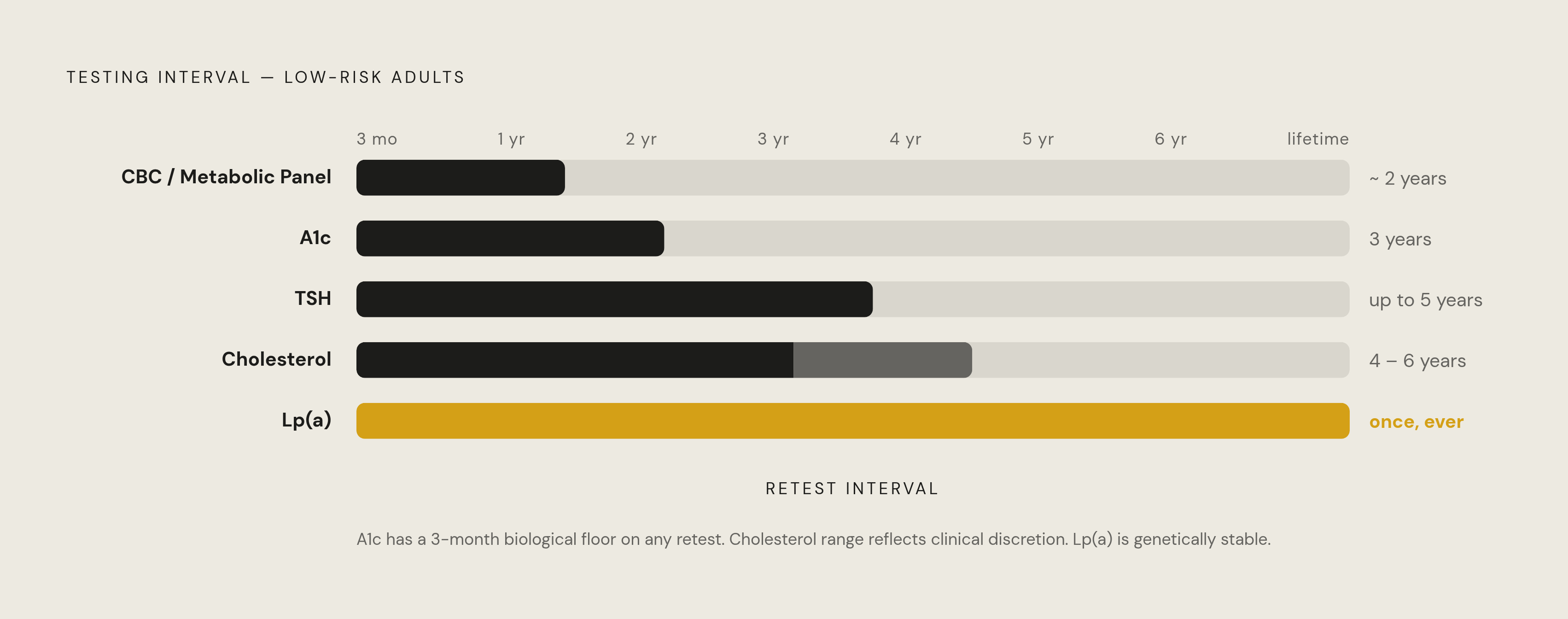
The full blood count and metabolic panel: workhorses with a two-year default that most people retest too often
For a healthy adult with no risk factors, no major guideline specifies a required screening interval for either one. The USPSTF takes no formal position for or against routine use of these tests in people without symptoms.
That absence of a mandate doesn't mean these panels are optional noise. For adults 65+, testing becomes roughly yearly as risk accumulates and more markers become clinically relevant, including the CBC. A metabolic panel tracks kidney function, liver enzymes, and electrolyte balance, all of which can drift quietly before a person feels anything different. What the lack of a guideline-mandated interval means is that these tests work best as part of the broader age-and-risk framework laid out earlier, rather than as an automatic yearly ritual bolted onto every physical regardless of age or risk tier.
The specific triggers that call for rechecking a CBC or metabolic panel sooner aren't vague. New fatigue, unexplained bruising or bleeding, a new medication known to affect kidney or liver function, unexplained weight loss, or a change in urination pattern all justify a recheck outside the standard interval. Someone managing a chronic condition, per the AHA's roughly every-three-months guidance for active monitoring, will naturally get these panels far more often than someone with no complaints and no flags.
Put together, the pattern across every marker in this guide repeats: cholesterol at four to six years for low-risk adults, A1c at three years with a three-month floor, TSH at up to five years before medication enters the picture, Lp(a) often just once in a lifetime. None of these numbers come from caution alone. Each reflects how fast the underlying biology actually moves, and the right frequency for any one person starts with matching the test to that pace rather than to the calendar.
Sources
- How Often Should You Get a Blood Test? Age & Risk Guide
- How often should you get blood testing?
- How Often Should You Really Get Blood Work Done?
- How Often to Get Blood Tests: 2026 Schedule
- How Often Should You Get Blood Tests? Frequency Guide by Condition
- Serum TSH level stability after 5 years in euthyroid adults at low risk for thyroid dysfunction
- 2026 ACC/AHA/AACVPR/ABC/ACPM/ADA/AGS/APhA/ASPC/NLA/PCNA Guideline on the Management of Dyslipidemia: A Report of the American College of Cardiology/American Heart Association Joint Committee on Clinical Practice Guidelines