Liquid Biopsy and Multi-Cancer Early Detection Tests for Low-Risk Adults
A blood test that detects multiple cancers struggles to catch early-stage disease.

Most standard cancer screening addresses four organs: breast, cervix, colon, and lung. Everything else, from the pancreas to the ovaries to the esophagus, has no routine screen at all. An MCED test uses one blood draw to look for many cancers at once, closing that gap. The science behind them is real, the early evidence is mixed, and a clear-eyed read of both is the only way to decide what they're worth.
Why cancer's early-stage advantage makes blood-based screening worth taking seriously
The case for earlier detection is not marketing language. It is a direct consequence of how cancer biology works, and liquid biopsy is the most technically plausible approach yet developed to act on it. Conventional single-cancer screens each address only one cancer type. Low-dose CT covers the lungs. Mammography covers the breast. Colonoscopy covers the colon and rectum. Each one needs its own procedure, schedule, preparation, and follow-up. Most cancer types remain entirely unmonitored.
That is the gap MCED tests are built to fill. The biological logic behind them is straightforward: tumors continuously shed DNA fragments into the bloodstream, and those fragments carry cancer-specific epigenetic signatures. Modern sequencing can read those signals from a single blood draw. The promise is not a replacement for existing screening but coverage where no screening currently exists.
Catching cancer at Stage I rather than Stage IV changes the arithmetic of treatment. A tumor caught before it has spread is more likely to be removable, less likely to require systemic therapy, and far less likely to kill. The biology makes earlier detection worth pursuing. The technology that might make it possible is the subject of the next section.
How liquid biopsy and MCED tests actually work
The signal these tests read is not a genetic mutation but an epigenetic mark. That distinction shapes both what they can detect and why they sometimes fail. DNA methylation is a process in which a methyl group gets added to cytosine bases at CpG sites. It regulates gene expression. In cancer, the mechanism goes wrong in two directions at once: oncogenes get activated through hypomethylation, and tumor suppressor genes get silenced through hypermethylation. The epigenetic fingerprint of a tumor is distinctive.
Cancer-type-specific methylation signatures arise early in tumorigenesis. That timing is why cfDNA methylation is the leading approach for MCED, rather than mutation-based ctDNA. A mutation-based test has a specific confounder in older adults: a phenomenon called clonal hematopoiesis, in which non-cancerous blood cells acquire mutations that mimic cancer signals. This is especially prevalent in the elderly population, precisely the group most likely to be screened. Methylation-based approaches largely sidestep the problem because the epigenetic signatures are cancer-type-specific rather than mutation-based.
Machine learning is now indispensable to making these signals clinically actionable. Deep methylation sequencing, aided by an ML classifier, can detect tumor-derived signals at extreme dilution. In one comparison, the approach nearly doubled early-stage lung cancer detection compared to ultradeep mutation sequencing at high specificity. Liquid biopsy also encompasses more than cfDNA: circulating tumor cells, microRNAs, exosomes, and proteins are all analytes under study. But the core MCED technology reads methylation marks.
A positive MCED result is a cancer-signal detection, not a diagnosis. The test finds an epigenetic marker of tumor burden and points to a likely tissue of origin. Clinical workup is always required to confirm.
What the evidence actually shows about how well these tests perform
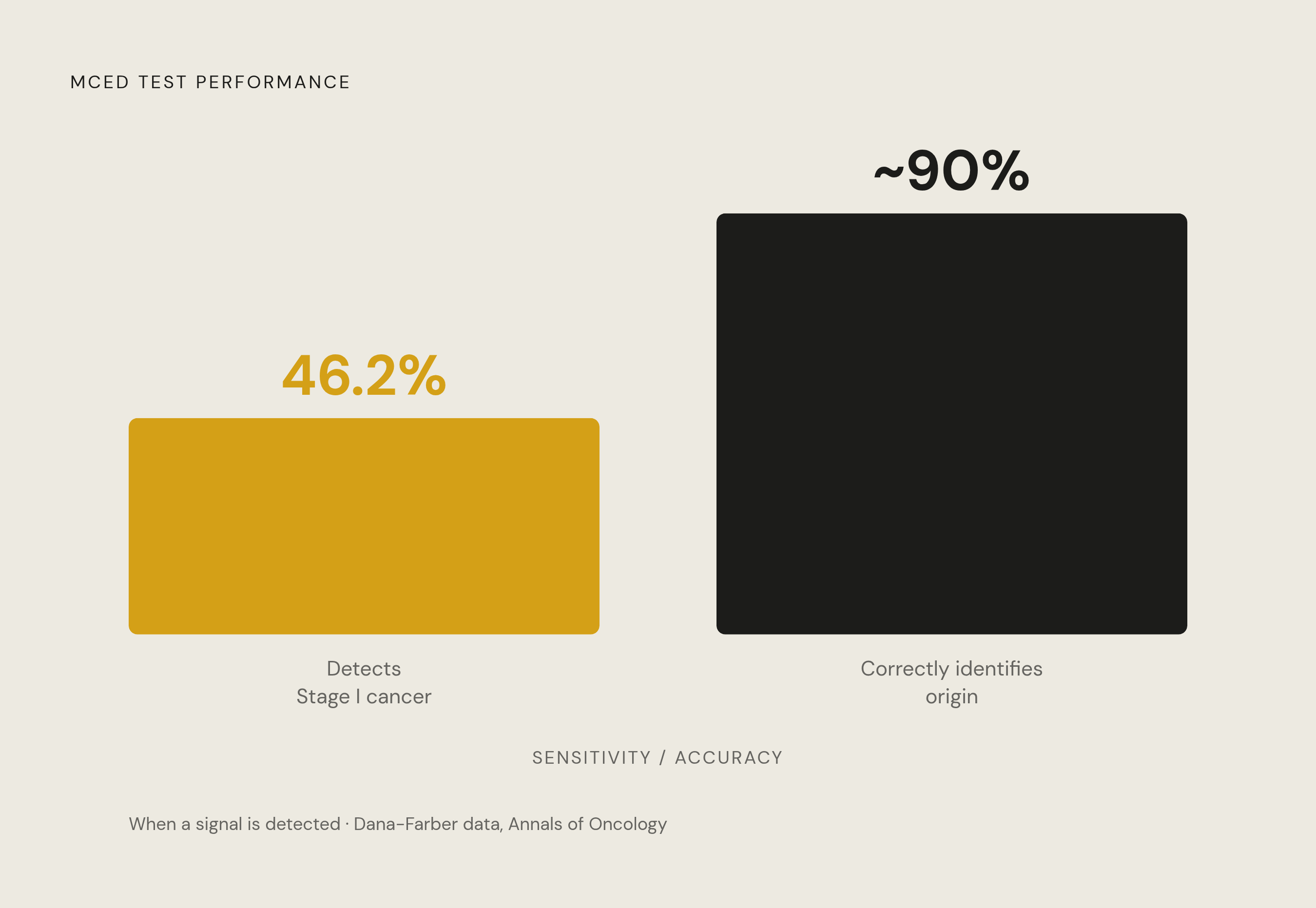
The tests are genuinely good at specificity and at identifying where a confirmed cancer originated. They perform worst at the very task low-risk adults most need: catching Stage I disease. The average sensitivity for identifying Stage I cancers across nine studies of nucleic-acid-based MCED tests was roughly half. One multi-study analysis put the figure at 46.2 percent. That is well short of what early detection requires, and it means a negative result leaves real uncertainty.
Specificity holds up better. The tests are highly specific, meaning few false positives relative to true negatives. But that statistic is less reassuring in a low-prevalence population, where even a small false-positive rate can generate more false alarms than true detections. The math of prevalence comes back with force in the section on what a positive result triggers.
When a signal is detected and the patient pursues workup, the tissue-of-origin prediction is accurate. In a 2025 study of Galleri tests, the test correctly predicted cancer signal origin in the vast majority of cases. At Dana-Farber Cancer Institute, a strong majority of patients who presented for clinical evaluation after a signal-detected MCED test were ultimately diagnosed with cancer, and the test accurately identified the first or second cancer signal origin in the vast majority of cases. Median time to diagnostic resolution was 20 days. The test knows where the cancer is coming from far better than it knows whether early-stage cancer is there at all.
The pre-diagnostic signal horizon adds another dimension. Changes in cfDNA methylation are detectable years before diagnosis in individuals who were cancer-free at blood collection. For breast cancer, hypermethylated enhancer regions distinguished future cases from controls and associated with future risk by tumor subtype and age. For prostate cancer, a high cfDNA methylome-predicted risk score meant a meaningfully higher chance of developing the disease than low-risk individuals had. In lung cancer, CDO1 methylation showed solid sensitivity and high specificity across seven pooled studies, with no significant heterogeneity across studies or geographic regions.
The NHS-Galleri trial and what it did — and did not — prove
The NHS-Galleri trial is the closest thing the field has to a definitive population-level test of MCED, and its results are simultaneously encouraging and sobering. The trial randomized a large cohort of adults aged 50 to 77 in England, one to one: Galleri plus usual care versus usual care alone, with blood stored untested in the control arm. The primary endpoint result was published in a leading medical journal in September 2026. Galleri plus usual care did not lower Stage III/IV cancer incidence more than usual care alone. The incidence rate ratio was 1.03, and the p-value was 0.63. The trial did not hit its primary endpoint.
The secondary endpoint was more interesting. Stage IV incidence was numerically lower in the Galleri arm, with an incidence rate ratio of 0.86. That trend did not reach statistical significance, but it is directionally consistent with an earlier stage shift. The contrast with PATHFINDER 2 makes the tension sharper: adding Galleri to USPSTF-recommended screening resulted in more than a six-and-a-half-fold increase in cancer detection. That striking detection uplift did not translate, in the NHS trial, into a significant reduction in late-stage diagnoses.
Detecting more cancer is not the same as detecting it early enough to change outcomes. This divergence is the most important honest framing for low-risk adults. The trial should not be read as a vindication of MCED, nor as a refutation. It is a precise measurement of a real gap between detection and outcome.
Why "no proven mortality benefit" does not mean the same as "does not work"
The absence of a mortality trial result reflects the timeline of cancer biology and trial design, not a verdict on the technology's value. Mortality trials require years of follow-up after diagnosis, then years more to count deaths. An MCED test validated today would not show mortality impact in trial data for a decade or more. The question remains open because the clock has not run out.
The overdiagnosis concern is legitimate and distinct from the mortality question. H. Gilbert Welch of Brigham and Women's Hospital's Center for Surgery and Public Health argues that screenings, including MCEDs, can detect indolent cancers that would rarely cause symptoms or death, leading to unnecessary treatment, cost, and anxiety. That is a real risk, not a fringe view. No honest assessment of MCED can wave it away.
There is a counterargument, and it deserves equal weight. The cancers MCED most reliably detects at higher stages, where sensitivity is stronger, are precisely the cancers most likely to be lethal if caught late: pancreatic, ovarian, and esophageal cancers with no standard screening. Detecting one of these at Stage II rather than Stage IV is a clinically meaningful shift, even without a completed mortality trial. The right posture is to hold the question open, not to reach a confident verdict in either direction.
What a positive result actually triggers, and why that matters for low-risk adults
For a low-risk adult, the downstream consequences of a positive MCED result matter as much as the probability of true cancer. The two are linked by the math of low-prevalence testing. Real-world data show that a majority of positive tests were false positives, and the positive predictive value was roughly in the 38 to 41 percent range depending on test version. Nearly a third of those false positives led to invasive procedures. A positive result starts a cascade.
Why does this happen in a highly specific test? In a low-risk population where cancer is uncommon, even a test with excellent specificity will generate false positives that outnumber true positives. That is not a flaw in the test. It is a mathematical consequence of testing a low-prevalence population. The fewer people who actually have cancer, the more the false positives dominate among all positive results.
A negative result also requires careful interpretation. Given the roughly half Stage I sensitivity, a negative does not rule out early cancer. It reduces probability, which is meaningful, but it is not reassuring enough to skip other indicated screening. A negative result should join colonoscopy, mammography, and low-dose CT, not replace the thinking behind them.
Where the regulatory and clinical guideline landscape stands
No MCED test has FDA approval or a clinical guideline endorsement, but one single-cancer cfDNA test has cleared FDA review. That establishes the regulatory pathway as real, not theoretical. Guardant Health's Shield blood test, a methylation-partitioning test that also analyzes fragmentomic and genomic signals, received FDA approval for colorectal cancer screening. It is a single-cancer test, not a multi-cancer panel, but it is the first FDA-approved cfDNA screening test and marks a meaningful regulatory precedent.
GRAIL submitted a premarket approval application to the FDA for Galleri in January 2026 and holds Breakthrough Device designation. The company's SEC filing confirms no version of Galleri has been approved or cleared by the FDA, and obtaining PMA approval can take several years. As of mid-2026, no MCED test is endorsed by any clinical practice guideline or recommendation body.
The NCI Vanguard Study, part of the NCI Cancer Screening Research Network, enrolled thousands of participants and confirmed the feasibility of implementing MCED tests in real-world settings across diverse populations. That is infrastructure-building for future large-scale randomized trials, not a clinical recommendation. For a low-risk adult today, the practical meaning is clear: MCED tests are commercially available and legal to purchase, but they are not standard of care, not reimbursed by most insurers, and not yet backed by guideline-endorsed protocols for managing results.
How to think about MCED testing if you are a healthy adult who wants to be proactive
The right question is not "should I get an MCED test?" but "what would a positive or negative result change about my next steps, and am I prepared to follow through on either answer?" MCED testing makes the most sense as a supplement to existing indicated screening, not a replacement for it. MCED adds coverage for cancer types that have no standard-of-care screen, while existing screens remain superior for the cancers they target. The two approaches do different jobs.
Personal risk context matters. Someone with a strong family history of a cancer type that currently lacks screening, such as pancreatic or ovarian cancer, has a more defensible rationale for MCED than a person at population-average risk with no family history. The evidence base for either group is still maturing, but the asymmetry in rationale is real.
Prepare for a positive before you test. Know in advance that a signal-detected result initiates a workup, not a diagnosis. Have a clinical relationship in place to guide that workup. Understand that resolution may take weeks and involve additional imaging or biopsy. The Dana-Farber data, with a median time to diagnostic resolution of 20 days and accurate tissue-of-origin prediction, should shape expectations: the process is finite and usually concludes with clarity, but it is not instant.
Prepare for a negative before you test, too. A negative does not clear you. Average Stage I sensitivity across nucleic-acid-based MCED tests was 46.2 percent in one multi-study analysis, so early cancers can be missed. A negative result should reinforce other screening and healthy behavior, not replace them. The decision to test is most useful when made with a clinician who can contextualize your personal risk, explain what a result would and would not mean, and help manage whatever the result shows. A clinician who specializes in preventive, biomarker-driven care is better positioned to do this than a general practitioner managing the result for the first time.
Being an informed decision-maker here means holding the technology's promise and its limits at the same time. The biology is real. The sensitivity gap is real. The regulatory lag is real. The tissue-of-origin accuracy is real. You do not have to resolve any of these tensions to make a sound decision. You only have to know they exist, know what a positive or negative result would set in motion, and choose with your eyes open.