Biological Age Tests and Epigenetic Clocks Explained
These tests measure DNA methylation patterns, not how long you'll actually live.
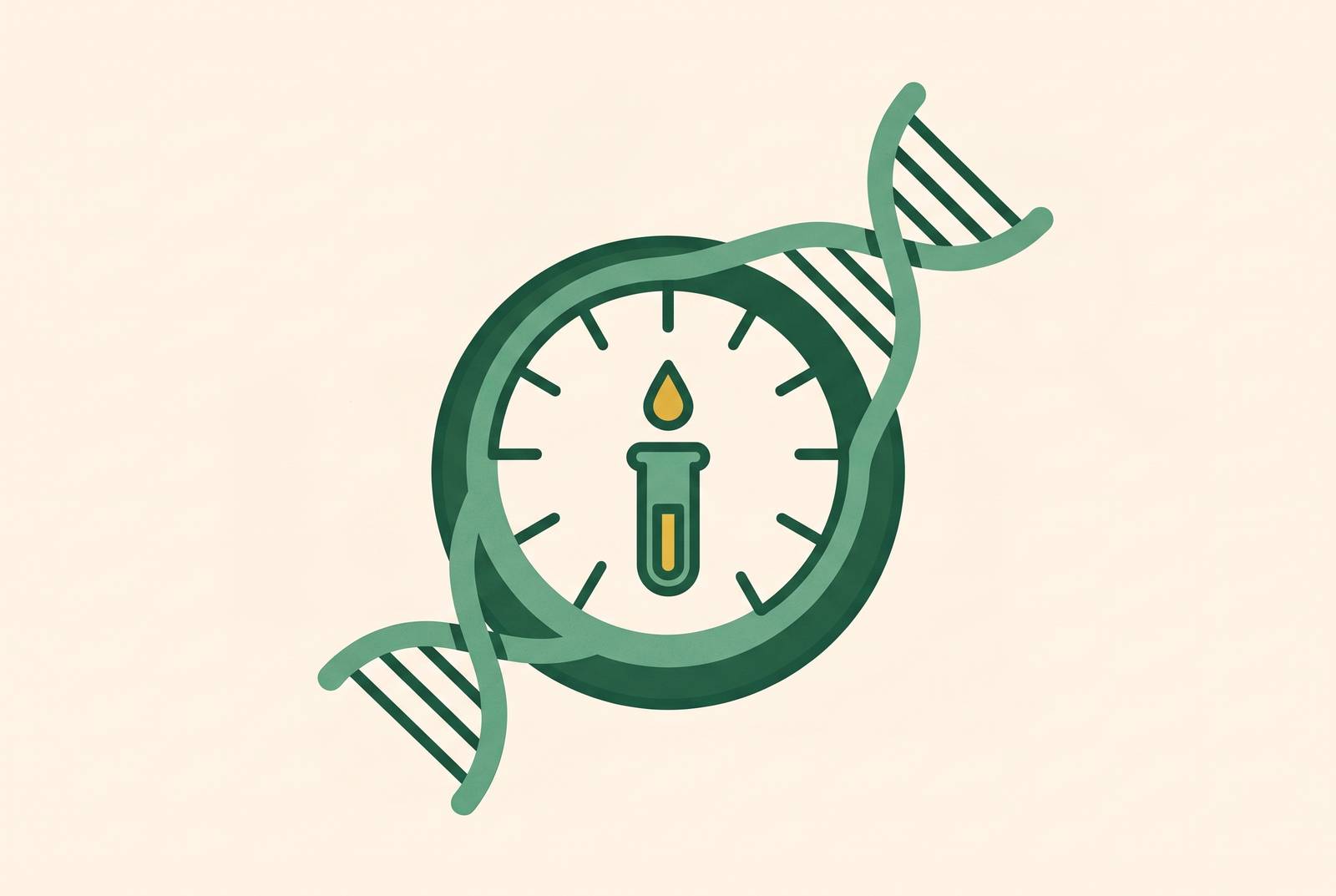
Biological age tests exist because the number on a driver's license says almost nothing about how a body is actually holding up. Chronological age counts years. Biological age tries to measure something harder to pin down: the wear and tear on cells, the strain on organs, how vulnerable a person has become to disease.
Stanford Medicine researchers put the problem in a simple comparison. Line up a handful of 60-year-olds and some are on a path that leads comfortably past 100, while others are on a path that ends within a few years. The calendar can't tell those people apart. It treats all of them the same, because it only counts time, not condition.
That's the gap biological age tries to fill. A biological age score is meant to describe a trajectory, how fast the underlying processes of aging are unfolding in that particular body. Researchers separate this from two related ideas: lifespan, meaning years alive, and healthspan, meaning years spent in good health. Stanford researchers are candid that the links between biological age, lifespan, and healthspan are still being worked out, not settled fact.
That unresolved science hasn't slowed the market down. Stanford neuroscientist Tony Wyss-Coray describes the current landscape of consumer tests as "a bit like the Wild West," with companies selling tests alongside products that have never gone through a clinical trial. No direct-to-consumer biological age clock has FDA approval as a medical diagnostic. These are sold as wellness or informational products, a regulatory fact to know before deciding how much weight to put on a number.
Reading epigenetic clocks from blood or saliva
Most biological age tests on the market are epigenetic clocks, and what they measure is narrower and stranger than most marketing suggests. They read DNA methylation: chemical tags attached to specific spots in the genome called CpG sites (short for cytosine-guanine dinucleotide). These tags turn genes up or down without altering the DNA sequence itself, and they shift in partly predictable ways as a body ages.
A blood or saliva sample gets processed to check methylation status across hundreds of thousands of these CpG sites. An algorithm then takes that pattern and compares it to a reference population, producing an age-like number. That number is a similarity score. It answers the question: how closely does this person's methylation pattern resemble the patterns seen in people of different ages in the data the algorithm was trained on? It is not a direct readout of how old someone's organs feel, and it is not a countdown to anything.
An eBioMedicine editorial notes that methylation changes at CpG islands now get used widely to predict disease risk, track exposures, and monitor age-related physiological decline. The same editorial adds an important caveat: most clocks build their predictive power from correlation, not causation. They notice patterns that travel together with aging. They don't necessarily explain what's driving those patterns.
Sample type adds another layer of variation, and most people never hear about it. Blood is the most common sample because most clocks were trained on blood data. Saliva and cheek swabs carry different mixtures of cell types, and that changes the methylation pattern in ways that make comparing results across sample types unreliable. Even within blood, the mixture of immune cells shifts constantly. An infection, a vaccination, an inflammatory flare, or a stretch of acute stress can all change that mixture and move a clock reading without reflecting any real, lasting shift in biological age. HealthE1 Medical recommends testing during a stable baseline and writing down recent illness, hard training blocks, and sleep disruption, so short-term immune noise doesn't get mistaken for a long-term trend. Technical processing in the lab can shift some clock estimates by several years even when the underlying biology hasn't changed. Newer, principal-component methods cut down this noise, but plenty of consumer reports still rely on the older, noisier ones.
Why three generations of clocks answer three different questions
Picture one person taking three different biological age tests from a single blood draw: you get three different numbers back. That's not a sign something went wrong with the lab work: clocks come in generations, and each generation was built to answer a different question.
First-generation clocks were built to predict chronological age itself, so they basically reverse-engineer the number already printed on a driver's license. Second-generation clocks, among them PhenoAge and GrimAge, were trained on something else: predicting mortality and disease outcomes. PhenoAge folds in markers tied to immune function, liver function, and metabolism. GrimAge goes further: it aims squarely at mortality risk and future disease risk rather than age for its own sake. Stanford Medicine News calls GrimAge "perhaps more informative" for clinical purposes, precisely because it was built around the biology that predicts disease rather than the biology that predicts a birth year.
Third-generation clocks, DunedinPACE being the clearest example, ask a different question again: not how old is this person's biology, but how fast is it currently changing? That's a meaningfully different kind of output. A static age estimate tells you where someone stands right now. A pace-of-aging measure tells you which direction they're heading and how quickly. DunedinPACE picks up on relatively short-term shifts in aging processes, which makes it useful for a question the other generations can't really answer: is a given change in diet, exercise, or sleep actually doing anything measurable?
That three-generation framework explains what researchers found in a Nature Communications analysis, cited in eBioMedicine's 2026 editorial, when they compared 14 different clocks against 174 disease outcomes. Effect sizes varied substantially. The number of significant associations varied substantially. No single clock came out on top across the board. That's what you'd expect when 14 tools are built to answer different questions and then get graded on the same test.
Why different clocks give the same person different numbers
Once you see the three-generation structure, clock disagreement stops looking like a flaw and starts looking like information. Different algorithms are asking genuinely different things of the exact same methylation data.
One clock asks how old this pattern looks relative to the calendar. Another asks how closely this pattern resembles people who developed cardiovascular disease or died early. A third asks how fast this particular pattern is shifting right now. Three distinct biological questions, asked of the same sample, will reasonably produce three distinct answers.
Tools like TEAPEE, mentioned in eBioMedicine's 2026 editorial, let researchers explore how different clock models relate to a wide range of health traits. What that research consistently shows is how much a result depends on the specific algorithm and the specific population it was trained on. Sex adds another wrinkle. The same editorial notes that male and female individuals follow distinct epigenetic aging trajectories, but most commercial reports don't consistently account for that difference. Tissue type matters too. Most clocks are trained on blood or saliva, and the brain, liver, and muscle can age at different rates from what a blood sample shows. A single number from a blood draw can't tell you what's happening in organs that weren't sampled.
So what should someone actually do when two tests disagree? The useful move is to ask which clock's underlying question matters most for the situation at hand, rather than averaging the two numbers or throwing both out. Someone trying to understand cardiovascular risk gets more out of a mortality-trained, second-generation clock like GrimAge than a first-generation clock built to guess chronological age. Someone trying to find out whether a new exercise habit or diet change is working gets more out of DunedinPACE's pace-of-aging number than a static age estimate, because pace is what's built to catch that kind of short-term shift.
Which lifestyle factors the research shows move these clocks
None of this interpretation matters much if the underlying scores are just noise. They don't appear to be. Across independent studies, a consistent set of modifiable, everyday health behaviors appears repeatedly as the strongest driver of epigenetic age acceleration, and that consistency gives these scores real predictive weight.
A longitudinal, multi-cohort study published in eBioMedicine found that smoking, higher BMI, elevated glucose, and poor blood pressure control all sped up aging as measured by DunedinPACE. Physical activity and a healthier diet slowed it down. People who shifted onto a faster-aging trajectory also tended to show worsening cardiovascular profiles over time, confirming what the clock was designed to measure.
A related study in BMC Medicine, cited in the same editorial, found that favorable cardiovascular health links to lower epigenetic age acceleration, with some differences by sex. Avoiding nicotine and keeping glucose regulated were stronger predictors in male individuals. Physical activity, glucose regulation, and a healthy BMI mattered more in female individuals.
The disease associations extend past cardiovascular risk. A systematic review and meta-analysis covering 13 studies found that people with accelerated biological aging, as measured by epigenetic clocks, were consistently more likely to have had a stroke, with a stronger association for a first stroke than for a repeat one. That pattern suggests epigenetic aging is picking up on vascular vulnerability that standard risk factors don't fully explain. An eBioMedicine study on colorectal cancer combined longitudinal epidemiology, Mendelian randomization, and methylation analysis to find specific CpG sites whose methylation appears to influence colorectal cancer risk through changes in gene expression. Accelerated biological aging showed stronger predictive value specifically for early-onset colorectal cancer, tying epigenetic drift to cancer risk earlier in life than expected. Research out of the Framingham Heart Study found that a faster DunedinPACE tracks with accelerated cognitive aging in older adults, which makes it a candidate tool for testing whether interventions aimed at Alzheimer's disease and related dementias are actually working.
The standard biomarkers doctors already track, blood glucose, BMI, blood pressure, smoking status, map closely onto what these clocks are picking up, which ties all of this together. Anyone already getting routine bloodwork has more context on their own biological age than they might realize. ApoB is a good example of why. It measures the actual particles responsible for arterial damage, and it predicts cardiovascular risk more accurately than LDL alone because it counts every one of those damaging particles directly, rather than estimating their number indirectly. Cardiovascular health keeps coming up as the single strongest modifiable predictor of epigenetic age acceleration across these studies, and that's not a coincidence. The same molecular pathways that drive inflammation, insulin resistance, and vascular damage are the pathways that also speed up methylation drift.
The gap between the science and the marketing
As useful as these findings are, epigenetic clocks remain research tools first, and the leap from research tool to individual clinical guidance has outpaced what the validation science can currently support. Anyone using a score to make real health decisions should know where that gap sits.
A commentary in npj Aging, titled "Do We Actually Need Aging Clocks?" cited in eBioMedicine's 2026 editorial, argues that the basic definition of biological age is still unsettled. Every clock defines its own version of what "biological age" even means. Validation isn't consistent across clocks or across the populations they're tested on. Clinicians and patients almost never see the prediction uncertainty, the margin of error around any given score.
There's a real difference between what these clocks are good at and what they're being sold to do. Across thousands of people, they reveal reliable trends. For one individual, they can't yet say with much confidence that a given score reflects a meaningful health risk rather than ordinary technical variation or just an unusual methylation profile. No direct-to-consumer epigenetic clock has FDA approval as a diagnostic tool. These are regulated as wellness products, so the clinical weight a consumer puts on the number carries no regulatory backing behind it.
There's also a specific population where these tests can mislead badly: cancer patients. Blood samples from people with cancer show DNA methylation patterns that look different from the patterns tied to ordinary physiological aging, so they can overestimate DNA methylation age substantially. The size of that overestimation depends heavily on cancer type. It runs extreme in blood cancers like leukemia and comparatively modest in solid tumors. If you're managing a serious illness alongside a biological age test, you should treat the number with real caution rather than alarm.
The honest response to all of this is to get sharper about how to read a score, which is what the limitations above point toward.
Treating a biological age score as a signal rather than a verdict
Put the pieces together: a workable approach emerges. A biological age score is a data point worth paying attention to; it is not a medical verdict to build decisions around on its own.
Start with the generation of the clock before trusting the number. A score from a first-generation clock answers a different question than a score from GrimAge or DunedinPACE, and knowing which question got asked changes how much weight the answer deserves.
Track direction over time rather than fixating on a single reading. One score, taken once, carries all the noise that comes with sample type, immune state, and lab processing. A series of scores, taken under similar conditions, starts to show a trend, and trend is closer to what these tools were actually built to capture.
Control for the noise that's controllable. Testing during a stable baseline, away from recent illness, intense training blocks, or major sleep disruption, helps separate a temporary immune blip from an actual shift in biological aging.
Treat the result as a prompt for a conversation rather than a standalone diagnosis. Given how often primary care physicians get asked to interpret these scores without the training to fully contextualize them, pairing a biological age result with standard bloodwork, like glucose, blood pressure, BMI, and lipid markers, gives both patient and doctor more to work with than the score alone.
Weigh the result against context that matters. Sex-specific differences in aging trajectories, tissue limitations in blood-based tests, and conditions like active cancer can all shift what a given number actually means for a given person.
None of that makes biological age testing a gimmick. It makes it what the underlying science actually supports: a genuinely useful signal about modifiable, measurable biology, read with the same care any complex lab result deserves.
Sources
- Epigenetic clocks: advancing biological age measures towards meaningful clinical use
- Epigenetic clocks: advancing biological age measures towards meaningful clinical use - eBioMedicine
- What biological age tests can
- An unbiased comparison of 14 epigenetic clocks in relation to 174 incident disease outcomes
- Biological age acceleration measured by DunedinPACE associates most consistently with cognitive decline in elderly individuals
- Biological age versus chronological age: What the science says