ApoB as a Cardiovascular Risk Marker Beyond Standard Cholesterol
Particle count, not cholesterol mass, better predicts cardiovascular risk from blood lipids.

Standard cholesterol panels count the wrong thing. They tell you how much cholesterol is packed inside your blood's fat-carrying particles, but plaque formation is driven by how many particles you have, not how much cholesterol each one is hauling. Apolipoprotein B, or ApoB, measures that particle count directly. The gap between those two numbers is where a lot of cardiovascular risk hides in plain sight.
Most people never see ApoB on a lab report. A typical panel gives total cholesterol, HDL, triglycerides, and LDL-C, plus maybe a ratio or two. LDL-C is the number everyone fixates on, and in most cases it is a calculated estimate rather than a direct measurement. It's calculated with the Friedewald equation: total cholesterol minus HDL, minus triglycerides divided by five. That formula estimates the mass of cholesterol sitting inside LDL particles. It says nothing about how many particles are actually carrying it.
That gap matters most for people whose triglycerides fall outside the typical range. The Friedewald equation leans on a fixed ratio between triglycerides and VLDL cholesterol, and that ratio doesn't hold for everyone, so the math gets shaky when triglycerides run high or very low. Even when the math works fine, the equation only accounts for LDL. It ignores cholesterol carried by VLDL, IDL, and Lp(a), all of which contribute to plaque. So the number patients have been told to watch for decades is an estimate of one slice of the problem, built on an assumption that doesn't always apply to the person in front of the doctor.
What ApoB measures and why particle number is the driver of plaque
ApoB is a structural protein sitting on the outer shell of every atherogenic lipoprotein. Here's the detail that makes it useful: each particle carries exactly one molecule of it. Not zero, not three. One.
Four particle types carry ApoB on their surface. VLDL is large and mostly ferries triglycerides. IDL is a mid-sized precursor to LDL. LDL itself is smaller and delivers cholesterol to tissues throughout the body. Lipoprotein(a), or Lp(a), is also small and also delivers cholesterol, but it carries its own added risk on top of that.
Because the ratio is fixed at one ApoB molecule per particle, measuring ApoB counts particles directly. That fixed ratio is the entire argument for why ApoB deserves more attention than it gets, and it's a simple one once you see it.
Consider what actually happens at the artery wall. A particle has to physically get in, lodge there, and start the inflammatory cascade that builds plaque. More particles means more chances for that to happen. A cholesterol-poor particle can wedge into the endothelium and kick off the same process as a cholesterol-rich one, so someone with lots of small, cholesterol-light LDL particles can carry real atherosclerotic risk while their LDL-C reads perfectly normal. Cholesterol content isn't what does the damage here. Traffic is.
The Discordance Evidence on ApoB and LDL-C Disagreement
Researchers call this mismatch discordance: cases where ApoB and LDL-C, which usually move together, pull apart, and one of them turns out to be the better predictor. Study after study lands on the same side of that split.
A 2025 systematic review in the Journal of Clinical Lipidology searched PubMed and pulled together 15 studies covering 593,354 people. ApoB beat LDL-C in every single one, 9 out of 9. It beat non-HDL-C in 7 out of 9. The review's conclusion was blunt: ApoB should be the primary measure used in clinical care to judge cardiovascular risk from these particles, and to judge whether lipid-lowering therapy is actually working.
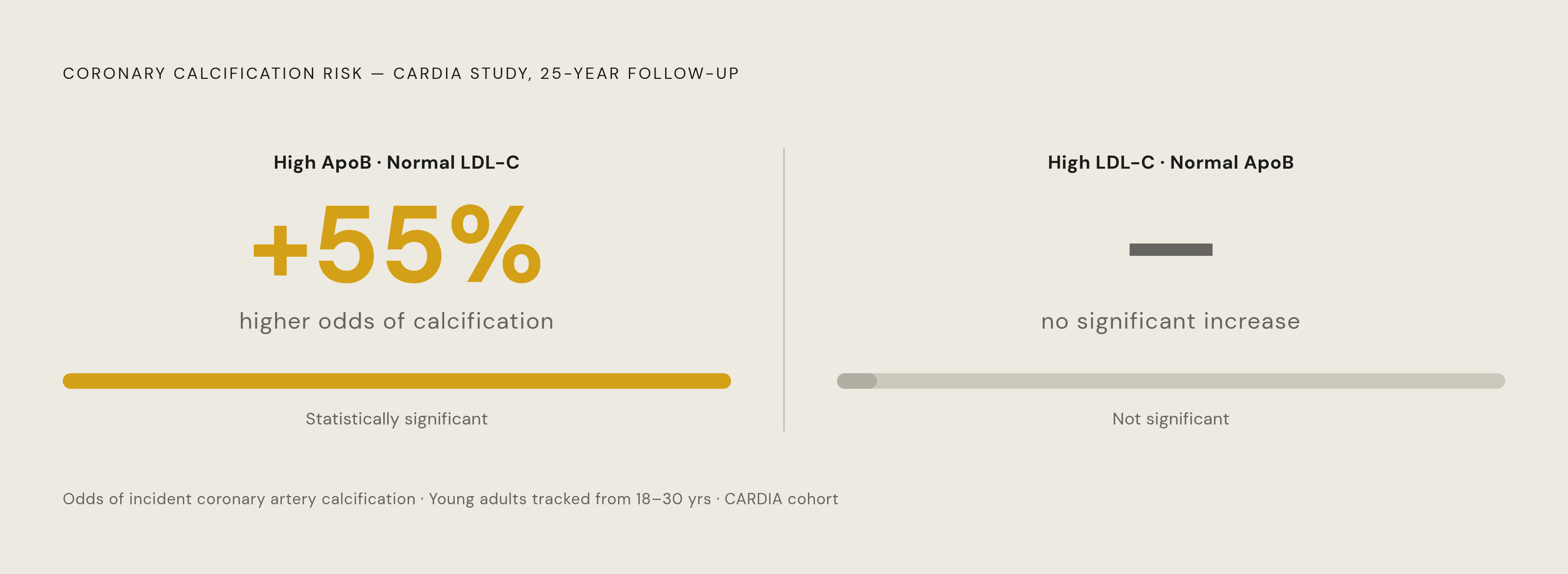
The CARDIA study adds a longer runway. Researchers measured LDL-C and ApoB in adults aged 18 to 30, then tracked coronary artery calcification with CT scans 25 years later. Young adults with high ApoB but normal LDL-C had 55% higher odds of developing calcified plaque. Flip it around: young adults with high LDL-C but normal ApoB showed no statistically significant bump in risk.
Sit with that asymmetry for a second. If cholesterol mass were the real driver, both discordant groups should carry elevated risk. Only one did. Risk moved with particle count, not cholesterol payload, and it moved that way over a quarter century of follow-up.
A UK Biobank study pushes the finding further. Even a mismatch as small as 2% between ApoB and LDL particle number (LDL-P) tracked with higher cardiovascular risk, but only in one direction: when ApoB ran higher than LDL-P. LDL-P alone didn't reliably predict events. ApoB did.
The evidence base has been building for a while now, and practice still hasn't caught up. If the data keeps pointing the same direction study after study, why does the standard panel still leave ApoB off by default?
Who Standard Cholesterol Panels Are Most Likely to Miss
Roughly 15% to 20% of people have elevated ApoB alongside a normal-looking standard cholesterol panel. That's somewhere between one in seven and one in five people walking around with atherogenic particles accumulating quietly, while the test their doctor ordered says everything's fine.
Almost nobody gets checked for it. Fewer than 1% of the insured population gets ApoB tested in a given year. The group most likely to need this test is also the group least likely to get it.
Discordance isn't random. It tends to appear in people with conditions associated with metabolic dysfunction, such as metabolic syndrome and type 2 diabetes. Notice that these risk factors overlap substantially with metabolic dysfunction, which is exactly where LDL-C tends to lose its footing as a reliable signal.
A systematic review in the Journal of Clinical Lipidology confirmed significant discordance between LDL-C and ApoB specifically in people with metabolic syndrome or type 2 diabetes. Some of these people hit their LDL-C targets on paper, treatment working exactly as intended on the number their doctor is watching, while ApoB stays elevated the entire time. The standard panel says success. The particle count says otherwise, and the particle count is the one tied to plaque.
How guidelines have shifted, and what the 2026 AHA/ACC update says
The rest of the world moved on this before the United States did, and by a wide margin. In 2019, the European Society of Cardiology and the European Atherosclerosis Society concluded that ApoB is a more accurate cardiovascular risk marker than either LDL-C or non-HDL-C. In 2021, the Canadian Cardiovascular Society went further, recommending ApoB (along with non-HDL-C) as the preferred measure over LDL-C for anyone with triglycerides above 1.5 mmol/L, and as generally preferable for interpreting lipid results overall, though LDL-C stayed part of standard screening.
US guidelines caught up in March 2026, with the AHA/ACC Multisociety Dyslipidemia Guideline. It gives ApoB measurement a Class 2a recommendation for adults already on lipid-lowering therapy, with specific call-outs for people with atherosclerotic cardiovascular disease (ASCVD), cardiovascular-kidney-metabolic (CKM) syndrome, type 2 diabetes, or elevated triglycerides. The guideline's own language frames ApoB testing as "reasonable to guide decisions regarding therapeutic intensification once LDL-C and/or non-HDL-C goals are achieved."
That line marks a real shift in how success gets defined. A patient can hit an LDL-C target and still get told to intensify treatment, if ApoB shows residual risk sitting there underneath a clean-looking panel. The guideline cites studies showing ApoB predicts ASCVD risk more accurately than LDL-C precisely in the cases where the two numbers diverge, the same discordance pattern turning up study after study.
Zoomed out, the 2026 guideline retires the old LDL-C-centered model in favor of something broader: non-HDL-C, ApoB, Lp(a), triglyceride-rich lipoproteins, inherited lipid disorders, and severe hypertriglyceridemia, all treated as co-equal pieces of the risk picture rather than LDL-C plus footnotes.
Lp(a) gets its own milestone in the same document. Universal Lp(a) testing gets a Class I recommendation for the first time in a major US dyslipidemia guideline: every adult should get it measured at least once. ApoB and Lp(a) now sit at the same level of clinical standing, which says something about how far the field has moved away from cholesterol mass as the only thing worth tracking.
ApoB Numbers in Practice: Normal, Optimal, and High-Risk Thresholds
Numbers drift upward with age, same as most cardiovascular markers do. Median ApoB in adults aged 18 to 29 is around 76 mg/dL. By age 70 and up, that median climbs to roughly 88 mg/dL.
Lab reports usually flag below 100 mg/dL as the normal range. Normal and optimal are not the same thing, though, and treating them as interchangeable is where a lot of people get misled by a clean-looking report. Evidence points toward keeping ApoB below 80 mg/dL as a better target for adults at lower baseline risk. Unlike markers that behave fine within a range and only become a problem past some cutoff, ApoB's relationship with cardiovascular risk is continuous: lower tracks with better outcomes across the entire scale, not just once you cross a threshold.
The 2026 AHA/ACC guideline and the European Society of Cardiology set risk-tiered targets that differ slightly from each other:
- Very high risk: below 55 mg/dL (AHA/ACC) or below 65 mg/dL (ESC)
- High risk: below 70 mg/dL (AHA/ACC) or below 80 mg/dL (ESC)
- Moderate risk: below 100 mg/dL (AHA/ACC and ESC)
Elevated ApoB well above guideline targets is increasingly treated as a signal for more aggressive primary prevention, even before disease shows up on imaging. For people at very high risk or with established cardiovascular disease, guideline targets reach as low as below 55 mg/dL (AHA/ACC) or below 65 mg/dL (ESC).
How to get tested and what it costs
ApoB isn't included on a standard lipid panel by default. It has to be ordered on its own, or bundled into a more advanced cardiovascular panel.
One practical upside: no fasting required. ApoB is measured directly rather than calculated from other numbers, so it can be drawn at any time of day, with no 12-hour fasting window to plan around.
In most US states, a doctor's referral isn't legally required either. Direct-access lab testing is widely available, so the test is reachable even for someone whose physician has never brought it up.
Cost depends on how it's ordered. As a standalone test paid in cash, ApoB typically runs $21 to $69. Bundled into a broader cardiovascular panel, cash pricing runs $190 to $689. Those figures reflect what the test costs when insurance never enters the conversation. Routed through insurance billing instead, list prices tend to climb well past that range, which is worth checking before assuming the insured path is the cheaper one.
Sources
- ApoB, LDL-C, and non-HDL-C as markers of cardiovascular risk - Journal of Clinical Lipidology
- ApoB, LDL-C, and non-HDL-C as markers of cardiovascular risk - ScienceDirect
- Cutting ApoB by 10 mg/dL drops heart disease risk by 9%
- Why ApoB is more accurate than LDL cholesterol
- Guideline on the Management of Dyslipidemia - Professional Heart Daily | American Heart Association
- empirical.health
- bloodtestcomparison.com
- acc.org