How to Sequence Lab Tests Over the First Year
Spacing out tests throughout the year catches metabolic shifts the annual panel misses.

Running every biomarker once a year, all in one draw, misses the actual point of lab work. The goal is catching direction before disease appears in the numbers, which only happens when tests are sequenced so each draw builds on the one before it. A fasting glucose of 99 mg/dL sitting inside the "normal" range tells you almost nothing by itself. Was it 85 two years ago? Is fasting insulin already climbing to compensate? A standard annual physical was never built to answer either question, and that gap is why a sequenced plan catches rising or falling risk over time, while one comprehensive panel only ever catches a single moment.
What the baseline draw must accomplish first
The baseline is the number every future draw gets measured against. Draw it before starting anything new: no diet change, no supplement, no medication adjustment. A clean starting point is what makes every later comparison mean something, and a baseline drawn mid-intervention just muddies the water for a year.
A proper baseline covers more ground than the three or four things a standard metabolic panel checks:
Metabolic: fasting glucose, HbA1c, and fasting insulin, the marker most panels skip. Insulin and glucose together let you calculate HOMA-IR, a rough measure of insulin resistance.
Lipids: a standard lipid panel plus ApoB and Lp(a), both of which carry more weight in current cardiovascular guidance than they did a few years back.
Inflammation: hs-CRP.
Organ function: a complete metabolic panel covering kidney and liver markers and electrolytes, plus a CBC.
Thyroid: TSH, free T4, free T3, and thyroid antibody markers.
Nutrients: ferritin alongside hemoglobin (iron deficiency can cause fatigue well before anemia appears on a standard blood count), 25-OH vitamin D, and B12.
Hormones, if symptoms are present or age warrants it: sex hormones and related markers such as testosterone, estradiol, and cortisol.
Fasting matters for some of these and not others. Glucose, insulin, and lipids generally call for a fasting draw, though non-fasting lipid testing has become standard for plenty of patients now. Thyroid markers don't need fasting at all, but drawing everything at one visit is just simpler.
Pick one lab network and stay with it for the whole year. This is where most people get it wrong, and it's not a minor detail. The two major commercial labs run different analyzers and use different reference intervals, so a result flagged "high" on one can read "normal" on the other. Switching labs mid-sequence doesn't just add noise. It erases the entire point of tracking a trend, because the trend line is now measuring a lab's calibration instead of a body.
Two markers the baseline almost always misses
Two tests get left off standard panels more often than any others, and both belong at baseline because waiting for them costs something real.
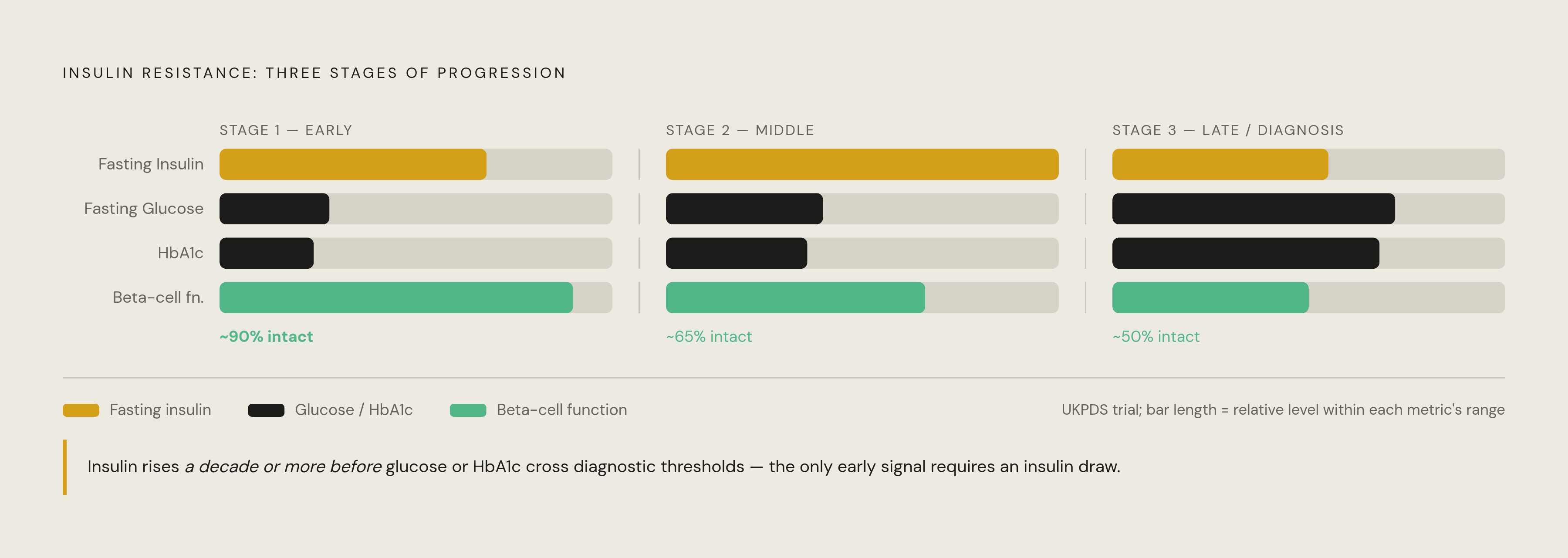
Fasting insulin catches insulin resistance long before glucose or HbA1c move. By the time fasting glucose crosses 100 mg/dL or HbA1c hits 5.7%, the pancreas has likely been overproducing insulin for years. Data from the UKPDS trial suggests up to 50% of beta-cell function may already be gone by the time a conventional diagnosis lands. Fasting insulin can flag the problem a decade or more earlier, while glucose and HbA1c still read completely normal.
The pattern runs in stages. Early on, glucose and HbA1c are in normal range because the pancreas is compensating, pumping out more insulin to hold the line. That's the window where lifestyle changes actually work, and it's invisible without an insulin draw. Later, as compensation starts failing, glucose and HbA1c drift upward, triglycerides climb, and HDL drops. Standard reference ranges get built from a population where most adults are already metabolically unwell, so "normal" on a lab report and "optimal" for one person aren't the same number. Ask for fasting insulin by name. Most panels leave it out unless someone specifically requests it.
Lp(a) is the other one, and it only needs to be drawn once. The 2026 ACC/AHA Dyslipidemia Guideline gives universal Lp(a) testing a Class I recommendation for the first time in a US guideline, so every adult should get it measured at least once in their life. Lp(a) is set genetically. Diet and lifestyle barely move it, so unlike almost everything else on this list, one number covers a lifetime. Roughly 20% of the global population carries an elevated level, and most of them don't know it. A 2025 survey of a large sample of US clinicians found 81% agreed Lp(a) drives cardiovascular risk and 77% said knowing the number would improve risk stratification, yet only 41% supported testing it universally. That gap between what clinicians believe and what they actually order means patients often end up requesting it themselves. If the number comes back elevated, screen first-degree relatives too, given how the condition inherits.
What "normal" obscures in baseline results
Population reference ranges cover the middle 95% of a broad, mixed-health population. Biological variation within one person, year to year, runs much narrower than that. A change that stays entirely inside the "normal" range can still represent something real happening in that person's body, and reading the report at face value misses it every time.
Take creatinine moving from 0.8 to 1.0 mg/dL. Both numbers fall inside the standard 0.6 to 1.2 mg/dL range, so a lab report flags neither. But that shift is large relative to normal within-person variation in kidney markers, large enough relative to typical within-person variation to be worth monitoring.
A handful of values deserve a second look at baseline even when the lab says everything's fine:
ApoB at an elevated level, a marker the EAS 2025 Consensus Statement identifies as the primary indicator of particle-driven cardiovascular risk.
hs-CRP above 1.0 mg/L. The 2025 ACC Scientific Statement points to hs-CRP as a marker of leftover inflammatory risk, one that predicts recurrent cardiac events even in patients already on statins with normal LDL-C.
Fasting insulin above the optimal range, even if it falls short of the lab's own flagged threshold.
Free T3 sitting low-normal alongside fatigue. Free T3 is the active thyroid hormone cells actually use, and standard panels most often leave it off. Research has tied low free T3 to insulin resistance even in people without diabetes.
TSH: the conventional range runs 0.4 to 4.0 mIU/L, but a lot of functional medicine practitioners treat 1.0 to 2.0 mIU/L as the more useful working target.
The baseline's second job, beyond generating numbers, is sorting them into two piles: markers borderline or actively shifting that need a follow-up draw soon, and markers stable enough to wait for the twelve-month recheck.
Months three to six: what to retest and what the follow-up draw is measuring
The first follow-up is a targeted check on whatever was borderline at baseline, whatever an intervention is supposed to move, or whatever tends to shift on its own regardless of intervention.
Timing depends on the marker. At three months: HbA1c, since it reflects several weeks of average blood sugar; fasting insulin and HOMA-IR if early insulin resistance showed up at baseline; hs-CRP if it was elevated and a diet or lifestyle change followed it; and lipids including ApoB if the intervention targets cardiovascular risk specifically. At six months: a full thyroid panel if medication dosing changed or symptoms are still present, sex hormones if a hormone protocol started, and ferritin and B12 if a deficiency triggered supplementation.
Hormones don't behave like a set-it-and-check-once marker. They get adjusted, retested, and adjusted again, so the hormone panel shows up twice within the first year instead of waiting for the annual draw.
So what actually counts as a meaningful change here? Because within-person biological variation is narrow for most metabolic markers, a consistent directional shift across two draws, even one that stays inside "normal" both times, tells you more than a single number sitting outside the reference range ever could.
The follow-up draw does something else too. Watching a biomarker actually move in response to a behavior change builds a feedback loop that beats the scale, or a vague sense of "feeling better" day to day.
Which markers warrant a different cadence
Not every marker deserves the same retest schedule, and treating them all the same is where most testing plans waste money. Some belong on a once-and-done timeline. Lp(a) fits here, since it's fixed genetically. One baseline reading covers most people for life, and retesting is rarely necessary once a baseline reading is established.
Others belong on an annual cadence unless something's actively being managed. CBC, the complete metabolic panel, and a standard lipid profile with ApoB settle into a yearly rhythm once baseline numbers look optimized. Thyroid antibodies, TPO and TgAb, follow the same logic: negative at baseline with no new symptoms means annual checks are plenty, but a positive result changes that math and calls for closer thyroid monitoring going forward.
Vitamin D sits in its own category. Some clinical guidance questions the value of routine vitamin D testing in healthy adults, since evidence that it prevents disease in low-risk populations remains limited. But for someone actively supplementing, a baseline draw followed by a six-month recheck makes practical sense, since it lets the dose get adjusted to the actual gap instead of guessing at it.
Then there's the group that needs closer watching than an annual panel allows: fasting insulin and HOMA-IR during any weight loss or dietary intervention, hs-CRP during an anti-inflammatory protocol, sex hormones during hormone optimization. Retest frequency should track how fast a marker is expected to move and what happens if a shift gets missed, not habit, and not whatever a generic annual panel happens to include by default.
Month twelve: what the comprehensive recheck produces
The twelve-month draw is the first real year-over-year comparison: same markers, same fasting conditions, same lab network, assuming the sequence has actually been followed. That consistency is what turns two data points into a trend line.
By month twelve, the sequence has generated a few things a single baseline never could. A confirmed pattern for every core marker, evidence of whether it's stable or moving in a direction. Proof of whether interventions actually worked on the markers most responsive to lifestyle change: fasting insulin, HOMA-IR, hs-CRP, ApoB, triglycerides, HDL. And a personalized list sorting which markers still need close monitoring from which ones proved stable enough to shift onto an annual schedule.
A 2025 Nature Medicine study looked at blood proteins from nearly 45,000 people and found that those whose brain and immune system both tested as biologically younger than their actual age had a 56% lower mortality risk over the following fifteen years. Biological age isn't fixed, and that's the point of the whole exercise. A year of sequenced testing builds the trajectory that lets someone actually steer it, instead of just watching it happen after the fact.
Month twelve is also the natural point to update the panel itself. New family history, new symptoms, or a new risk factor might mean adding markers that weren't part of the original baseline: homocysteine, DHEA-S, GGT, an omega-3 index. The goal at this stage is a calibrated plan for year two, built on what one person's own biology has actually shown, not on whatever a generic annual panel defaults to running.
Building the sequence into a sustainable structure
The most common failure is losing track between draws. It's losing track between draws: forgetting what got flagged three months ago, not having last year's numbers on hand for comparison, or switching labs partway through the year without realizing it breaks the whole trend line.
Lab consistency isn't optional if tracking a trend is the actual goal. Different analyzers and different reference intervals between commercial labs mean a result reading "high" on one platform can read "normal" on another. Pick a network at baseline and stay put.
Between every draw, keep a log with the date and fasting status, any intervention started or stopped (new diet, new supplement, medication change, a real shift in weight or training volume), and any symptoms that appeared or went away. Symptoms are the qualitative layer that gives a quantitative shift on paper its actual meaning. Skipping that log turns next year's comparison into guesswork about what changed and when.
Most of the markers covered here can be ordered without a physician's referral, so getting these numbers doesn't require a doctor's order or an insurance card. Clinician review still adds something a raw result can't offer on its own, though, especially for interpreting ApoB targets, hormone levels, or any marker that moved substantially between draws. And the incentive behind whoever's running the testing shapes what actually gets recommended: a company that makes money on membership rather than on test volume has a real reason to recommend only what a given person needs, not whatever pads the invoice.