Fasting vs. Non-Fasting Lab Draw Protocols
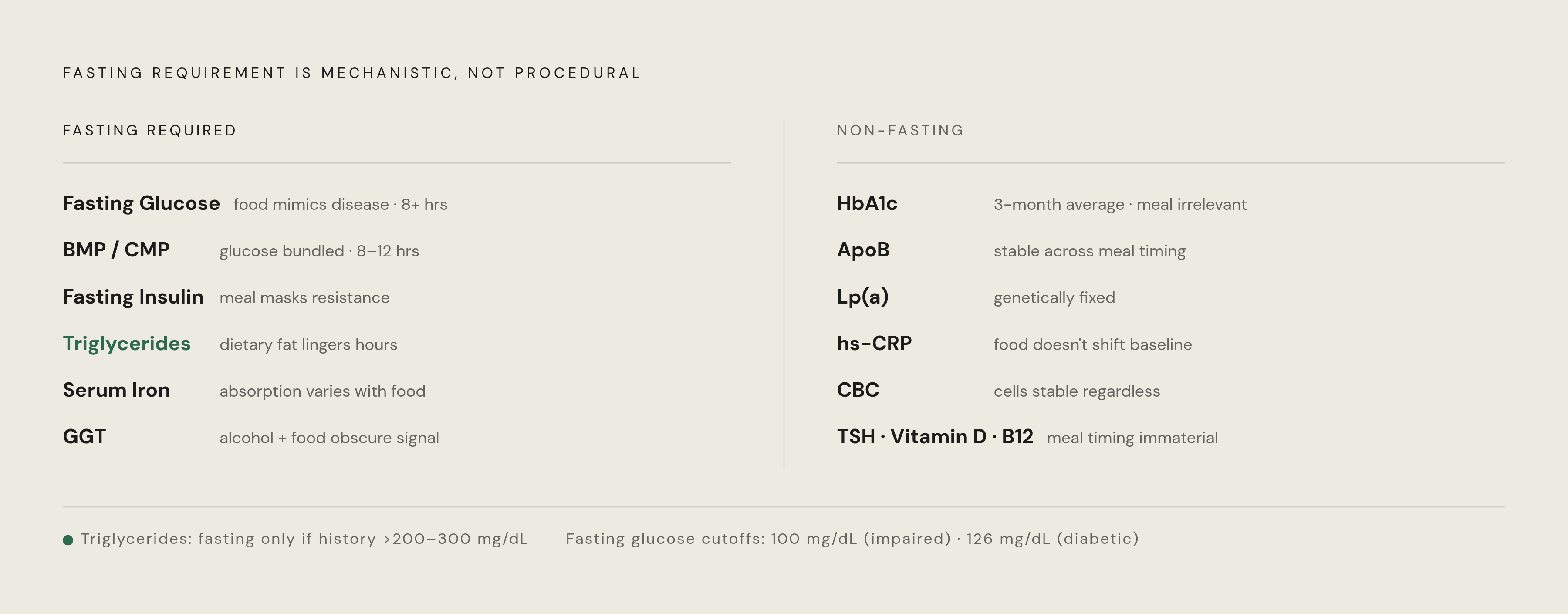
Fasting matters only for tests where food mimics disease or masks early pathology.
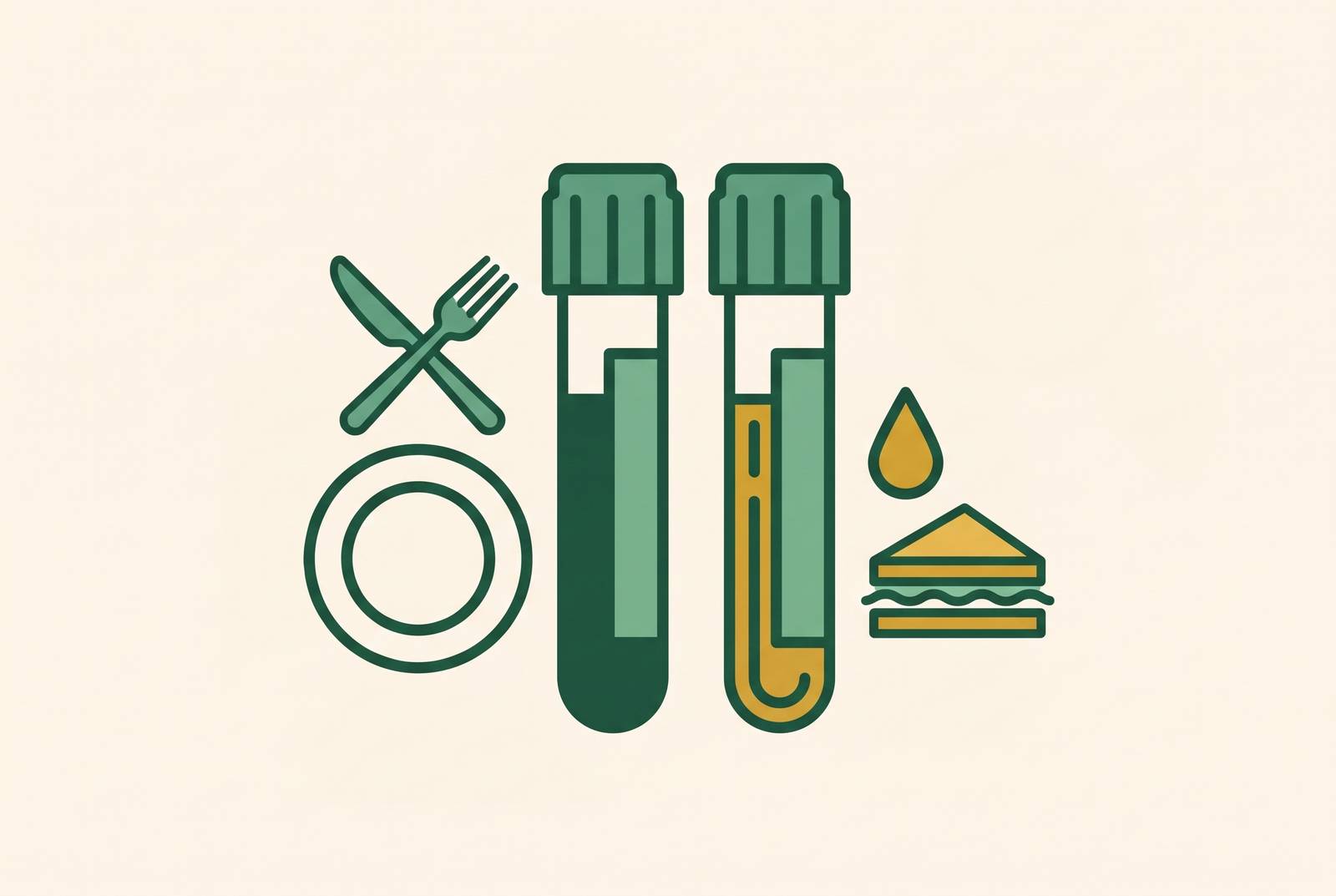
The most common thing people ask before a blood draw is "do I need to fast for this?" It's "do I need to fast for this?" And the honest answer is: it depends entirely on what's being measured, not on some blanket rule that gets slapped onto every order form. A 2024 meta-analysis in Lipids in Health and Disease, covering 244,665 participants, found statistically significant differences between fasting and non-fasting states for cholesterol, HDL-C, triglycerides, and LDL-C. But statistical significance and clinical significance aren't the same thing, and that gap is exactly where most of the confusion lives.
Add to that some genuine disagreement between countries. U.S. and European guidelines now say fasting isn't necessary for routine lipid testing. Chinese guidelines still call for it. So if two people compare notes on how to prep for the same test, they might walk away with contradictory instructions, and both would be right, depending on which guideline their provider follows.
Fasting doesn't clean up blood or make a result more "pure." It removes one variable, food, so a specific marker can be read without that noise. The skill is knowing which markers actually care. It's knowing which markers actually care.
How eating changes blood chemistry, and why it only matters for certain markers
Eating sets off a chain of predictable changes. Carbohydrates break down into glucose, so blood sugar climbs. Dietary fat enters circulation, so triglycerides climb too. Insulin spikes to manage the glucose load, digestive enzymes ramp up, and other markers can shift in ways tied to the digestive process. None of that is subtle. It's the body doing exactly what it's supposed to do after a meal.
The catch is that most of this noise doesn't touch most lab markers. Red blood cell count doesn't move because someone ate toast. Thyroid hormone output isn't nudged by a bowl of cereal. HbA1c reflects roughly two to three months of glucose exposure, so whatever happened at breakfast is a rounding error against that timeline.
For a small handful of tests, though, this is the entire problem. A recent meal can push a glucose reading past a diagnostic cutoff, and the difference between 95 mg/dL and 130 mg/dL isn't a rounding error, it's the line between "normal" and "concerning" for diabetes screening. Misread that line, and someone walks away with a diagnosis they don't have, or reassurance they shouldn't.
For tests where food matters, the standard fasting window runs 8 to 12 hours, with lipid panels historically asking for 9 to 12. Water is fine, actually encouraged, since it keeps veins easier to find. But black coffee, juice, gum, and snacks all introduce the exact variables fasting is trying to eliminate. Chewing gum can kick off digestive processes even without swallowing food. Coffee, even without sugar, can shift blood sugar and hydration. Neither should happen before a fasting draw unless the ordering provider says it's fine.
Tests that genuinely require fasting and what goes wrong without it
Fasting glucose is the strictest of the bunch. At least 8 hours of fasting, drawn in the morning, no exceptions worth taking. Eat anything, even a small snack, and the number stops reflecting a baseline and starts reflecting whatever was just digested. The diagnostic thresholds only make sense with true fasting behind them: below 100 mg/dL is normal, 100 to 125 mg/dL signals prediabetes, and 126 mg/dL or higher on two separate tests points to diabetes.
Fasting insulin runs into the same problem from a different angle. Eating triggers insulin release, so a non-fasted draw produces a number that looks alarmingly high without meaning much. HbA1c does not require fasting, but fasting insulin absolutely does. And fasting insulin earns its name because it can catch early insulin resistance before glucose or HbA1c have climbed enough to register on their own. A normal glucose next to an elevated fasting insulin is still a signal that deserves attention.
Triglycerides are the lipid marker most sensitive to a recent meal, since dietary fat shows up in the bloodstream and stays elevated for hours. The 2026 ACC/AHA Dyslipidemia Guideline narrows the fasting requirement to patients with a known history of elevated triglycerides, roughly above 200 to 300 mg/dL. Outside that group, a non-fasting draw is acceptable under the same guideline.
Basic and Comprehensive Metabolic Panels check kidney function, liver health, electrolytes, and glucose all at once. Glucose is the fasting-sensitive piece, and because it's bundled in, the whole panel gets ordered fasting, typically 8 to 12 hours, to keep the full snapshot accurate.
Serum iron reflects recent absorption from food, so an overnight fast gives the cleanest baseline, especially when the draw is meant to diagnose anemia or an iron-deficiency condition.
GGT, gamma-glutamyl transferase, responds to both alcohol and certain foods. Fasting plus avoiding alcohol beforehand helps separate a liver issue from a simple dietary effect, which matters for anyone trying to get a clean read on liver function without a confounding variable muddying the result.
Across all of these, the pattern holds. Food either mimics disease (glucose), hides early pathology (insulin resistance), or makes it impossible to tell one cause from another (GGT). None of these fasting rules are procedural habit. They're mechanistically necessary.
Tests that don't require fasting, and why that's not a shortcut but a scientific fact
HbA1c measures average blood glucose over the roughly three-month lifespan of a red blood cell. A meal from the night before doesn't register against that kind of average, so fasting adds nothing. Retesting sooner than about 8 weeks won't show a real change, because the red blood cell population simply hasn't turned over enough yet. And HbA1c and fasting glucose get conflated often, even though they're answering different questions: one's a long-run average, the other's a same-day snapshot.
ApoB doesn't require fasting either, and the value holds steady whether someone's eaten or not. ApoB is worth ordering regardless of meal timing because one ApoB molecule sits on every atherogenic particle, meaning LDL, VLDL, IDL, and Lp(a), so it counts particle number directly rather than estimating cholesterol concentration inside those particles. Atherosclerosis tracks more closely with particle count than with cholesterol amount, which is exactly why ApoB has gained traction. The AHA/ACC Multi-Society Cholesterol Guideline flags ApoB at or above 130 mg/dL as a risk-enhancing factor, and for anyone with established cardiovascular disease, targets under 80 mg/dL are increasingly the goal. Guidance from 2025 also points to ApoB at or above 1.2 g/L as a sharper cardiovascular risk read than LDL-C alone, particularly for people with metabolic disorders. One practical wrinkle: if ApoB gets ordered alongside a full lipid panel and triglycerides run high, fasting might still get recommended, not for ApoB's sake, but to improve the accuracy of calculated LDL.
Lp(a) needs no fasting at all. Levels are largely set by genetics and don't shift much based on what's eaten. The 2025 guideline sets the threshold at 50 mg/dL or above for meaningfully elevated cardiovascular risk.
hs-CRP doesn't strictly require fasting, though some providers ask for it anyway just to keep results consistent when it's ordered next to a lipid panel. A result above 10 mg/L often points to an acute infection or inflammation that has nothing to do with cardiac risk, so a high reading there should trigger a retest once whatever's causing it clears up, not an immediate cardiovascular conclusion. The ACC notes that people with elevated CRP carry roughly 2 to 3 times the risk of those with low levels, and emerging guidance suggests considering statin therapy for persistently elevated hs-CRP in primary prevention. One ordering detail matters here: ask specifically for the "high-sensitivity" version. Older CRP tests can't measure precisely enough in the range needed to assess cardiac risk.
CBC panels, covering red and white blood cells, hemoglobin, hematocrit, and platelets, don't shift meaningfully after a meal, so no fasting needed.
Thyroid panels (TSH, Free T4, Free T3) are generally accurate without fasting too, since food doesn't meaningfully alter thyroid hormone output for most people. But timing produces a real exception, as the next section shows by unpacking it.
Vitamin D, B12, folate, PSA, and blood type and antibody screening round out the non-fasting group. None of them are meal-sensitive in any way that matters clinically.
Why thyroid testing is a special case: timing and medications matter more than food
Thyroid testing sits in an odd spot. Food isn't really the variable to worry about, since thyroid hormone output doesn't move much based on a recent meal. Timing and medication, though, are a different story entirely.
TSH follows its own daily rhythm, running highest overnight into early morning and lowest in the mid-afternoon. For anyone tracking subtle changes over months or years, drawing in the morning consistently matters because of where TSH sits on its daily curve.
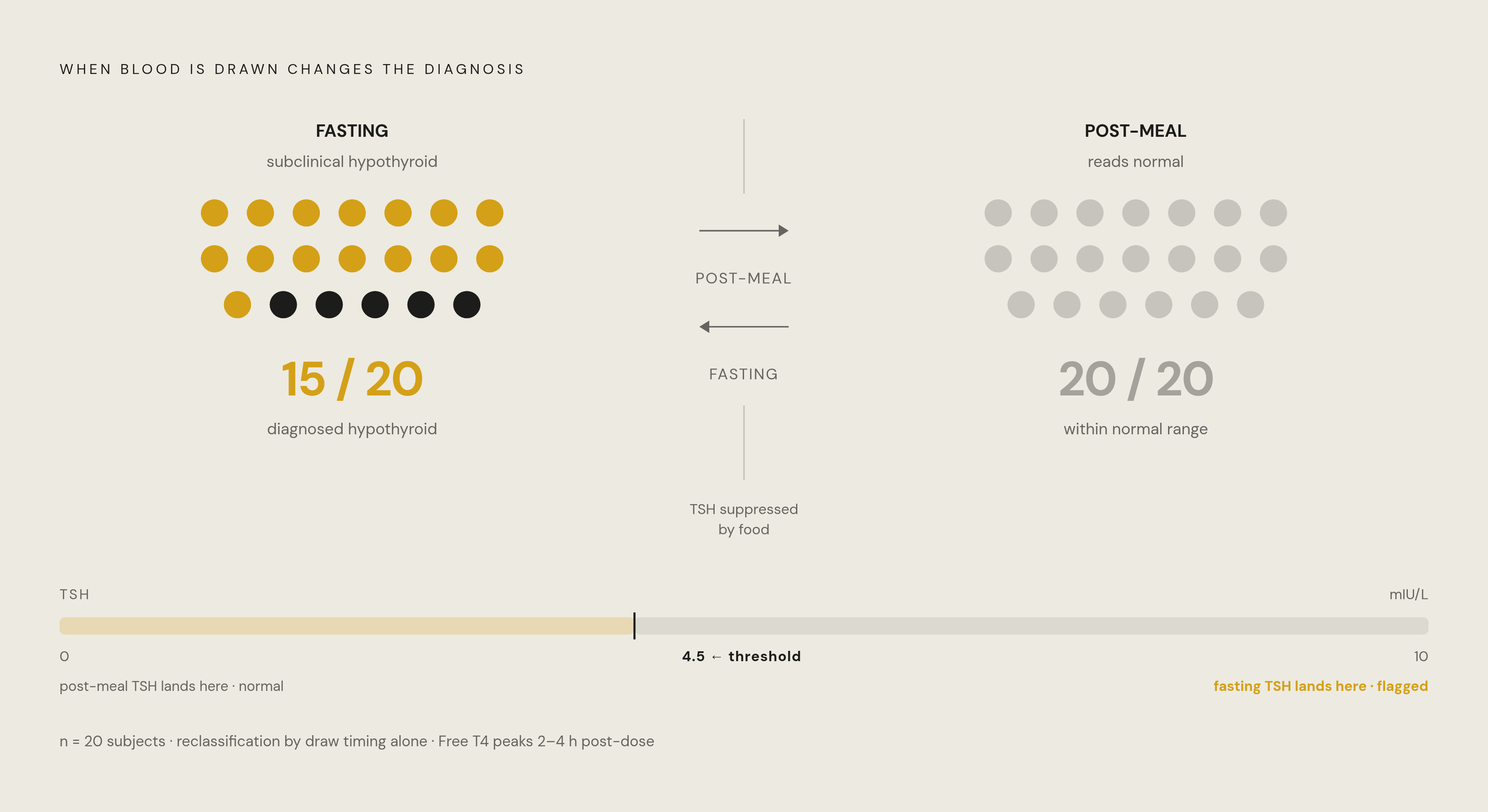
One finding deserves more attention than it usually gets. A study found TSH suppressed in every subject after eating, regardless of their fasting baseline, while Free T4 barely moved. The consequence was striking: 15 of 20 subjects, 75%, got reclassified as having subclinical hypothyroidism based on fasting values, when their postprandial TSH would have read as normal. That's not a rounding error, that's a missed or a false diagnosis depending on which sample got drawn. So a fasting TSH draw is worth requesting specifically to avoid that kind of misclassification.
Medication timing complicates things further. Levothyroxine, a T4-only drug, has a long half-life and builds up gradually over weeks, so TSH tends to stay steady no matter when the last pill was taken relative to the draw. Free T4 behaves differently. It rises after each dose, peaking somewhere around 2 to 4 hours later, so a blood draw timed right into that peak won't reflect the trough level a prescriber actually wants to see. Best practice: hold the levothyroxine dose until after the draw.
T3-containing medications, Armour Thyroid and compounded T4/T3 preparations, raise the stakes further. T3 has a much shorter half-life than T4, so dose timing relative to the draw can swing results enough to affect an actual treatment decision. Unlike levothyroxine, this isn't a minor nuance, it's clinically significant.
Biotin is the other quiet variable nobody thinks about. Biotin supplements interfere with the immunoassays that most labs in a certain country use for thyroid testing. labs use for thyroid testing, and that interference is common enough that it shouldn't be treated as a rare edge case. Standard advice is to stop biotin at least 48 hours before testing, or 72 hours for high-dose, mega-dose supplements. This has nothing to do with fasting status. It'll skew results whether someone's eaten or not, and it's a detail both patients and providers frequently overlook.
Why a non-fasting lipid panel is now the default for most people, and when it isn't
For decades, the standard lipid panel instruction was a 9 to 12 hour fast, no debate, no exceptions. That's simply what clinical practice called for.
That has shifted: a non-fasting lipid profile is now considered sufficient for most people, reflecting updated evidence rather than the older blanket fasting rule. The 2026 ACC/AHA Dyslipidemia Guideline, published in Circulation and built on a literature review running through late 2024, now states that a non-fasting lipid profile is sufficient for most people. The logic follows directly from what fasting actually protects against: for the majority of patients, without a history of significantly elevated triglycerides, a non-fasting draw gives a result close enough to fasting values that the extra 9 to 12 hours of avoiding food adds little.
Fasting still earns its place for specific situations, particularly a known history of elevated triglycerides, where the 2026 guideline explicitly calls for a fasting draw to get an accurate read. Outside that group, the default has genuinely flipped. Skipping the fast for a routine lipid panel is what the current evidence actually supports. It's what the current evidence actually supports.
Sources
- Unraveling the controversy between fasting and nonfasting lipid testing in a normal population: a systematic review and meta-analysis of 244,665 participants
- Fasting vs Non-Fasting Blood Tests: What You Need to Know - Areca Diagnostics
- Why Fasting Matters Before Blood Tests - HealthE1 Mobile Medical
- themednet.org
- pmc.ncbi.nlm.nih.gov
- hcplive.com