What a Meaningful Preventive Baseline Looks Like at Different Budget Levels
Standard insurance falls short—here's what a meaningful baseline costs at every budget level.

Nearly a million Americans die of heart disease or stroke every year. Another 1.7 million get a cancer diagnosis annually, according to the AMA's citation in the context of the Preventive Health Savings Act. More than 98 million people are walking around with prediabetes, and 38 million already have diabetes, often after years of metabolic drift that goes undetected. None of these conditions announce themselves early. These conditions appear first in bloodwork, quietly, long before a symptom ever forces a doctor's visit.
That's the whole case for building a preventive baseline: a set of tests that catches drift before it turns into disease. And it doesn't require a five-figure executive physical to start. It requires knowing what to test, how often, and what each budget level actually buys you.
Adult wellness care and sick-visit care are not the same job. One responds to a problem that already exists. The other tries to find the problem before it has a name. The AMA's endorsement of the Preventive Health Savings Act (S. 3204 / a companion bill in the other chamber. A companion bill in the other chamber makes this exact argument at the policy level: a legislative budget scorer scores legislation mostly within a 10-year window, which means long-term savings from prevention get undercounted and prevention loses out on paper. The same blind spot plays out in an individual's life. Insurance and the broader health system are built to react. Getting ahead of that requires someone to go looking on their own, not wait for a referral that may never come.
What "a baseline" means and what makes one meaningful
A baseline isn't a checklist of tests to cross off. It's a snapshot of the systems most likely to fail silently: cardiovascular, metabolic, inflammatory, thyroid. A meaningful one hits three criteria. The condition has to be common. It has to be symptom-free in its early stages. And once found, someone has to actually be able to do something about it.
Most annual physicals fall short of this because the standard panel is thin. A typical physical runs a relatively thin set of markers. It won't include ApoB or Lp(a), the two markers that catch cardiovascular risk that a normal LDL number completely misses. So the physical isn't wrong, exactly. It's just not built to catch what it's not looking for.
That's where the idea of anchor markers comes in: the minimum set no baseline should skip, no matter the budget.
- Fasting glucose or HbA1c, for metabolic trajectory
- A lipid panel, for the baseline cardiovascular picture
- TSH, often the earliest signal of thyroid trouble
- Blood pressure, still the single most powerful modifiable risk factor for heart disease
- CBC and CMP, for broad organ and blood-cell health
One data point tells you where things stand today. It's the second and third data point, months or a year apart, that tell you whether something's getting worse, holding steady, or improving. So no tier below should be judged by how many tests it includes. Judge it by whether it gets the right tests, interpreted correctly, tied to a plan, tested again later.
Tier 1: What insurance already covers and where its edges are
Insurance is a floor. It's built around age and risk stratification, not around catching what's quietly drifting in someone who looks healthy on paper.
Under the ACA, most marketplace and private plans cover certain preventive tests at no cost: cholesterol screening, HbA1c or diabetes screening, hepatitis B and C screening, and HIV testing. But coverage kicks in on a schedule, and the schedule is built around age, not individual biology.
- Blood pressure: checked every two years for adults
- Cholesterol: screening usually starts around age 20, per the Highmark 2026 Pennsylvania Adult Preventive Health Guidelines (which reference USPSTF standards), then every five years
- Diabetes screening: starts at 35, or earlier with risk factors present
- Colon cancer screening: now begins at 45 for most people
- Thyroid testing: becomes more clinically relevant in someone's 40s, especially for women, who are five to eight times more likely than men to develop thyroid problems
- Mammography: USPSTF recommends every two years for women 40 to 74; Pennsylvania law requires annual coverage for women 40 and up, per the same Highmark guidelines
The exact same blood test can cost nothing or cost real money depending on why it's ordered. The exact same blood test can cost nothing or cost real money depending on why it's ordered. Coded as preventive during a wellness visit, it's free. Coded as diagnostic because someone mentioned fatigue or a symptom, it now applies toward the deductible. A CMP ordered at a routine physical and a CMP ordered because someone's tired all the time can land on two very different bills, even though it's the same tube of blood going to the same lab.
And insurance simply won't touch the markers that matter most for catching risk early: ApoB, Lp(a), hs-CRP, and similar advanced markers. These aren't considered routine preventive screening, so they're rarely covered. Insurance catches what's already been flagged by age or symptom. It's not designed to catch what hasn't announced itself yet, and that's precisely the gap a self-pay baseline is meant to fill.
Tier 2: Building a self-pay baseline for roughly the cost of a dinner out per month
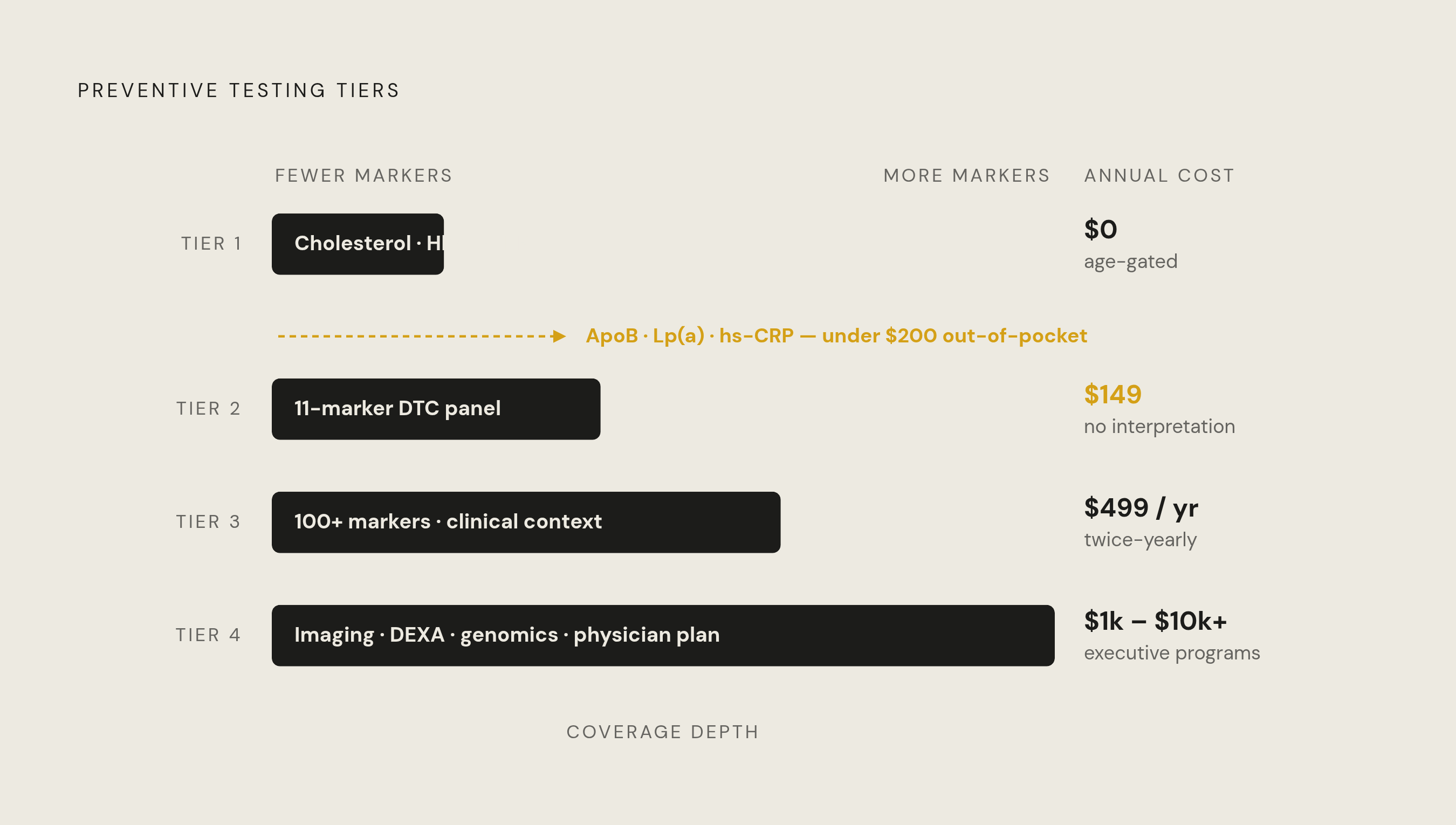
The same test, run at the same CLIA-certified lab, can cost several times more depending on where it's ordered. A hospital system marks up a lipid panel through facility fees and billing overhead. A direct-to-consumer lab orders the identical test from the identical reference lab and charges a fraction of the price. The blood isn't different. The paperwork is.
Cash prices for self-pay labs in 2026 vary by test, with a CMP, a CBC, a lipid panel, TSH, and HbA1c each available at modest individual price points. Add those up and the full anchor-marker set, run once a year, comes in well under a few hundred dollars.
Justlabs offers a "Longevity & Aging Panel" priced around $149 that bundles CBC, CMP, lipid panel, HbA1c, fasting insulin, hs-CRP, homocysteine, vitamin D, testosterone, DHEA-S, and IGF-1. That's eleven markers spanning metabolic, inflammatory, vitamin, and hormonal systems, for less than the cost of a decent dinner out.
But watch for the fees that don't show up in the headline price.
- Almost every lab tacks on a blood-draw fee separate from the test cost. For a cheap single test, that phlebotomy charge can end up being most of the total bill.
- Portals handle this differently. Some build the draw fee into the listed price so there's no surprise at checkout. Others add it on afterward. The only way to know the real cost is to compare the total.
- The same test, processed at the same reference lab, can cost multiple times more depending on which portal someone orders through.
Tier 2 gets someone the full anchor-marker panel with room left over to add hs-CRP or fasting insulin for anyone who wants to go a step further. What it doesn't include is a clinician telling you what the numbers mean or a system that tracks the trend over time. At this tier, someone's on their own to make sense of the results, which is fine for a motivated reader but a real limitation for anyone else.
Tier 3: Comprehensive biomarker platforms and what the membership model buys
This is where the model shifts from buying tests to buying a system. Instead of the limited marker set on a standard physical, these platforms test upward of 100, pair the results with clinician or AI-assisted interpretation, and check in with members throughout the year instead of once.
Pricing varies a lot depending on how much service comes with it. One platform runs around $499 a year for a detailed biomarker overview plus a follow-up test, and it's HSA and FSA eligible. Others sit at a higher monthly rate and bundle in quarterly testing, health coaching, and prescription management.
Some platforms in this space price the membership low, then lean on AI-generated supplement recommendations that can run several hundred dollars a month on their own. A low entry price sounds appealing until the recommended supplement stack multiplies the real annual cost several times over. Platforms earn trust when they are willing to tell a member they need fewer tests, not more, when the data says so. A business that makes money on membership has a different incentive than one that makes money on upsells, and that difference is visible in the advice given.
What this tier adds over a self-pay panel: ApoB, Lp(a), hs-CRP read in clinical context, fasting insulin, DHEA-S, IGF-1, homocysteine. These are the markers most tied to the specific risk patterns. And because these platforms test twice a year or quarterly, someone can actually see whether a change in diet, exercise, or medication moved a number. A single annual snapshot can't show that. A trend line can.
Tier 4: Executive health programs and what justifies the price jump
Price climbs fast here. Entry-level executive programs in 2026 run in the low thousands and typically include enhanced bloodwork, an ECG, a physical exam, and age-appropriate screening. Hospital-grade programs move into the mid-to-high thousands. At the top end, advanced longevity diagnostics with imaging and genomics can reach into the tens of thousands.
A lot of entry-level executive programs still skip ApoB, Lp(a), DEXA body composition, VO₂ max testing, and coronary calcium scoring. So a higher price tag doesn't automatically mean a more complete baseline than a well-built Tier 3 platform. Someone could spend three times as much and still walk away with less useful data.
What genuinely justifies the jump is what a blood panel can't do on its own. A physician sitting down and turning a stack of numbers into an actual plan someone will follow. Imaging like a coronary calcium score or a DEXA scan that catches structural risk no biomarker can see. Genomic testing that flags inherited risk, Lp(a) being the clearest example, since it's driven almost entirely by genetics rather than lifestyle.
So the test isn't how long the menu is. It's whether the program turns the right handful of findings into a plan a physician actually walks someone through.
Who actually needs this tier? Someone with a strong family history of early heart disease or cancer. Someone whose Tier 3 results turned up a signal, an elevated Lp(a) or a concerning ApoB, that calls for imaging or a specialist. And people whose schedule and risk profile genuinely justify the spend. For most everyone else, a well-run Tier 3 platform with real clinical follow-up captures the bulk of the value at a fraction of the cost. That's not a knock on Tier 4. It's just math, since a well-run Tier 3 platform captures the bulk of the value at a fraction of the cost for most people.
The markers that belong on every tier's must-catch list
Cardiovascular risk goes deeper than LDL. ApoB counts the actual number of atherogenic particles in the blood, and it predicts long-term cardiovascular risk even when non-HDL cholesterol looks fine. Research including longer-term cohort studies backs this up. And here's the detail that should give anyone pause: a meaningful portion of people hospitalized for coronary artery disease had cholesterol numbers that looked completely normal going in. That's the entire argument for testing beyond the standard lipid panel.
The guidelines have caught up to this. Under the 2026 AHA/ACC guidelines, Lp(a) testing is now a Class 1 recommendation for every adult, and ApoB carries a Class 2a recommendation to help guide treatment decisions. The newer PREVENT-ASCVD risk equations, which fold in kidney function and metabolic markers, have formally replaced the older Pooled Cohort Equations.
Inflammation matters too. The American College of Cardiology's 2025 scientific statement names hs-CRP as a marker of residual inflammatory risk that carries independent cardiovascular significance. The JUPITER trial showed something striking: in people with normal LDL-C but elevated hs-CRP, statin therapy meaningfully cut cardiovascular events compared to placebo. Normal cholesterol didn't mean normal risk.
A few patterns to watch for once someone has this data in hand:
- Elevated ApoB paired with elevated hs-CRP points to an inflammatory, high-risk plaque pattern
- Elevated insulin, elevated triglycerides, and low HDL together suggest a metabolic syndrome pattern
- Elevated Lp(a) alongside elevated fibrinogen suggests a genetic and clotting-driven risk pattern
Metabolic drift appears in bloodwork before diabetes does. A fasting glucose between 100 and 125 mg/dL, confirmed on repeat testing, means impaired fasting glucose, otherwise known as prediabetes. That's years of warning before an actual diabetes diagnosis. And on the CMP, a slow climb in ALT across a few quarters warrants investigation. It could point to fatty liver disease, a medication side effect, alcohol use, or viral hepatitis. None of those show symptoms early. The number moves first.
TSH catches thyroid trouble before hormone levels do. TSH tends to shift before T3 and T4 actually drop, which makes it the highest-value first test for thyroid function. That said, screening everyone who's asymptomatic isn't universally recommended, since it risks overdiagnosis. But anyone with symptoms, a family history, or known risk factors, particularly women, has a clear reason to test. One practical note: stop biotin supplements three to five days before the blood draw, since biotin can throw off the reading. If TSH comes back abnormal, or symptoms persist despite a normal TSH, that's when free T4, free T3, reverse T3, and thyroid antibodies come into play.
Longevity markers are promising, but still emerging. Emerging research in longevity science consensus process among longevity researchers identified fourteen biomarkers to track in intervention studies, spanning metabolic, inflammatory, hormonal, and functional domains. These are real research tools. They're not yet standard-of-care screening, and that distinction matters. Metrics like VO₂ max, heart rate variability, and body composition have decades of solid validation behind them as health markers, even though marketing sometimes repackages them as brand-new longevity discoveries. A validated clinical tool is not the same as a familiar concept wearing new branding.
How to choose a starting tier and build from there
Choosing a tier isn't about finding the "correct" one. It's about matching a starting point to where someone actually stands right now, then letting the results decide what comes next.
Someone with no family history of heart disease or diabetes, who's simply never had a real baseline, can start at Tier 2 and get real signal for a modest annual cost. Someone with a parent who had a heart attack in their 50s, or a personal blood sugar marker that's been creeping toward the prediabetes range, has more reason to start at Tier 3, where ApoB and Lp(a) are on the table from day one. And someone who's already run a Tier 3 panel and found a red flag, a high Lp(a), an ApoB that doesn't match a "normal" LDL, has a legitimate reason to escalate to Tier 4 for imaging.
The through-line across every tier is the same: pick the right handful of markers, test them again later, and let the trend, not the single number, decide the next move. That's the whole system. Everything above it is just deciding how much support to buy along the way.