Labs That Require a Clinician Order vs. Direct-Access Testing
State law determines whether you can order a lab test yourself.
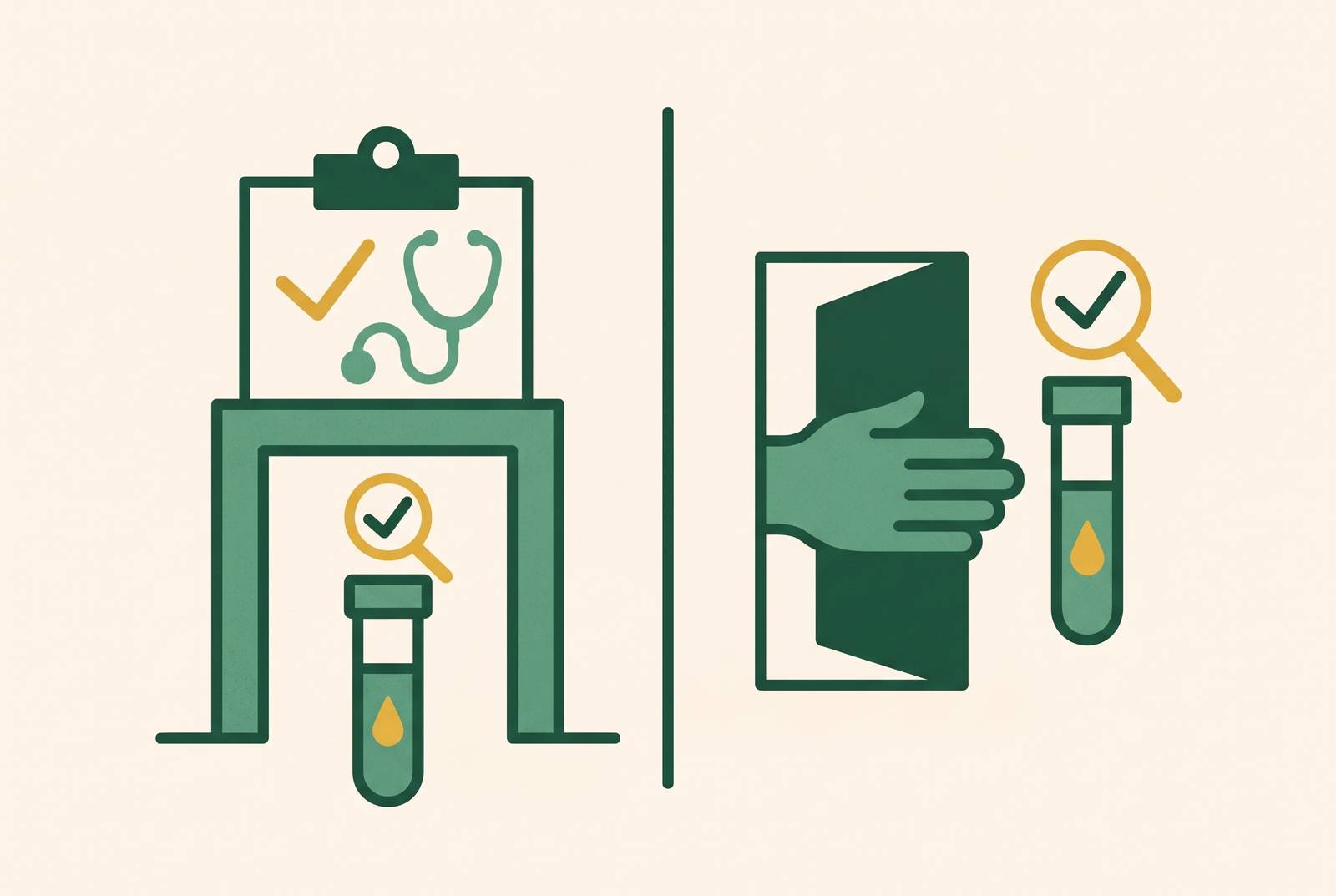
Whether you can order a lab test on your own or need a doctor to do it for you comes down to three things: which state you live in, what the test actually checks for, and which company you're ordering through. Get those three variables right and the whole system stops feeling like a maze. This piece walks through the federal rules that apply everywhere, the state-by-state differences that actually decide the question, and what each pathway gets you once you're in it.
The federal framework that sets the floor: CLIA, HIPAA, and the 21st Century Cures Act
Start with what federal law actually controls, because it's less than most people assume.
A federal quality-standards law sets the operating standard for every lab in the country. It governs the equipment, the technicians, the accuracy checks. It says nothing about who's allowed to order the test. A direct-access panel run through a CLIA-certified lab meets the exact same quality bar as one ordered by a physician. Same machines, same techs, same rules. The certification doesn't care who clicked "order."
HIPAA works on the access side. It guarantees you can get your finalized results, usually through whoever placed the order in the first place.
Then there's the 21st Century Cures Act, and this one changed the landscape more than people give it credit for. It requires labs and providers to release results in real time and bars what's called "information blocking," basically, sitting on a patient's own data for no clinical reason. This law is a big part of why who can order a test became a sharper issue in recent years. Once patients started getting instant access to their own results, the next logical question became: why do you need someone else to order the test in the first place?
There are exceptions. Results can be delayed if release poses a documented harm risk, if privacy rules require it, or if state law treats a minor's consent differently. Federal mandate and clinical judgment don't always point the same direction.
One more piece: the FDA sorts diagnostic tests into risk tiers, Class I through III. Low-risk, general wellness tests mostly skip pre-market review. Moderate-to-high-risk tests marketed direct-to-consumer face more scrutiny before they can be sold that way. This tiering is the federal lever that actually shapes what you can buy without a clinician, more than CLIA or HIPAA do.
So here's the floor: CLIA guarantees the lab is legitimate, the Cures Act guarantees you'll get your results fast. Neither one tells you whether you, personally, are allowed to order the test. That question gets answered somewhere else entirely.
How state law determines whether you can order without a clinician
Somewhere else is the state you live in.
Per JustLabs' direct-access state comparison, 48 of 50 states let consumers order standard lab tests without going through a doctor first. That's the headline, and it's a bigger number than most people expect. But two states break from it hard: New York and New Jersey both require a licensed physician with an established patient-provider relationship before a lab test can be run. Direct-access platforms simply can't fulfill orders for residents of either state, full stop.
Why is New York the strict one? The state runs its own oversight body, the Clinical Laboratory Evaluation Program (CLEP), which sets a higher bar than federal CLIA rules. The state's logic: without an actual clinician relationship, nobody's watching the variables that affect a result before it's even drawn, things like fasting status, hydration, timing, and nobody's responsible for explaining what the number means afterward.
Rhode Island sits in a gray zone. It doesn't ban direct access outright, but requires a formal requisition signed by a licensed provider (MD, DO, NP, or PA) for at least some services, which knocks certain platforms out of the market there even though the state isn't as restrictive on paper as New York.
Even within the permissive states, who can sign that order varies more than people realize. Nurse practitioners have independent ordering authority in full-practice states. Naturopathic doctors can order labs where their licensure allows it, Oregon, Washington, Arizona, and Vermont among them. Chiropractors and registered dietitians have narrower, more inconsistent authority depending on the state (per Fullscript's state-access guide).
Telehealth adds one more wrinkle. When the ordering provider is in a different state than the patient, it's the patient's state law that governs. That often means the provider needs a license in the patient's state to write the order legally.
So the sequence for figuring out where you stand: check your state first. Then check the test category. Then check which platform you're using, because it changes which rules apply to you.
Test categories that commonly require a clinician order regardless of state
Living in one of the 46 fully permissive states doesn't mean every test is fair game. Test type creates its own set of gates, separate from anything your state legislature decided.
Genetic and genomic testing is near the top of the restricted list. Consumer genomic products come with explicit language saying they're not meant for diagnosis or treatment decisions, and clinical-grade panels, BRCA testing or pharmacogenomic panels, generally need a provider behind the order. Certain cancer biomarkers and tumor markers get flagged too, often restricted even in states that are otherwise loose about direct access, because the interpretation is complicated enough that a wrong read carries real weight. Specialized infectious disease panels, especially ones with public health reporting implications, run into similar limits.
Then there's a category that's less about the test itself and more about what happens next: panels that feed straight into a prescription decision. Hormone panels used to titrate HRT dosing are the clearest example. A platform might sell you the test itself with no issue, but acting on the result, adjusting a dose, starting a new medication, usually requires a prescriber in the loop.
What's actually wide open? More than most people guess. Across consumer platforms, routine panels move freely through direct-access channels in permissive states: CBC with differential, comprehensive metabolic panel, lipid panel, HbA1c, TSH, fasting glucose, ApoB, Lp(a), hs-CRP, ferritin, vitamin D, sex hormone panels. All standard, all available without a clinician relationship in the states that allow direct access at all.
For the categories that do require a clinician, most platforms have built a workaround: a network physician issues the requisition on the back end, the consumer just picks the test and shows up at a draw site. From where the consumer stands, the friction is minimal, maybe an extra form, but the legal requirement gets satisfied without anyone needing an in-person visit.
Bottom line on category: it's a real filter, but a narrower one than most people expect. For the preventive and biomarker panels most people actually want, category is rarely the thing standing in the way.
The two pathways in practice: what clinician-ordered and direct-access routes each unlock
Once you've cleared the state and category checks, what do you actually get from each route? They're not interchangeable, and knowing what each one unlocks saves a lot of wasted time.
Clinician-ordered testing is the on-ramp to everything downstream in traditional medicine. Diagnosis, treatment planning, prescriptions, all of it flows from a provider relationship, and lab work is just one input into that larger process. Imaging, an ultrasound, a CT, an MRI, an ECG, a biopsy, an endoscopy: none of that gets triggered off a direct-access lab result on its own. If insurance coverage is the goal, a clinician-ordered test is generally the requirement, though coverage still isn't guaranteed; it depends on medical necessity, plan design, and how the claim gets coded. And if there's an actual acute concern, new chest pain, neurological symptoms, signs of an active infection, that's a reason to see a clinician directly, not a reason to order a panel and wait for results.
Direct access unlocks something different: speed and depth. No appointment, a draw at a national lab network location, and results back in 24 to 48 hours for a lot of common markers. The depth is visible in what gets included. Direct-access panels routinely offer ApoB, Lp(a), fasting insulin, HOMA-IR, hs-CRP, ferritin, homocysteine, free T3, testosterone, estradiol, markers that a standard annual physical often skips entirely because insurance won't cover them without a specific diagnosis code attached.
There's also the trend-tracking piece, which is where a lot of the real value sits. A single lab value is easy to misread. Hydration, sleep, training load, a minor illness, even lab-to-lab variation can shift a number without anything actually being wrong (per VitalsVault). Repeating the same panel over months and watching the trajectory tells a very different story than one snapshot does. And the ordering process runs outside the traditional clinical workflow, which matters to people who want the data on their own terms.
So which one is right? Wrong question, honestly. Choosing between a doctor and direct labs comes down to matching the tool to the job (per VitalsVault). Someone tracking cardiometabolic risk over time, testing a diet or training change against real numbers, building a longevity baseline, or trying to get past a "everything looks fine, come back next year" conversation, direct access fits that job well. Someone with a new symptom or an active health concern needs a clinician evaluating them.
What direct-access panels cost compared to traditional self-pay and insured rates
Pricing at the big reference labs is oddly hard to pin down. Labcorp and Quest don't publish full price sheets; both run online estimator tools instead, which means the actual number often depends on the location you enter and how the tool feels that day.
What is knowable: self-pay cash prices, verified as of September 2026 by labtestmenu.org, run in fairly wide bands. A basic metabolic panel costs $20 to $45. A comprehensive metabolic panel runs $30 to $65. A CBC costs between $15 and $35. Lipid panels run $25 to $55, TSH $25 to $50, HbA1c $20 to $45. STI panels swing widely, $50 to $220, depending on what's included.
Quest's own self-pay rates, per JustLabs' pricing guide, run a bit higher for some tests: $45 to $85 for a lipid panel, $28 to $65 for a CBC, $38 to $75 for HbA1c. Labcorp prices similarly on the self-pay side, and per VitalityScout, both companies' consumer-facing storefronts list individual tests starting around $25 to $29, return results in one to two days, and bundle in an independent physician order so no office visit is needed.
Direct-to-consumer platforms tend to undercut traditional self-pay by a meaningful margin, JustLabs puts it at 40 to 70% below, because they negotiate a fixed, published price instead of working off a fee schedule built for insurance billing. A CMP running $85 to $120 at Quest is often available through a direct-access platform for $45 to $60.
Someone with insurance who hasn't hit their deductible yet often pays the plan's "negotiated rate," and that rate can land higher than a competitive self-pay price. Direct access can end up cheaper even for people who are, on paper, covered.
Costs escalate fast in certain categories. Hormone panels for fertility workups or HRT monitoring can run $400 to $800 self-pay at a traditional lab. A standard annual physical ordering five to seven tests can total $300 to $500 without coverage, which is context for why the design of a panel, what's included and what's skipped, matters as much as the per-test price.
Transparent, published pricing has one more benefit: no surprise bills, and eligible tests can usually be paid with FSA or HSA funds since the cost is known before ordering. Some platforms have also moved to a membership pricing model rather than charging per test, offering a flat annual fee that bundles access to a broad range of biomarker tests.
The clinician-oversight question: who reviews results and what support is available
Ordering the test yourself solves the problem of getting access to it. Ordering the test yourself solves the problem of getting access to it, but it doesn't automatically solve the problem of interpreting the results.
The traditional model has a built-in feedback loop: a doctor decides you need a test, orders it, calls with results, and lays out next steps. Direct access removes the doctor from that loop by design, which means the burden of making sense of a result can land back on the person who ordered it. A number outside the reference range, with no one to explain what it means or whether it matters, can trigger unnecessary worry or an overreaction to a result that a repeat test would resolve.
"Clinician-reviewed" doesn't mean the same thing everywhere. Some platforms build a board-certified practitioner into the process, someone who reviews results, flags anything abnormal, and gives personalized guidance on what to do next. Others hand over a PDF with reference ranges and nothing else. A platform that lines up a compliant ordering clinician just to satisfy state law isn't automatically the same platform that offers real interpretation. Those are two different services, and it's important to ask which one you're actually getting before you order.
The ADLM's review flags exactly the risk described above: pre-analytical variables, hydration, sleep, training load, a recent illness, can shift a single reading without anything being clinically wrong. A platform that explains that context up front cuts down on the panic-read of an out-of-range number.
To be fair, the clinician-ordered path has its own version of this gap. Plenty of people leave a doctor's visit with "everything looks normal" and no real next step, no matter what they came in worried about, and per VitalsVault, that exact experience is a big part of what pushed people toward direct access in the first place.
So what should someone actually look for in a direct-access platform? Transparent pricing, CLIA-certified draw sites, a clinician behind the order, and some form of interpretation or action plan. The quality of that guidance layer matters as much as how many tests are on the menu. A membership platform with a clinical team of board-certified practitioners focused on preventive, biomarker-driven care is set up to deliver that kind of guidance at scale. A platform that only sells test access, without it, is not.
How to decide which pathway fits your situation
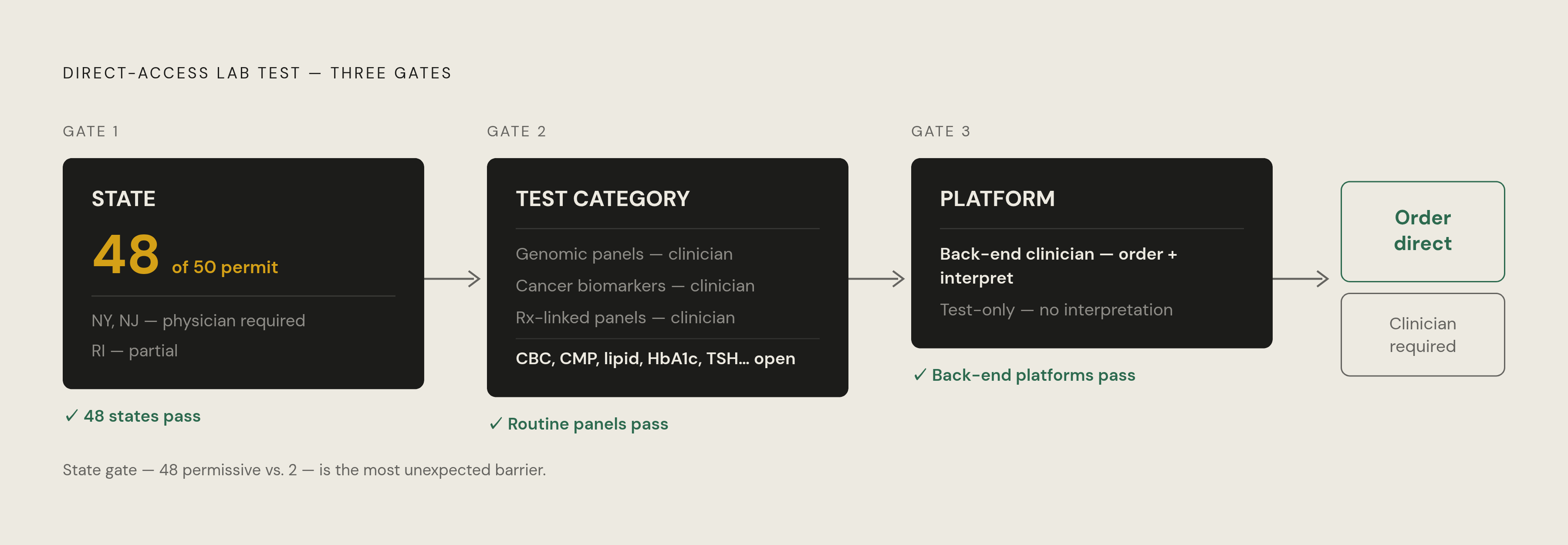
Run it in order, and the decision mostly makes itself.
Check your state first. Most states allow full direct access. New York and New Jersey require a physician order across the board. Rhode Island and Hawaii carry partial restrictions that knock some platforms out of the running.
Then figure out what the test is actually for. Symptoms, urgent concerns, anything that might need imaging or a prescription: that's a clinician-ordered situation, no way around it. Building a baseline, tracking a trend over months, running preventive panels for their own sake: direct access is well-matched to that job. If getting insurance to pay is the actual goal, clinician-ordered is generally the requirement, though coverage still isn't guaranteed once the order's placed.
State, category, purpose. Work through those three in sequence, and the guesswork mostly disappears. What's left is a decision that fits the actual thing being solved for.