IGF-1 and Growth Hormone Axis Testing in Longevity Contexts
Both high and low IGF-1 carry cardiovascular and metabolic risks depending on context and genetics.

IGF-1 testing matters because the number on the page can mean almost opposite things depending on who's holding it. This piece walks through the GH/IGF-1 axis, the research showing why "higher" and "lower" both carry real risk, and how to actually read a result.
Why IGF-1 is measured instead of growth hormone
Growth hormone starts the whole chain, but almost nobody tests it directly, and there's a good reason for that. The hypothalamus sends out growth hormone-releasing hormone, which tells the pituitary gland to release GH in short bursts, the biggest ones hitting during deep sleep and right after exercise. GH then travels to the liver, where it triggers the production of IGF-1, and that's the point where things become clinically useful.
Why skip straight to GH and measure IGF-1 instead? Because GH comes and goes too fast to catch reliably. Its half-life in the blood is short, and its release is so uneven that a single draw could land right on a spike or completely miss one, telling you almost nothing. IGF-1 behaves the opposite way. Once it's made, most of it travels through the bloodstream bound to a carrier protein called IGFBP-3, and that binding stretches its half-life out across many hours. One blood draw gives a reading that actually reflects what the axis has been doing, not just what it happened to be doing in the last ten minutes.
That stability is what makes IGF-1 worth the test. It reaches nearly every cell in the body through a receptor called IGF-1R, and it's the main way GH's effects on growth and metabolism actually get carried out. For testing purposes, there's a bonus: IGF-1 stays fairly steady across the day, so no fasting window or specific draw time is required. That's rare among hormone tests, and it's part of why IGF-1 has become a standard way to track the GH axis over time instead of guessing from a single, unreliable GH reading.
The normal lifecycle of IGF-1 and the somatopause
IGF-1 follows a fairly predictable arc across a lifetime. It peaks in the teens and twenties, starts a slow decline through the 30s and 40s, and settles at noticeably lower levels by the time someone reaches their 60s. This drop has a name: the somatopause. It describes a normal, well-documented part of aging, not a medical deficiency that needs correcting in an otherwise healthy adult.
That distinction got blurred somewhere along the way. A review published in Nature Reviews Endocrinology, led by Junnila and colleagues, points out that the natural drop in GH and IGF-1 among adults aged 60 and older has fueled widespread promotion, and misuse, of recombinant human growth hormone as an antiaging treatment, despite a lack of evidence that it actually works.
The appeal makes intuitive sense even if the science doesn't back it up. Seeing IGF-1 numbers fall with age looks like something is being lost, so pushing it back up looks like it should fix the problem. But that logic skips over what the longevity research actually shows. The same review found that multiple strains of mice with reduced activity in the GH/IGF-1 axis lived significantly longer than mice with normal or elevated activity, flipping the assumption that more signaling equals better outcomes. Whatever's happening here, it isn't a simple story of decline and restoration.
Why the research on IGF-1 and longevity points in two directions at once
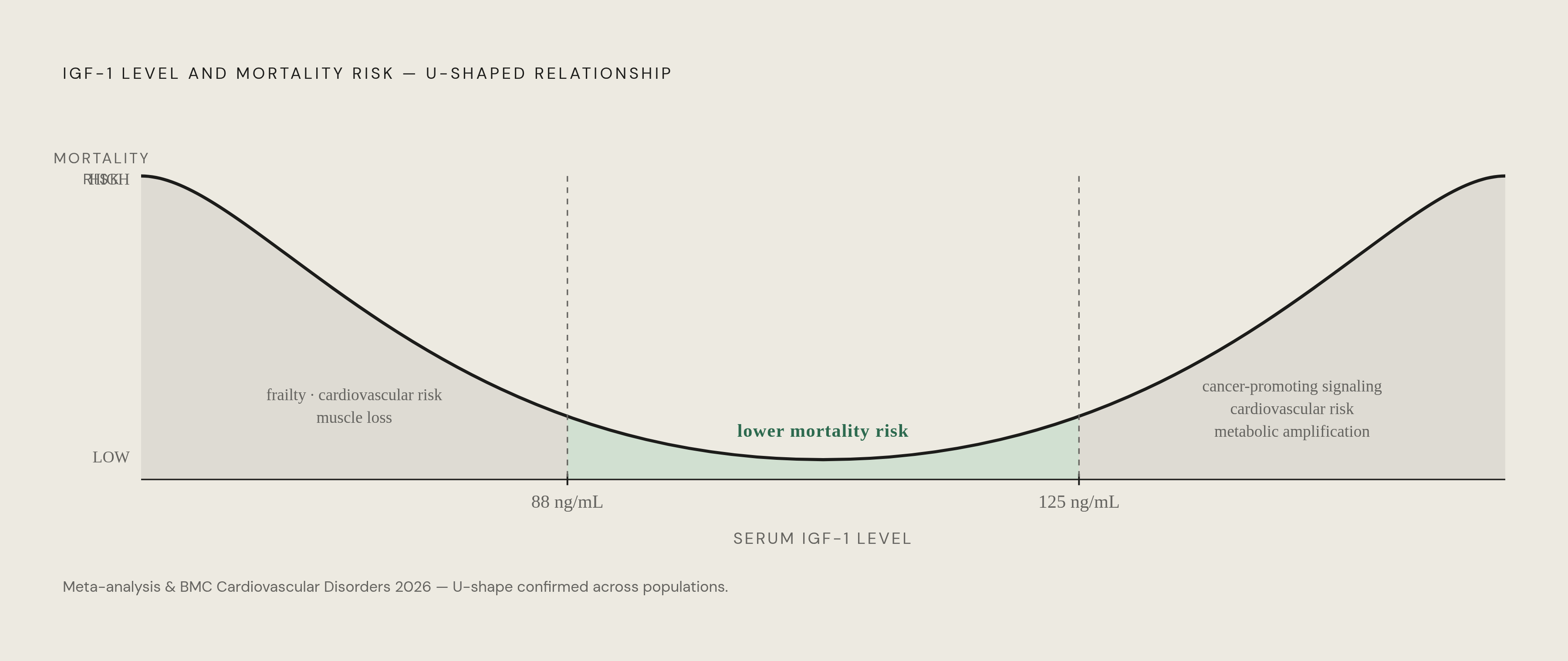
The data on IGF-1 and longevity aren't murky or incomplete. They describe a U-shaped curve, where both very high and very low levels carry measurable risk, and the safest zone sits somewhere in the middle. A large meta-analysis backs this up directly, finding that mortality risk climbs at both ends of the IGF-1 range, not just one.
Start with the high end. A 2026 cohort study in BMC Cardiovascular Disorders confirmed the U-shape specifically for cardiovascular disease, showing that both low and high serum IGF-1 raise cardiovascular risk, partly through effects on triglyceride-glucose-related metabolic markers. Sustained high IGF-1 also lines up with cancer-promoting signaling. The IGF-1/insulin axis interacts with cancer development through several mechanisms: it can suppress normal cell death, feed chronic inflammation, and interact with insulin resistance in ways that compound the risk.
The low end carries its own dangers, and they look different. In observational data, people with acute coronary syndrome tended to have lower baseline IGF-1, while those in the highest IGF-1 quartile had a meaningfully lower relative risk of heart attack. (Framingham data address a related but separate question, heart failure and ischemic stroke risk, not this specific finding about acute coronary events.) Among older men, IGF-1 at or below 88 ng/mL was tied to a much higher chance of developing frailty compared to men with levels at or above 125 ng/mL.
Then there's a third pattern that complicates things further: certain longevity cohorts where lower IGF-1 actually predicts better survival. Milman and colleagues found in a 2014 study that among nonagenarians, women with IGF-1 at or below the median lived significantly longer than women above it. That same pattern didn't hold for men, except in one specific group: people of either sex with a history of cancer, where lower IGF-1 predicted longer survival regardless of sex. The fact that the sex difference shows up at all says something important on its own. IGF-1's relationship to survival isn't the same from one person to the next, even within the same study population.
A 2025 review by Milman in Innovation in Aging looked across epidemiologic and genetic evidence and found that reduced GH/IGF-1 signaling tends to line up with healthier aging and lower rates of cancer, diabetes, dementia, and cardiovascular disease. That's a population-level pattern, though, not a prescription for any one person's blood test. Taken together, this research doesn't support cranking IGF-1 up or pushing it down as far as possible. What it supports is figuring out where a given person sits on that curve, at what point in life, and under what metabolic conditions. Does that answer stay the same across someone's lifespan, or does it shift depending on something deeper in their biology?
A 2026 finding that makes the paradox harder to flatten into a single recommendation
Research from 2026 adds a layer that makes "just lower your IGF-1" harder to defend as a blanket strategy. Shemtov and colleagues, publishing in a peer-reviewed journal, found that reduced IGF-1 signaling usually extends lifespan in mammals and protects against age-related disease, but that benefit disappeared in mice with a specific genetic trait: a mutation causing accelerated damage to their mitochondrial genetic material. In other words, cutting IGF-1 signaling only helped the mice whose mitochondrial genomes were intact enough to make use of it.
That's a meaningful complication. The longevity payoff from lower IGF-1 signaling doesn't come free. It depends on whether the cellular machinery, specifically the mitochondria, is healthy enough to benefit from reduced growth pressure. Two people with identical IGF-1 numbers could be looking at very different biological situations.
Timing seems to matter as much as the level itself. An antibody that blocks the IGF-1 receptor, given late in life, improved healthspan in female mice, extended their median lifespan, and reduced both tumors and inflammation. A separate finding from that research area showed that reducing IGF-1 late in life lowered cancer risk in mice without extending their lifespan, suggesting cancer protection and lifespan extension can split apart as outcomes.
There's no single IGF-1 number to aim for, since the way this signal plays out depends on mitochondrial health, age, sex, and disease history all at once, which makes chasing one ideal number across the board a mistake in reasoning, not just an oversimplification.
What moves IGF-1 up or down
IGF-1 isn't fixed. It responds to daily habits, and the same habit that helps one person might work against another, depending on where they already sit on the U-curve described earlier.
Protein intake drives this more than almost anything else in the diet. Cutting protein too low suppresses IGF-1 fast, regardless of how much someone exercises, and getting enough protein is one of the most important things for keeping the axis functioning, especially for older adults trying to avoid muscle loss.
Sleep deserves just as much attention, maybe more than it usually gets. The largest GH pulses happen during deep, slow-wave sleep, so chronic sleep deprivation blunts GH release and, downstream, IGF-1 production. It's a lever a lot of people overlook simply because sleep doesn't feel like a biological intervention the way diet or exercise does.
Exercise is the strongest natural stimulus available. A 2025 systematic review and meta-analysis found that exercise programs significantly raised serum IGF-1 in older adults dealing with frailty or sarcopenia, and the combination of aerobic and resistance training produced the biggest effect of any approach tested.
On the other side, excess visceral fat and insulin resistance push IGF-1 in the wrong direction. Too much visceral fat suppresses GH output and raises baseline insulin, which compounds metabolic problems through the IGF-1/insulin relationship. Correcting zinc deficiency, vitamin D deficiency, or an underactive thyroid can raise IGF-1 meaningfully on its own, so it's worth ruling out these simpler explanations before assuming a low result means something is broken.
For someone whose IGF-1 reads high, and whose broader picture (metabolic syndrome, a history of cancer) suggests that bringing it down is the right goal, the research points to specific dietary levers. Restricting certain amino acids, methionine in particular, has been shown in both animal and human studies to lower circulating IGF-1, and longer fasting periods produce bigger reductions than short ones.
That sets up a real tension. Exercise and adequate protein, the two habits most commonly recommended for healthy aging, both raise IGF-1. Caloric restriction and amino acid restriction, both linked to longevity signaling in research, lower it. Neither direction is automatically the right one. Which way to lean depends entirely on the individual's own context, not on a general rule.
How to read an IGF-1 result without oversimplifying it
A single IGF-1 number means very little on its own. It only becomes useful once it's read alongside age, sex, body composition, metabolic markers, and how someone is actually functioning day to day. The most honest thing a result can tell a person is which direction deserves more investigation, not what needs fixing.
Testing itself is straightforward. Fasting serum IGF-1 offers the most practical window into how the axis is functioning, and LC-MS/MS or a high-quality immunoassay method gives the most accurate read. No special timing is needed at the draw. Age-adjusted reference ranges matter just as much as the test method, since a number that counts as low for a 35-year-old might be perfectly normal for someone in their 70s. Reading a result without an age-specific range attached is one of the most common mistakes people make with this test.
Context changes what a number should prompt someone to ask. A younger or middle-aged adult with low IGF-1, muscle loss, and fatigue has reason to look into GH deficiency, but liver dysfunction, an underactive thyroid, and inadequate protein intake deserve ruling out first, well before any pharmacological option enters the conversation. Resistance training, enough protein, and better sleep quality come first as practical starting points. Someone with high IGF-1 alongside metabolic syndrome and insulin resistance is looking at a different kind of signal, one that may call for moderating calories or protein and working on visceral fat, since the interaction between IGF-1 and insulin tends to amplify both cardiovascular and cancer risk in that setting. A borderline or unclear result calls for patience more than action: tracking body composition, sleep quality (deep sleep especially), and fasting insulin alongside repeated IGF-1 measurements builds a far more complete picture than any single draw could.
Trend matters more than any one result. IGF-1 declines gradually with age and shifts in response to daily habits, so a pattern across several measurements says more than a snapshot ever could. The goal is understanding where someone's trajectory is heading. And without knowing protein intake, sleep habits, exercise, body composition, and other metabolic markers, there's no way to tell whether a low reading comes from an underactive axis, from calorie restriction, or from the kind of genetic pattern seen in long-lived populations. That distinction determines whether any action is warranted. IGF-1 earns a place in a longevity panel precisely because it's repeatable, affordable, and responsive to the habits that matter most for healthy aging, which makes the next question a practical one: how does someone actually go about getting it measured?
Getting the test: cost and inclusions
IGF-1 testing shows just how much price can swing for the exact same lab work. The same assay, processed by the same reference labs, can cost several times more or less depending purely on where someone orders it.
Pricing varies widely across the market. Hospital outpatient labs tend to charge a steep self-pay rate for this test, while direct-to-consumer options routing through the same national reference labs often undercut that price by a wide margin. Across a broad sample of online direct-to-consumer providers, IGF-1 pricing varies considerably, and some list the test at a notably low starting price while still using major reference labs, with no doctor's visit or insurance required. One direct-to-consumer company prices IGF-1 competitively when it's ordered by itself, with lab processing built into that price and no separate draw fee or physician fee tacked on.
The total price matters more than the number printed on the label. A test advertised at a low price can end up costing more overall once a draw fee gets added, compared to a slightly higher sticker price that includes everything. Comparing the all-in cost, not just the headline figure, is the only way to know what a test will actually run.
Geography plays a role too. Residents of New York, New Jersey, and Rhode Island face state-level restrictions on direct-to-consumer lab testing, and most providers in this space list those three states as excluded.
A test this central to understanding GH axis status, the most reproducible proxy available for it, can be ordered for a modest price with no referral, no insurance card, and no specialist visit required. Knowing the option exists is the real barrier, not cost.
Sources
- Association analysis of insulin-like growth factor-1 axis parameters with survival and functional status in nonagenarians of the Leiden Longevity Study
- The GH/IGF-1 axis in ageing and longevity - PMC - NIH
- GH/IGF-1 Axis as a Gerotherapeutic Target
- The longevity effects of reduced IGF-1 signaling depend on the stability of the mitochondrial genome - PMC
- Exercise interventions and serum IGF-1 levels in older adults with frailty and/or sarcopenia: a systematic review and meta analysis
- Late-life targeting of the IGF-1 receptor improves healthspan and lifespan in female mice
- Cell Metabolism Review The Somatotropic Axis in Human Aging:
- Low insulin-like growth factor-1 level predicts survival in humans with exceptional longevity