Whole-Body MRI Screening for Asymptomatic Adults
Many findings turn out benign, raising concerns about harm from unnecessary follow-up.
Whole-body MRI screening promises to find cancer early in people with no symptoms at all, using a scan that covers nearly the entire body in one session. The evidence so far tells a more complicated story: the scan finds plenty, but what it finds and what actually helps a patient are two very different lists.
How whole-body MRI works
If you get a screening whole-body MRI, it's usually done without intravenous contrast, on a standard-strength scanner. A full session in a structured program typically takes 45 to 55 minutes, though the exact protocol varies from one institution to the next.
No radiation is involved, and no contrast dye is used in the standard protocol. Those two facts make the scan feel low-risk, and that feeling is a large part of why demand for it has grown.
But the breadth of the scan is also where the trouble starts. Radiologists at Fred Hutch and UW Medicine have pointed out that the evidence behind these scans is low on the research hierarchy. Most of what's been studied is how well the exam performs technically, not what happens to the people who get scanned years down the line.
If you skip contrast, you also miss things that contrast-enhanced imaging would catch. Whether those contrast-only findings would have added to patient care is unknown, since they were never seen.
What the scan reliably finds and misses
Whole-body MRI is very good at picking up soft-tissue abnormalities. In clinical screening programs, the findings that most often lead to further workup include complex renal cysts or solid renal masses, liver lesions, complex ovarian cysts or tumors, thyroid nodules, and adrenal adenomas.
What the scan misses matters more. A "clear" result can create false reassurance about the cancers that kill the most people: colorectal, breast, and lung cancer. Those are exactly the cancers that established, guideline-backed screening tests, colonoscopy, mammography, low-dose CT, are built to catch. No study has directly compared whole-body MRI against these organ-specific tests, and no modeling has been done to estimate how the two approaches would stack up against each other.
That gap points to a real asymmetry in what the scan can detect. It picks up soft-tissue incidentalomas, which are usually benign, with high sensitivity. But it misses the early lesions in the GI tract and breast tissue, where early detection could actually change a patient's outcome. This isn't a matter of tuning the machine better. Whole-body MRI wasn't built for either job, and it shows.
Finding rates in asymptomatic adults
For most people who get a whole-body MRI, the experience is walking away with an ambiguous finding, something that showed up on the scan but whose meaning nobody can say for sure, and then entering a process of testing, waiting, and uncertainty to figure out what it is.
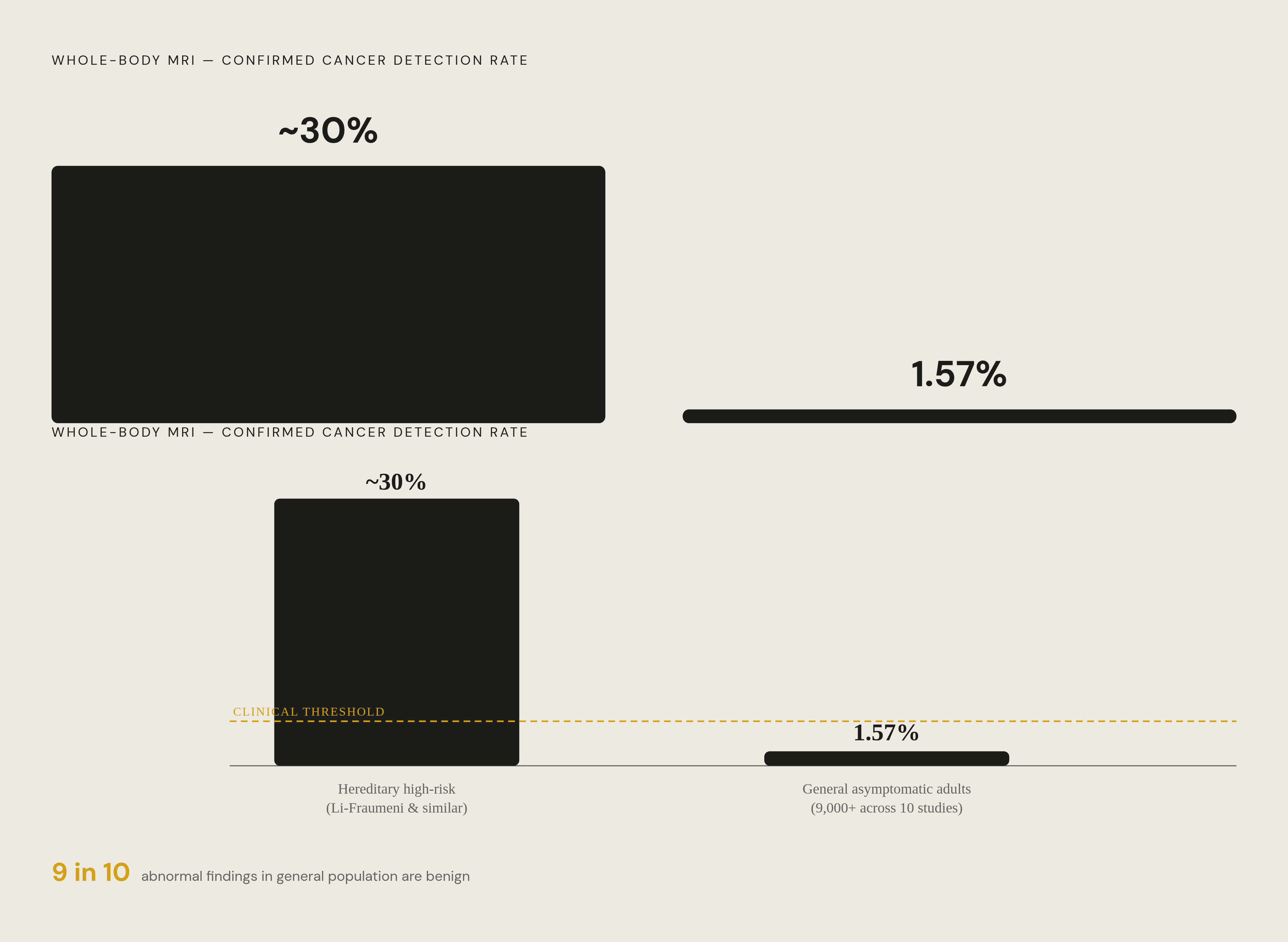
A systematic review and meta-analysis covering ten studies and more than 9,000 asymptomatic adults found a pooled rate of confirmed cancer at about 1.57%. When the analysis was narrowed to the higher-quality studies in that pool, the detection rate dropped closer to 1.2%.
If you look at individual findings rather than whole patients, the numbers tilt even further toward noise over signal. Roughly nine out of ten abnormal findings turned out to be benign and held no oncological relevance. Only a small fraction were potentially relevant and needed further evaluation.
A multicenter study of 327 asymptomatic adults used a classification system called ONCO-RADS to sort findings by how concerning they were. The ONCO-RADS system exists precisely because radiologists have historically classified and described findings so inconsistently that confusion and uneven downstream care became a problem of their own.
What happens after a finding appears on the scan? If you scan the whole body, you will, predictably, find something in nearly every organ system.
Why the cascade from incidental findings causes real harm
None of this is theoretical. The chain of events that follows an incidental finding, more tests, more appointments, more waiting, carries real costs: psychological, physical, and financial. Those costs land on the patient whether or not cancer is ever found.
On the psychological side, studies show that if you get an uncertain or indeterminate result, your short-term anxiety and health-related worry go up. But if a result settles down after two or three years, that doesn't erase what happened during that window, which often includes invasive follow-up procedures carrying their own risks.
You can see the financial side clearly in a German population-based cohort. Pancreatic cysts offer a concrete example: a common incidental finding that, once flagged, tends to generate its own trail of downstream tests, with costs climbing further whenever additional testing gets ordered.
There's an equity angle too. The Canadian Association of Radiologists, in a policy statement issued in September 2025, pointed out that whole-body screening is marketed as empowerment and peace of mind but often delivers the opposite: uncertainty, overdiagnosis, and harm. Insurance rarely covers the initial scan if you have no symptoms, but once a finding triggers follow-up care, those downstream costs often do get billed to insurance, so the financial burden shifts onto the broader healthcare system.
Where whole-body MRI has demonstrated genuine clinical value
None of this means whole-body MRI lacks value. It has real, guideline-supported use in people who carry a high hereditary cancer risk, and understanding why sharpens the case against using it as a general screening tool.
Li-Fraumeni syndrome is the strongest example. In a prospective cohort study presented at ASCO's annual meeting (Abstract 10501, Dana-Farber Cancer Institute), most cancers found through whole-body MRI screening in Li-Fraumeni patients were still localized when caught, so doctors could treat them with the intent to cure.
Other inherited conditions carry formal or partial recommendations for the scan. Hereditary paraganglioma-pheochromocytoma syndrome has support from AACR guidelines. Across this group, whole-body MRI is an established tool if you're a child or adult who carries a high genetic risk of cancer, and Li-Fraumeni syndrome has the strongest evidence behind it.
The numbers back this up. The 1.1% to 1.6% detection rate in general asymptomatic populations is far lower.
That gap comes down to pretest probability. In a population where roughly one in eight people will develop cancer, a test with modest specificity earns its cost. If a test proves useful in high-risk patients, that doesn't mean it carries over to the general public by analogy. These are different populations with fundamentally different odds, and a test proven useful in one has no automatic claim to usefulness in the other.
How major medical bodies and academic institutions are positioning on general-population screening
The formal consensus among medical organizations leans against recommending whole-body MRI for people with no symptoms and no elevated risk. Even the academic programs that choose to offer it anyway tend to say openly that the evidence isn't there yet.
The Canadian Association of Radiologists' September 2025 policy statement called whole-body MRI screening in asymptomatic individuals an inefficient and inequitable use of healthcare resources, one that tends to deliver uncertainty, overdiagnosis, and harm rather than the reassurance it's sold on. The American Academy of Family Physicians advises, through its Choosing Wisely guidance, against whole-body scans for early tumor detection if you have no symptoms. The American College of Radiology said the evidence was insufficient to recommend total-body screening for people without symptoms, risk factors, or a family history suggesting underlying disease or injury. A systematic review and meta-analysis concluded that whole-body MRI lacks the diagnostic yield, follow-up data, and standardization needed for opportunistic cancer detection in asymptomatic people, and that it may lead to unnecessary testing.
Some academic medical centers are moving forward regardless, but with conditions attached. Other academic institutions are holding back, citing the same lack of outcomes data that the professional bodies point to.
The split comes down to what surrounds the scan: standardized reporting, access to specialists, continuity of care from one visit to the next. Institutions building that infrastructure around the scan are implicitly acknowledging the same distinction drawn in the last section: a high-risk patient with a genetic syndrome and a support system of specialists is in a different situation than a healthy adult booking a scan on their own.
The evidence gap that makes all other questions premature
Every question raised so far, what the scan finds, what it misses, who it helps, runs into the same wall eventually. So far, no study has shown that whole-body MRI screening saves lives.
No randomized controlled trial has compared people who get the scan against people who don't. The entire evidence base rests on observational cohort studies, and those studies can't tell you whether finding cancer earlier this way actually leads to better outcomes down the road. Without mortality data, the field can't answer the question that matters most: if a scan finds a cancer that would otherwise have been found later, or never found at all, does that change how long someone lives, or how well?
Two statistical traps make this question harder than it sounds. If you detect a cancer earlier, survival-from-diagnosis can look longer because of lead-time bias, even when the disease's actual course never changes. Overdiagnosis adds another layer: some cancers detected through screening are real tumors that would never have caused symptoms or death if left alone.
A screening test earns its place by meeting several conditions. It has to be minimally invasive, catch disease before symptoms appear, and, by catching it early, improve survival compared to catching it after symptoms show up. Whole-body MRI clears the first bar easily. It hasn't cleared the third.
Whole-body MRI could still prove its worth, but it hasn't yet, and right now, people spending thousands of dollars on the scan, and health systems absorbing the costs that follow, are acting on hope.
What a scan costs
The price tag on the scan is only the opening cost. What follows it, specialist visits, repeat imaging, sometimes a procedure, adds expenses most people never factor in when they book the appointment.
Cash-pay screening clinics charge between $650 and $3,999 in 2026 for a full-body MRI, with the price depending on the provider, how long the scan takes, and how many organ systems it covers. Insurance rarely pays for this when there are no symptoms to justify it, so out-of-pocket payment is the normal arrangement.
The real financial exposure sits downstream. Pancreatic cysts, a common incidental finding, carry a mean evaluation cost per cyst that climbs further whenever additional testing gets ordered. In the German population-based cohort mentioned earlier, two-year outpatient costs ran 11.6% higher on average among people whose scans led to further evaluation, driven mostly by imaging and specialist visits, and that cost increase appeared even among people whose scans found nothing.
So whether a whole-body MRI program makes financial sense as a public health tool comes down to how much cancer it actually catches. Threshold modeling suggests a program would need an actionable cancer yield at or above what current studies report if it's going to be cost-effective under standard frameworks. That margin is thin, and the studies behind it come from populations that may not look like the average person considering the scan today.
One practical note for anyone weighing the cost: a whole-body MRI may count as a deductible medical expense under IRS Publication 502 when it's performed for diagnostic or medically justified preventive reasons, which can lower the after-tax price for people who decide to go ahead with it. That eligibility isn't automatic and depends on proper medical justification.
Weighing the Decision as a Healthy Adult
The most useful thing a healthy adult can do before booking a whole-body MRI is get clear on what question they're actually trying to answer. The scan answers a different set of questions than most people assume going in.
Is there a known hereditary cancer syndrome in the family, or a first-degree relative with one, that would push cancer risk well above the general population? If so, the entire risk-benefit calculation changes, and a conversation with a genetics counselor or physician makes sense before any imaging happens. Are routine, guideline-backed screenings already up to date, mammography, colonoscopy, low-dose CT for eligible smokers, cervical and prostate screening as appropriate? A whole-body MRI doesn't substitute for any of these, and a clean result on one doesn't mean the others can be skipped. Is there a tolerance for the real possibility of walking away with an indeterminate finding, one that triggers months of follow-up imaging or a procedure, with no guarantee the finding ever amounts to anything? And is there room in the budget for costs beyond the scan price itself, in case follow-up care becomes necessary?
Programs using a standardized reporting system like ONCO-RADS, read by subspecialist radiologists in neuroradiology, body imaging, and musculoskeletal imaging rather than generalist readers, tend to produce more consistent and useful reports. Academic medical centers often bring structural advantages that standalone commercial clinics can't match: access to a patient's prior scans, a built-in referral network, and continuity of care if something needs following up. You should also ask ahead of time whether results come with a plain-language explanation alongside the clinical report, because delayed or poorly explained results tend to add anxiety that a clearer conversation could have prevented.
If early detection is your main motivation, you can also consider blood-based biomarker testing alongside, not instead of, guideline screening. Cardiovascular risk markers, metabolic panels, inflammatory markers, and hormone levels can flag real, actionable risk factors for a fraction of the cost, without setting off an imaging cascade. Paired with routine, evidence-backed screening, a disciplined biomarker testing approach gives many people a more solid, evidence-grounded starting point than a scan whose biggest promise, that finding more means living longer, remains unproven.
Sources
- Whole-body magnetic resonance imaging for cancer screening in asymptomatic adults: a multicenter study - PubMed
- Whole-body MRI and cancer screening - Fred Hutch
- Whole-body MRI for opportunistic cancer detection in asymptomatic individuals: a systematic review and meta-analysis - PubMed
- Applying ONCO-RADS to whole-body MRI cancer screening in a retrospective cohort of asymptomatic individuals