Continuous Glucose Monitor Use in Non-Diabetic Adults
Healthy adults with CGM data need context to interpret what it means.

Using a continuous glucose monitor in non-diabetic adults raises a useful question about what counts as healthy metabolism. Glucose is not simply normal or abnormal, and a CGM can reveal differences that standard blood tests miss. But having more data does not always lead to better health. The data helps when patterns are understood in context and each rise is kept in perspective.
How glucose monitoring moved from a clinical tool for diabetes management to a consumer product for healthy adults
Continuous glucose monitoring was traditionally a tool for managing diabetes. Over-the-counter devices have widened access beyond people with a prescription or diagnosis. That shift reaches a large population, including tens of millions of US adults with prediabetes and millions taking GLP-1 drugs. People in either group may or may not use insulin, but both groups have reasons to watch glucose.
Dexcom Stelo and Abbott Lingo bring this monitoring into consumer use. Stelo reads at regular intervals and displays trends across a defined range, while Lingo reads more frequently. Each uses the same sensing platform as its prescription version, but has different app features, is cleared for different users, and differs in some hardware specifications. Access is now easier than interpretation. What does a CGM actually show a healthy adult, and what should they do with it?
Why glucose behaves differently in healthy adults than the binary diabetic/non-diabetic framing suggests
Hall et al.’s study of 57 healthy volunteers showed why a normal lab result does not tell the whole story of a person’s glucose response. Participants classified as normoglycemic by standard criteria still spent measurable time above prediabetic and diabetic thresholds. Those excursions were invisible to their fasting glucose or HbA1c results.
CGM captures the distribution of glucose across days and conditions. Researchers can use those patterns to group people into distinct “glucotypes,” reflecting differences that a simple diabetic/non-diabetic label leaves out. Healthy adults are not all metabolically alike. Those differences need to be understood before deciding whether a pattern is a cause for concern.
What actually moves glucose in healthy people — food composition, exercise type, and psychological stress each play a distinct role
The CGM-HYPE study, published in November 2025 in PLOS Digital Health, helps explain what a sensor responds to during daily life. In controlled conditions, foods rich in carbohydrate caused the largest food-related rises in glucose among the healthy people in the study. A rise after eating cannot be interpreted as though it happened during fasting. Nor can the shape of that rise be separated from the other conditions surrounding the meal.
Exercise adds a less intuitive distinction. The study clearly characterized a much larger glucose excursion from anaerobic exercise, including high-intensity and resistance activity, than from aerobic exercise. A rise after weightlifting can therefore be a normal physiological response. Treating all exercise as something that must immediately lower glucose would misread what the device shows.
Psychological stress can change glucose on its own, apart from food or exercise. The study’s Trier Social Stress Test produced a significant difference in baseline-corrected glucose over time. A food log alone would miss that effect. For someone interpreting a rise at home, the preceding hour of activity and stress is therefore part of the evidence. The sensor shows what happened, but not why it happened.
Where CGM data in non-diabetic adults has genuine predictive value — the cardiovascular and metabolic risk signal
The Framingham Heart Study CGM substudy, published in Diabetes Care and reported in October 2026, moves the discussion beyond interesting individual responses. It analyzed data from over a thousand adults without diabetes and found a gradient in predicted cardiovascular risk. Adults with high glycemic burden and high variability had meaningfully higher predicted 10-year CVD risk than those with low burden and low variability. The signal was not limited to fasting glucose. More time above 140 mg/dL was independently associated with higher odds of hypertension and dyslipidemia beyond what fasting plasma glucose predicted.
This is the strongest population-based evidence described here for CGM as a risk-detection tool in adults without diabetes. But prediction is not proof of prevention. The findings show associations and estimated risk. Whether CGM-guided behavior change reduces cardiovascular events remains an open research question. That distinction separates a promising marker from a proven intervention.
Higher ApoB levels are significantly associated with higher fasting glucose, HbA1c, and HOMA-IR, and the highest ApoB quartile had substantially higher odds of prediabetes than the lowest. The link between them supports looking at ApoB and CGM data together to get a fuller picture of cardiovascular health than glucose alone can give.
How hormonal status and age shape the glucose patterns a CGM reveals
The PREDICT 1 cohort found distinct glucose patterns in post-menopausal women compared with pre-menopausal women. Post-menopausal participants had higher postprandial glucose area under the curve, greater glycemic variability, and less time in range. What people ate and the makeup of their gut microbiome helped account for those differences. Hormonal context changes how the trace should be understood. A single HbA1c or fasting glucose result would not describe these daily patterns.
Older adults without diabetes also tend to have somewhat poorer glycemic control than younger adults, with more hyperglycemic excursions and less hypoglycemia. CGM can characterize those differences continuously rather than relying on what happens during a clinic visit. Age is therefore another part of the interpretation. These gradual, often asymptomatic changes make the data potentially more informative in these groups, but do not establish that every older adult or post-menopausal woman needs a sensor.
What the research actually shows CGM changes — and what it doesn't — in non-diabetic users
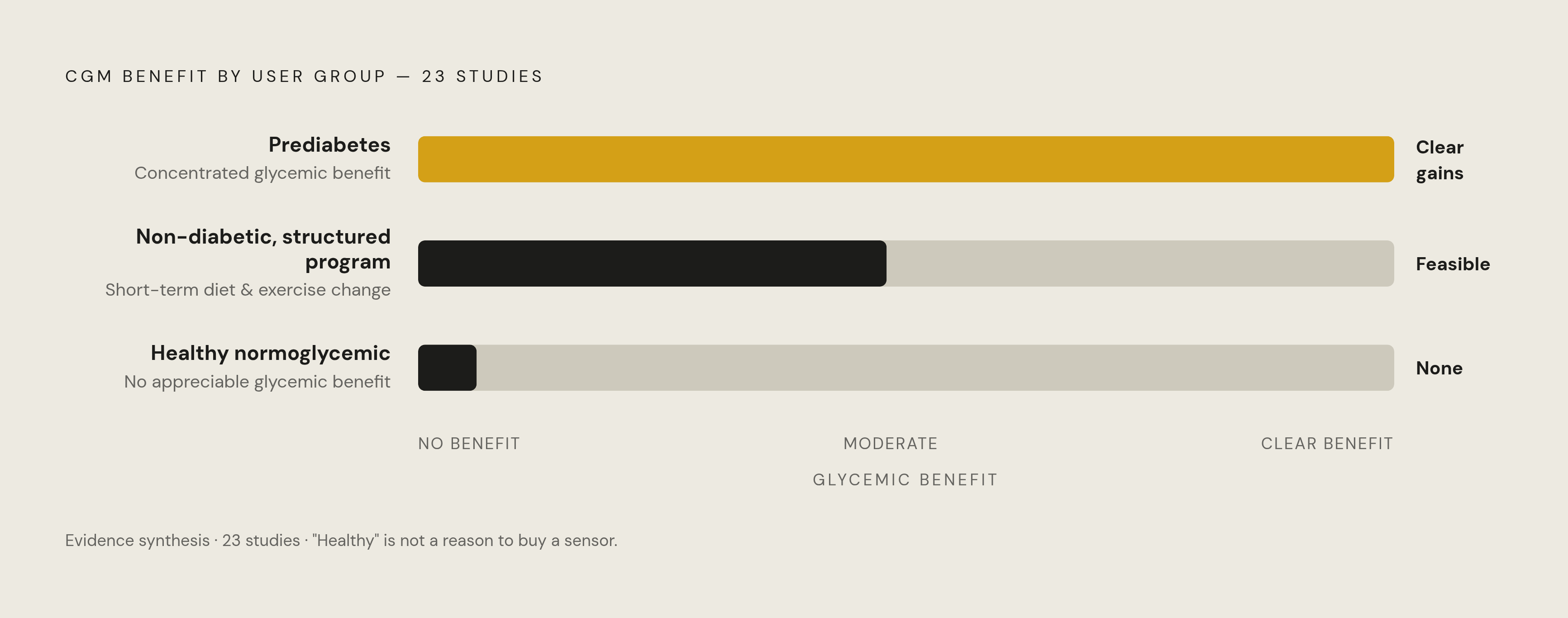
Finding a risk signal is different from improving an outcome. The 2026 evidence synthesis covering 23 studies and over a thousand non-diabetic participants found that CGM improved mean blood glucose compared with controls, but produced no significant effect on BMI. The glycemic benefit was concentrated in people with prediabetes. Healthy normoglycemic participants showed no appreciable glycemic benefit. Across the evidence, improvements in glycemic variability were not consistent either.
CGM can support adherence to lifestyle interventions and is feasible for changing short-term dietary behavior. It can also increase readiness for physical activity and help personalize exercise timing. For example, using feedback to initiate walking before an individual’s postprandial glucose peak significantly reduced postprandial glucose, insulin, and C-peptide levels.
How long do those changes last without support? That is still unclear, and the evidence so far does not show measurable long-term gains in health from CGM use in people without diabetes. The evidence here gives the most support to using precision biofeedback as part of a structured lifestyle program. The device supplies feedback about a change, while the program supplies a framework for interpreting and sustaining it.
The real risks of using CGM without clinical context — anxiety, misinterpretation, and the orthorexia concern
Researchers at University College London and Birmingham Children’s Hospital warned that using CGM in people without diabetes may lead to anxiety and food restriction, including orthorexia. They also identified a lack of consistent, high-quality evidence supporting its use in this population. This is a substantive clinical concern. A person can become more attentive to glucose while developing a less healthy relationship with food. The psychological cost belongs in the decision.
Michael Fang, PhD, MHS, assistant professor at the Johns Hopkins Bloomberg School of Public Health, described the interpretation gap in January 2026. “In people without diabetes, we don't really know how to act on differing glucose patterns. All the clinical information about how to interpret and act on the information from CGMs is for people with diabetes.” Clinically validated benchmarks and scoring procedures remain insufficiently established for non-diabetic users.
One hazard is treating diabetes-related thresholds as hard limits that healthy people must never cross. Brief excursions can occur with exercise, stress, or carbohydrate-rich meals, so a threshold crossing alone does not establish that something is wrong. Another hazard is narrowing attention too far. CGMs measure glucose, while cholesterol, triglycerides, and blood pressure fall outside their scope and may have equal or greater cardiovascular relevance. A smoother glucose line is not a complete definition of health.
How to use CGM data wisely — what to look for, what to ignore, and how to pair it with the lab markers that give it context
The practical lesson is to use CGM for pattern recognition across days and conditions, rather than as a moment-to-moment alert system. Look at time in range and overall variability over several days, and bear in mind the limits of non-diabetic benchmarks. Compare how the same meal or activity produces different responses on different days. Context makes those comparisons useful. A larger excursion after anaerobic exercise, for example, need not be worse than a smaller one after aerobic activity.
Hold isolated threshold crossings lightly when there is no other context. The same caution applies to any app alerts calibrated for diabetic users, whose clinical meaning may differ for a normoglycemic adult. The goal is to identify recurring patterns and test specific dietary or exercise hypotheses without turning normal variation into a running score of success or failure.
Keep standard lab testing in the picture. Fasting glucose and HbA1c remain validated screening tools for prediabetes and diabetes, and CGM complements them. ApoB, CRP, triglycerides, and insulin resistance markers such as HOMA-IR can add information the sensor cannot provide. A clinician can consider these with the glucose patterns to build a fuller assessment of metabolic risk. No single measure answers every question.
Broader tracking can also help place readings in context. Oura launched a Glucose feature in May 2025 that shows Dexcom Stelo readings alongside data on sleep, stress, and activity, as well as AI-driven insights into the nutrition in meals. Monitoring need not be indefinite. A one-time or periodic session can establish a baseline and test a focused question at lower financial and psychological stakes.
What OTC CGMs cost and how to approach the decision without overpaying
OTC CGMs are not covered by insurance for non-diabetic wellness use, so purchase structure affects the out-of-pocket expense. Dexcom Stelo’s September–October 2026 options included a one-time purchase of two biosensors, each lasting up to two weeks, for roughly a month of data. A monthly subscription supplied two sensors at a modest saving over the one-time price. For a single metabolic check-in, the two-pack was the most cost-effective entry point. A subscription saving is relevant only if ongoing monitoring is actually wanted.
Abbott Lingo offered single-sensor, two-sensor, and multi-sensor plans during the same period, with the per-sensor cost falling as the plan lengthened. Subscription platforms that offered coaching and used FreeStyle Libre sensor hardware charged much more each month. The premium paid for proprietary analytics and dietitian coaching. Its value depends on whether someone needs guided interpretation or can analyze trends independently. Buying more sensors and buying more support are different decisions.
Both OTC devices qualify as eligible medical expenses under FSA and HSA accounts without a prescription under current IRS guidelines, including the device, sensors, and transmitters. That can reduce the effective out-of-pocket cost for eligible account holders. A focused trial keeps the commitment limited. For most non-diabetic readers, a single 30-day trial with two Stelo sensors offers a low-commitment way to establish a personal baseline and test a dietary or exercise question. After that, the decision to continue can rest on what remains to be learned, rather than on anxiety about going without the numbers.
Sources
- Continuous glucose monitoring in non-diabetic populations: a systematic review of observational and interventional studies with meta-analysis
- Use of Continuous Glucose Monitoring in Non-diabetic Individuals for Cardiovascular Prevention: A Systematic Review of Its Impact on Guiding Lifestyle Interventions
- Is Glucose Monitoring Useful for Non-Diabetics?
- Editorial: Continuous glucose monitoring: beyond diabetes management
- The efficacy of using continuous glucose monitoring as a behaviour change tool in populations with and without diabetes: a systematic review and meta-analysis of randomised controlled trials
- Continuous Glucose Monitoring under standardised conditions regarding diet, exercise and stress in Healthy Young People (CGM-HYPE study): An exploratory clinical trial
- Glycemic Variability and Control by CGM in Healthy Older and Young Adults and Their Relationship With Diet
- Continuous Glucose Monitoring for Metabolic Phenotyping and Precision Nutrition: Current Evidence, Clinical Applications and Future Perspectives