At-Home Finger-Prick Blood Tests vs. Venipuncture Accuracy
Accuracy depends on which biomarker and collection method you use.

At-home finger-prick blood tests can give results that match venipuncture for some biomarkers but are misleading for others. Their accuracy depends on what is being measured, how the sample is collected, and how the lab processes it. The useful choice is therefore not between two methods in the abstract, but between collection pathways for each test and the decision its result will inform.
Why the finger-prick versus venipuncture debate is framed wrong
“Is finger-prick accurate?” sounds like a straightforward question. But accurate for which marker, under which collection conditions, and for what purpose? A method that works well for HbA1c can be unreliable for potassium, even when both appear on the same panel.
The WHO guidelines describe capillary blood as a mixture of arterial blood, venous blood, and interstitial fluid. It is not simply venous blood obtained through a smaller puncture. Some results differ because of what is in the sample, even when it has been collected well.
Most error originates before analysis, during collection, handling, and shipping. Even a precise instrument cannot undo changes that have already happened in the sample. A particular marker must tolerate that collection pathway well enough for the intended use. Hemolysis and physiological capillary bias are two ways that pathway can fail.
How hemolysis and capillary physiology introduce error before the lab sees the sample
Hemolysis means that red blood cells have ruptured. Squeezing a fingertip during collection can damage those cells, releasing their contents into the plasma. Potassium, AST, LDH, and ferritin can then appear higher than they should. Capillary samples have much higher rates of hemolysis and lab rejection than venous specimens, so some samples never give a usable result.
Physiological bias is different because it does not require damage. Glucose is measurably higher in capillary blood because of its arterial component. Careful technique cannot remove that biological difference. Tissue-fluid contamination also changes the sample’s composition, making dilution another concern when interpreting an absolute plasma concentration.
Handling and preparation can compound these underlying problems. Not fasting when required, measuring hormones at the wrong time of day, and shipping delays can all add error. Even small absolute errors matter a great deal when concentrations are low. That is why some sex hormones need a closer look than markers measured at higher levels, even when the samples seem to have been collected equally well.
Markers where capillary sampling reliably matches venous results
HbA1c has a strong record of capillary–venous agreement across comparison studies. It is measured as a percentage of red cells rather than an absolute plasma concentration, which makes it relatively robust to dilution during capillary collection. That gives it a useful built-in advantage. The sample still needs to be collected correctly.
A 2026 UK primary care study found that results for TSH and vitamin B12 from a capillary collection device closely matched those from venous samples. Those findings support only the tested pathway. Vitamin D belongs among the markers broadly suitable for capillary screening, with validation necessarily drawn from evidence beyond this study’s analytes.
Several comparison studies show that CRP results agree well at typical clinical levels, which supports using finger-prick tests for population-level screening. Variability increases at higher CRP values, however. The evidence-backed safe zone for home-panel results is bounded by the ranges studied.
Enable Biosciences Inc.’s 2020 serological assay study, published in Scientific Reports, found 100% sensitivity and specificity using finger-prick dried blood spots that US participants collected at home. The assay detected SARS-CoV-2 antibodies. Its performance shows what a specifically designed and validated dried blood spot, or DBS, assay can achieve. It does not establish the same performance for unrelated antibodies, hormones, or chemistry tests.
Markers where finger-prick results are clinically unreliable and venipuncture is necessary
Potassium provides the clearest counterexample to those successes. The UK study found that it failed every interchangeability criterion, with a mean difference of more than ten percent against venous results. The authors called capillary potassium clinically unreliable. Because damaged cells release potassium into the sample, even modest hemolysis can give a reading that suggests a clinical problem where there is none.
LDH is also extremely sensitive to red cell damage. Mild hemolysis can inflate its apparent level enough to make capillary results unusable for clinical interpretation. AST rises through the same intracellular-release mechanism and belongs with potassium and LDH among markers that should not be reported from capillary samples. These are known vulnerabilities that compromise clinical interpretation.
White cell differential and platelet counts face another collection problem. Mechanical trauma from lancing and squeezing activates neutrophils and introduces tissue thromboplastin, skewing those readings. Glucose has the physiological offset described earlier. A published 34-analyte comparison study found that glucose alone failed CLIA acceptance criteria, showing why capillary and venous glucose cannot simply be treated as interchangeable.
For panels intended to provide these clinical measurements, venipuncture is required. A finger-prick result should not be treated as an equivalent substitute because the collection was convenient or the laboratory instrument was precise. Including these markers without explaining their limitations can prompt unnecessary follow-up or false reassurance.
The contested middle — hormones and lipids where collection quality determines the verdict
Hormones and lipids sit between clear agreement and clear failure. Their interpretation depends on collection quality, tube type, concentration, medications, and what will happen next. Is the result an initial screen, or will it change treatment? A result can be useful for the first purpose without being dependable enough for the second.
Testosterone is particularly difficult at the low concentrations found in female reference ranges. A small absolute error can be a large percentage error, which makes finger-prick testosterone especially unreliable for women. Estradiol is similarly difficult to measure accurately at low concentrations. Venipuncture is therefore the preferred method when an estradiol result moves beyond a preliminary signal to inform a clinical or therapeutic decision.
Topical hormones introduce a separate risk of external contamination. Gels applied to the hands or fingers can falsify capillary hormone results entirely. Medichecks explicitly recommends venous collection for anyone using hormone gels, regardless of which hormone is being measured. This is not an error that careful interpretation of a borderline number can resolve.
Capillary cholesterol results can show positive bias and still have a meaningful false-negative rate for elevated cholesterol. For hormones and lipids, finger-prick testing can be a reasonable first screen, but borderline or unexpected findings need venous confirmation before they drive dose changes, referral, or a lifestyle intervention.
Where the evidence has not yet reached — ApoB, proteomics, and the longevity marker gap
ApoB exposes a gap between clinical importance and capillary validation. The 2026 ACC/AHA Dyslipidemia Guideline gives it elevated standing, particularly for patients with diabetes, hypertriglyceridemia at TG ≥150 mg/dL, or low achieved LDL-C. ApoB directly counts atherogenic lipoprotein particles, a distinct measure from estimated cholesterol content. It is not meaningfully affected by fasting status and remains reliable where calculated LDL fails, making accurate measurement especially valuable.
Yet a promising assay is not a validated collection pathway. A 2026 proof-of-concept study in Analytical Science Advances found that full clinical interchangeability could not yet be assumed for dried blood spot ApoB. The study used venous blood to prepare the spots and did not directly evaluate capillary finger-prick DBS. That missing comparison leaves finger-prick ApoB’s performance unestablished and is a reason to choose venipuncture when ApoB is on the panel.
A 2025 King’s College London study published in Proteomics: Clinical and Applications found no prior studies comparing venous and capillary collection for proteomic measurement. That gap becomes more consequential as protein panels for biological aging expand. Clinical ambition does not substitute for specimen validation, so the case for venous collection extends to these emerging panels.
How device design and lab accreditation determine whether any collection method reaches its potential
The marker is only one part of the system. Even where capillary testing is well supported, a particular service depends on its collection device and processing laboratory to reach that potential. Two finger-prick kits measuring the same marker can produce meaningfully different results because their collection mechanisms differ. Evidence for an engineered device cannot be taken as proof that a generic lancet kit works as well.
BD and Babson Diagnostics published studies showing clinical equivalence between the BD MiniDraw Capillary Blood Collection device and venous draws across most of a curated analyte set, with exceptions. A 2025 peer-reviewed study in the Journal of Applied Laboratory Medicine reported clinical equivalence across 39 analytes for the Babson BetterWay system. That system combines MiniDraw with Babson’s sample preparation device and hand warmer. The result applies specifically to that whole system.
CLIA certification in the US and ISO 15189 / UKAS accreditation in the UK set baseline requirements for analytical quality once a sample arrives. A well-collected specimen can still be poorly processed. Even an accredited laboratory cannot undo the damage that hemolysis has already done to a specimen.
Analytical methods also need validation for the sample they receive. Techniques such as LC-MS/MS and HPLC can produce equivalent quantification from DBS or venous plasma when properly calibrated. For a consumer choosing a test, the practical disclosure questions are which laboratory processes the sample, what accreditation it holds, and whether the specific device has been validated for the specific marker.
A working framework for choosing the right collection method, marker by marker
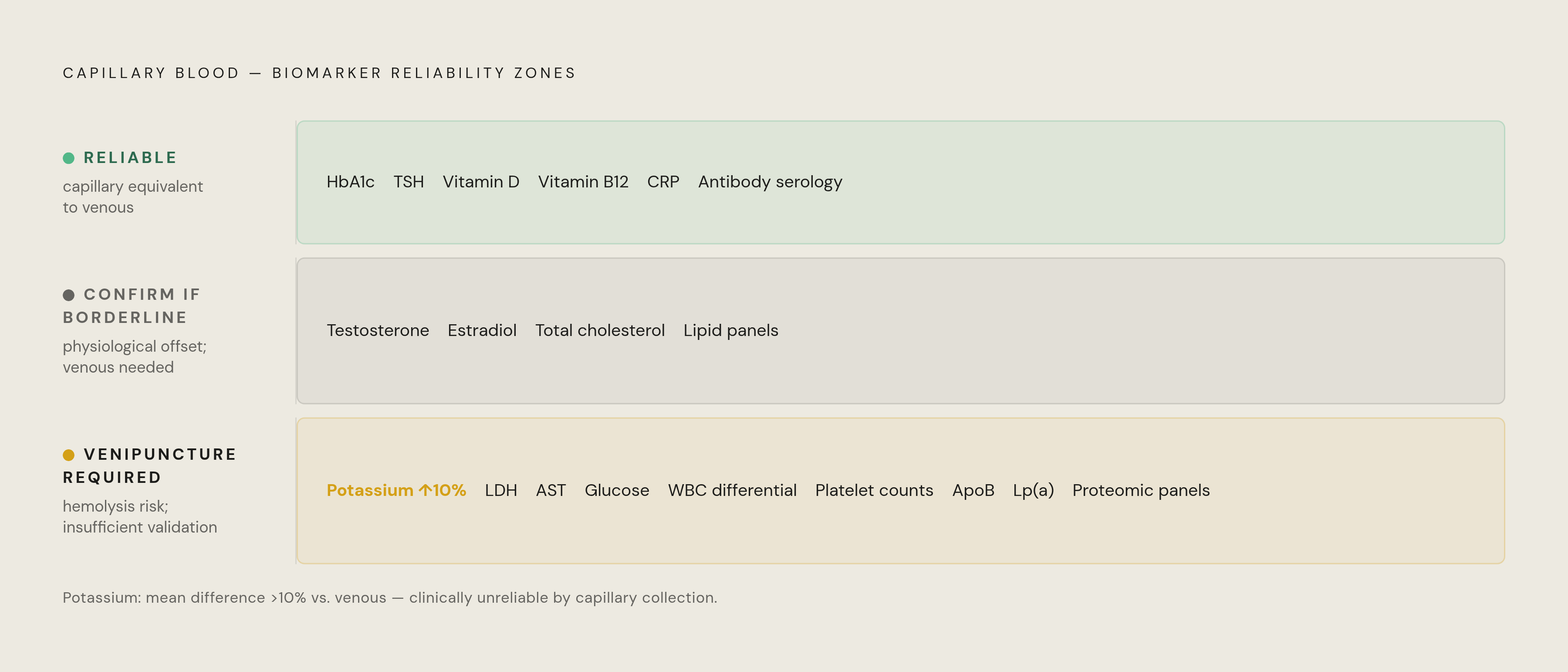
The practical choice follows three questions in sequence. Is the marker validated for capillary collection? What decision will the result inform? Does the kit disclose its device, laboratory, and validation?
For screening and trend monitoring, the green zone includes HbA1c, TSH, vitamin D, vitamin B12, and CRP at typical clinical levels, provided the collection pathway is appropriately validated. Antibody serology also fits when a validated DBS assay exists for the specific analyte. These are reasonable options for tracking stable markers or beginning a clinical conversation. Their inclusion does not validate every other marker bundled into the same panel.
The red zone requires venipuncture for potassium, LDH, AST, white cell differential, and platelet counts, while glucose needs recognition of its physiological capillary offset. ApoB, Lp(a), and proteomic panels also belong on the venous side because capillary validation is insufficient to support clinical decisions. These are different reasons for the same choice.
The gray zone includes testosterone, estradiol, total cholesterol, and lipid panels. Finger-prick results can begin screening, but diagnostic decisions, borderline findings, and unexpected results require venous confirmation, with particular caution for hormone measurements in women. People using topical hormone preparations should default to venous collection. When an abnormal result from a single home test will directly guide treatment or referral, the appropriate next step is a confirming venous draw and a clinician conversation.
Sources
- Studies Confirm: New Fingertip Blood Collection Device Has Equivalent Testing Accuracy of Higher-Volume Draws from Vein
- A serological assay to detect SARS-CoV-2 antibodies in at-home collected finger-prick dried blood spots
- Full article: Comparing capillary blood collection technologies: assessing patient experience, device performance, & clinical accuracy