STI Testing at Home Versus a Clinic
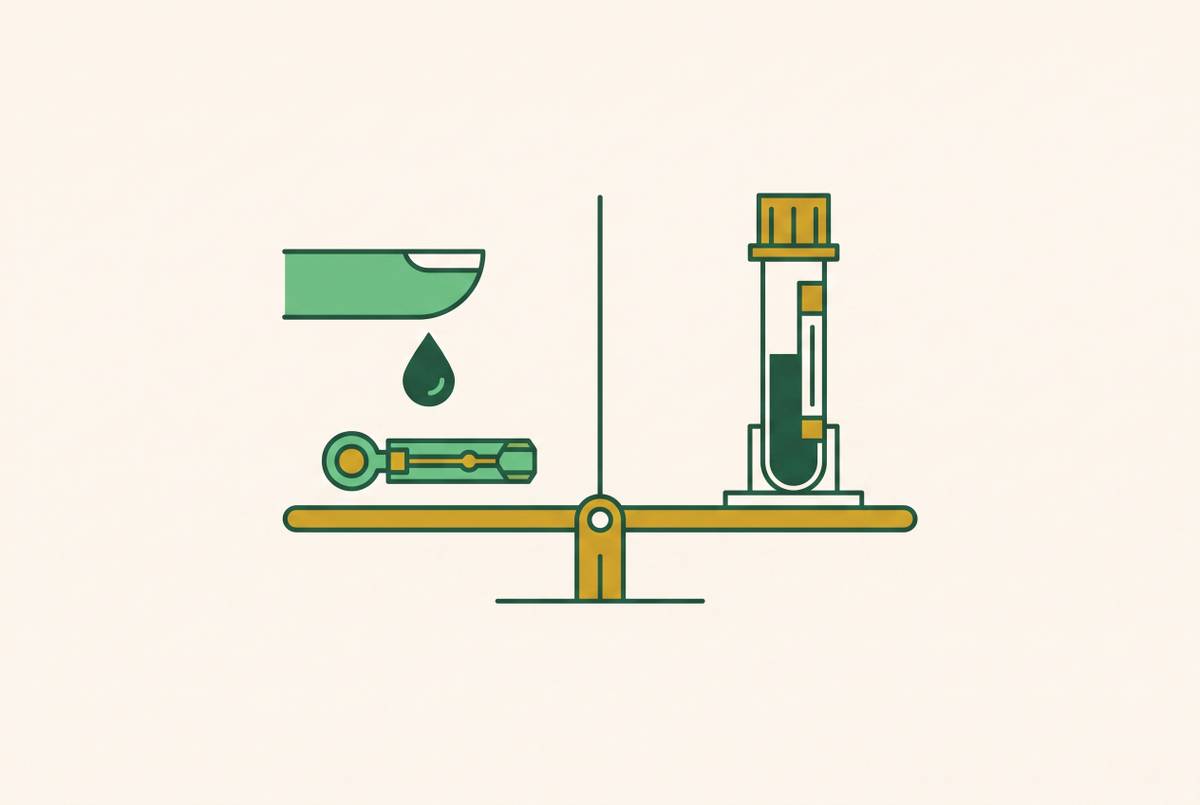
The choice between home and clinic testing depends on infection type, timing, and follow-up care.
At-home and clinic-based STI testing are both legitimate options, but neither is the right choice for every situation. A reliable result depends on the infection, the time since exposure, and correct sample collection. Choosing well also means knowing what happens next, because you may still need clinical care if a test finds an infection.
Why the home-versus-clinic framing misses the real question
What does “better” mean when comparing two testing settings? It could mean a test that detects an infection reliably, a service someone can actually access, or a direct route to treatment. Those are different questions with different answers. The three variables that organize the decision are infection type, timing, and follow-up.
A NAAT-based mail-in kit that a certified laboratory processes uses the same laboratory science as clinic testing. Samples must be collected correctly and tested after the infection’s window period, and a clinic may be needed to provide treatment, handle partner notification, and ensure anatomical-site coverage.
How at-home test kits actually work, and where the accuracy claims come from
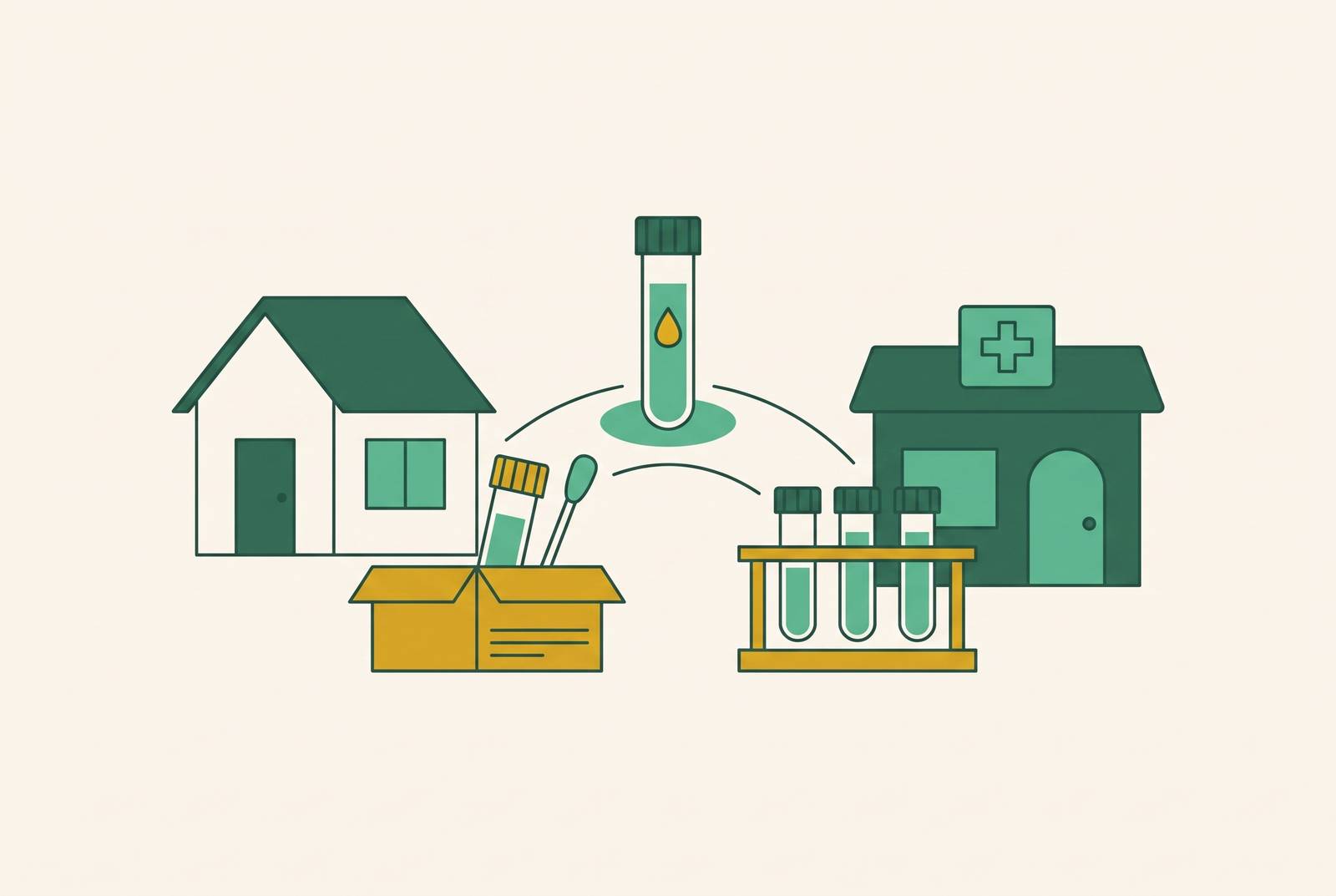
“At-home STI test” describes two distinct kinds of testing. With a mail-in kit, a person collects urine, a swab, or finger-prick blood and sends it to a laboratory. Reputable kits use certified laboratories and the same NAAT or antibody-detection methods used for clinic samples. When samples are collected correctly and tested by the same method, sensitivity and specificity are about the same. The collection happens at home, but the analysis does not.
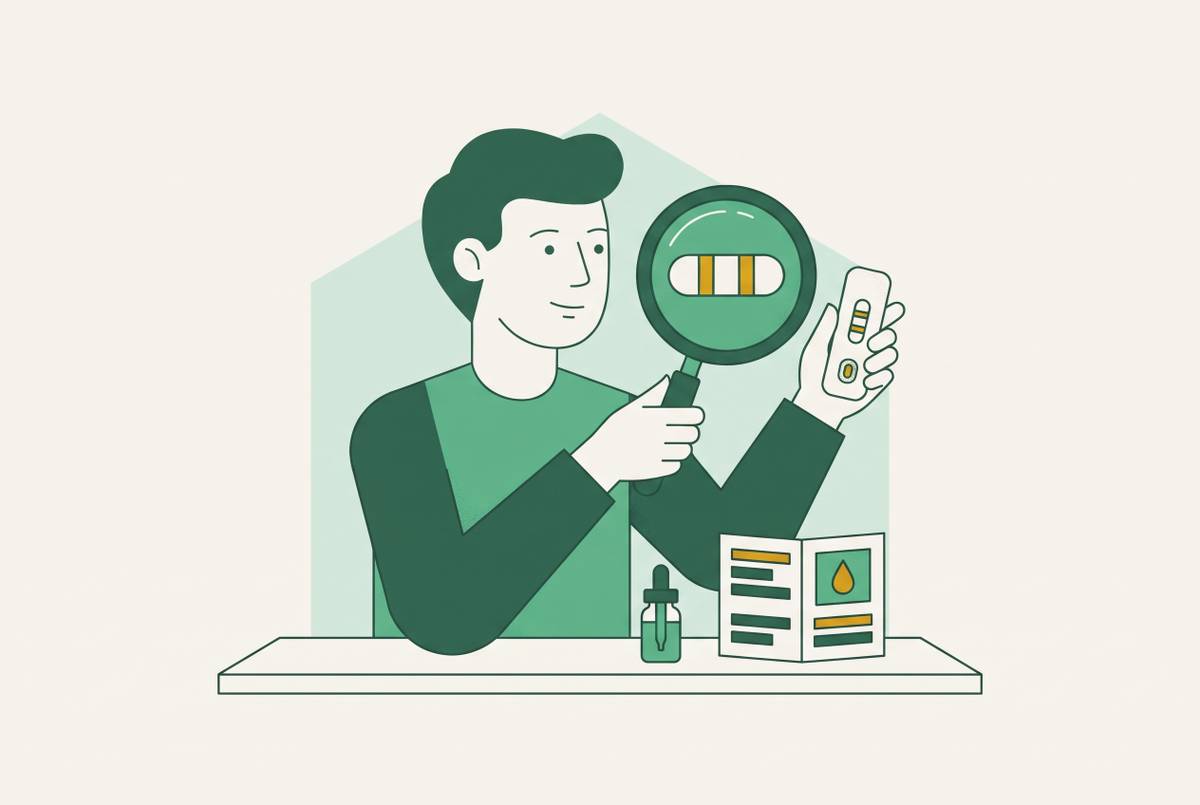
A rapid lateral-flow test works differently. This is the cassette-style immunoassay read at home, which gives an immediate, fully private result without the need to send it to a laboratory for processing. That speed involves a trade-off in analytical sensitivity. These tests can be valid population-level screening tools without being NAAT-equivalent, so an accuracy claim about one technology should not be applied to the other.
Even within one technology, “accuracy” is not a single measure. Sensitivity describes how well a test catches true positives, while specificity describes how well it rules out true negatives. Positive predictive value asks another question entirely. It describes what a positive result means given how common the infection is in the population being tested. A single marketing figure can obscure those distinctions.
Collection is the main variable introduced at home. A systematic review and meta-analysis comparing self-collected and clinician-collected sampling found that tests for chlamydia and gonorrhea worked about as well when people collected their own specimens correctly. Urine collection is much the same in both settings, while throat and rectal swabs depend more on how they are taken. The Calgary pilot study found that dried blood spot cards were especially hard to use.
The window period problem, and why timing matters more than which test you use
Even when a sample is collected well, testing too early can give a misleading negative result. During the window period, the biological markers a test looks for have not yet reached detectable levels. Timing is the leading source of misleading results from home testing, but the same biological limit applies in a clinic.
For chlamydia and gonorrhea, NAAT can detect infection as early as one to two weeks after exposure. Syphilis generally takes three to six weeks for reliable antibody detection. For hepatitis B, the window is usually three to nine weeks, while for hepatitis C it is around two to three months. The relevant window depends on the infection and the test used.
HSV-2 IgG antibody testing takes 12–16 weeks for most individuals, with 12 weeks as the primary endpoint and conservative retesting at 16 weeks for those who tested negative earlier. HIV needs a test-specific timetable too. Some HIV tests have windows of up to 90 days, but that does not make 90 days the required wait for every HIV test. The CDC advises retesting after the window period for the particular test taken.
For someone testing after an exposure, the practical step is to match the testing date to that window. Anyone tested inside it should plan a retest after the full period has elapsed, whether the first sample was collected at home or in a clinic. A clinician can help make that timing clear.
Which infections home testing handles well, and which genuinely require a clinic
Routine, asymptomatic screening for chlamydia and gonorrhea is a strong use case for home testing. NAAT on properly self-collected specimens performs near-equivalently to clinician-collected sampling for these infections. That supports home testing as a legitimate screening choice. It does not mean that every positive result can be treated remotely, because the laboratory method and the treatment route are separate questions.
Gonorrhea makes that distinction concrete. Recommended first-line treatment is a single injectable dose, so an in-person visit is needed even when the infection was detected at home. Syphilis follows the same logic because its recommended treatment is an injection of penicillin G. Home testing identifies the problem, and the clinic treats it. Neither treatment requirement undermines the usefulness of the initial test.
HIV home mail-in testing can be accurate after the correct window period, but it is not a standalone care pathway. Dried blood spot collection, used in some home kits for HIV and syphilis, is the most error-prone sample type described in the notes. A clinician also needs to confirm a positive HIV result before treatment starts. Home screening can identify the need for care without completing it.
Herpes raises a different question about whether screening is helpful at all. HSV-2 IgG blood tests are more likely to give false-positive results at low index values, even after the window closes. Because of that risk, many clinicians do not recommend routine blood-based herpes screening in groups where few people have the infection. More testing is not automatically more clarity. Clinical judgment can guide appropriate use of the test and interpretation of its result.
The anatomical site also changes the choice. Home kits do not reliably cover rectal and pharyngeal sites in every configuration, and a test panel’s infection names do not establish which sites were sampled. For men who have sex with men who require multi-site screening, clinic testing is the appropriate setting.
What home testing does that clinics structurally cannot: reach, uptake, and repeat testing
The strongest case for home testing is its ability to reach people who otherwise would not test. Trouble finding time or transport, stigma, and feeling uneasy about discussing sexual practices face-to-face can all keep someone from visiting a clinic. Confidentiality concerns about insurance records or employer access can also deter testing. These barriers are not evenly distributed. Younger people, rural residents, and communities with medical mistrust can face them disproportionately.
A randomized intervention trial of home- versus clinic-based recall for chlamydia retesting found roughly double the retest participation in the home group. That is a public-health benefit. A testing service only helps detect infection when people use it, and reducing the need to attend a clinic can change participation.
The Calgary pilot enrolled people from diverse sex and gender backgrounds, many of whom had not been tested in the prior 12 months and reported low condom use. Existing clinic pathways were not reaching everyone in that group. An international public-health organization recommends making self-sampling and self-testing available in addition to clinic-based services. Access improves when there is more than one workable route. Whether a person can afford that route is the next question.
What testing actually costs in each setting, and where the hidden charges appear
An advertised clinic test price may not be the final bill. The quoted amount may leave out fees for office visits, separate charges for laboratory processing, and follow-up appointments. So someone without insurance may pay more in total than they expected when they booked. The test price is only one component. A fair comparison has to account for the care surrounding the sample.
Mail-in NAAT kits offer flat pricing that is easier to evaluate in advance. That transparency is useful, but it does not establish that home testing is cheaper for every person. An upfront kit charge can be a substantial access barrier. The people who stand to gain most from privacy and flexible collection may still be unable to afford it.
Under federal rules, Title X family planning clinics charge nothing to clients at or below the federal poverty level and offer sliding-scale discounts to those above it. The ACA requires most insurance plans to cover recommended HIV and STI screening at no cost to the patient. The structural irony is that a home kit’s privacy premium may be least affordable to populations with the highest STI burden.
The treatment gap: why a positive home result is the beginning of a clinical process, not the end
Home testing means a person needs fewer contacts with the health system to get a result. Those same contacts, however, traditionally connect a positive result to treatment, partner notification, and follow-up. This is the genuine trade-off. Easier testing can improve uptake while leaving a person with more work to do after a positive result. The gap is a reason to plan follow-up.
Telehealth can bridge part of that distance for infections treated orally, including chlamydia and trichomoniasis. Expedited partner therapy also allows a clinician to prescribe treatment for a patient’s partner without a separate clinical evaluation. It is legal or permissible in most U.S. states, though its use depends on the infection and applicable rules. A remote consultation can therefore connect testing to further care. It should not be confused with a promise that every infection can be managed remotely.
For syphilis and recommended first-line gonorrhea treatment, the injection still requires an in-person visit. Any positive home result should be checked with a follow-up test or clinical evaluation before treatment, because false positives can occur. A positive screen starts a clinical decision. How much it helps depends partly on whether the person can get follow-up care, including care for partners when needed.
How to decide: a practical framework by situation, not by setting
For someone choosing a testing route, the first question is whether this is routine screening or a response to symptoms or a recent exposure. Home testing is a strong default for routine, asymptomatic chlamydia and gonorrhea screening when the window period has elapsed and collection instructions can be followed carefully. Privacy, scheduling, or geographic barriers strengthen that case. Repeat testing is another good fit. The evidence supports home collection as a way to make a testing routine easier to sustain.
A clinic is the stronger default when symptoms are present, because a physical examination adds diagnostic information that a kit cannot provide. It is also the appropriate route when rectal or pharyngeal sampling is needed for complete coverage. Recent exposure calls for attention to timing, especially for HIV, hepatitis C, and HSV-2. Clinical guidance can help plan testing and retesting, but it cannot remove the window period. A negative result taken too soon should not be treated as the final answer.
If the result is positive, what clinical evaluation will be needed, and will treatment require an in-person visit? For a proactive routine, a clinician-reviewed plan based on individual risk factors can establish which biomarkers to track, how often to test, and what results mean. That plan is more useful than any single test.
Sources
- Comprehensive at-home sexually transmitted and blood borne infection (STBBI) testing program: A pilot study
- Retesting for genital Chlamydia trachomatis among visitors of a sexually transmitted infections clinic: randomized intervention trial of home- versus clinic-based recall
- Understanding Reach, Effectiveness, Adoption, Implementation, and Maintenance of home-based comprehensive sexual health care: a Realist Review
- Self-Collected versus Clinician-Collected Sampling for Chlamydia and Gonorrhea Screening: A Systemic Review and Meta-Analysis